



| HEADLINE |

|

Put the Phone Down, Bro
An Unfiltered Parody Interview with the Ghost of SM Sultan
Published : Saturday, 10 October, 2026 at 12:00 AM
Shaon Arafat


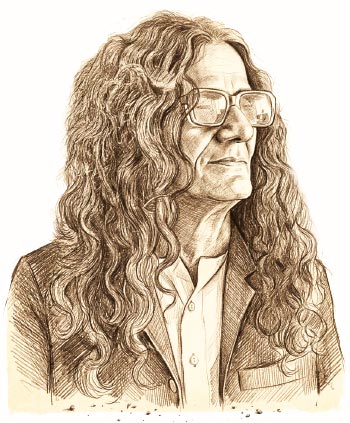 Artist SM Sultan, aka Sheikh Mohammad Sultan, died today. Well, not today - but on this day in 1994. When he was alive, finding him alone was nearly impossible, as he was perpetually occupied with his unusual entourage of snakes, cats, wild birds and stray dogs. Thirty-two years after his death, we finally managed to track him down for a conversation.
We found the master painter sitting on the damp earth beneath the sprawling aerial roots of an ancient banyan tree beside the Chitra River in Narail. Wearing his signature pink saree and sipping hot milk tea (which occasionally dripped right through his ectoplasm) Sultan spoke candidly with The Daily Observer about modern culture, city snobs and the growing hype surrounding his legacy. As expected, Bengal’s ultimate bohemian had a lot to say, delivering a hilariously blunt, unfiltered reality check to today’s screen-obsessed generation.
The interview was conducted by Shaon Arafat, Editorial Assistant at The Daily Observer. Hearing the interviewer’s identity, Sultan squinted through the smoke of his bidi and said, “Newspaper people? Sit down. But if you ask me about my ‘post-colonial canvas,’ I am jumping into the river.”
The interviewer sat down, and Sultan immediately glanced at his hands.
“What’s that rectangular piece of plastic you’re clutching like a hookah?”
“My phone.”
“I know it’s a phone. But why are you holding it like that? As if it’s going to explode and waste all the weed if you put it down?”
And that was how the interview began with Sulan's ghost.
On Intellectuals and Tea
The Daily Observer: Sultan Bhai, thank you for giving us your valuable time.
SM Sultan: Don’t say “valuable time.” I’m dead. I have plenty of it.
Observer: We assume your afterlife is treating you well. Anyway, every 10th October, Dhaka’s elite intellectuals organise grand seminars, panel discussions and retrospectives about you. They analyse your philosophy, your subversion of Western realism and your subaltern aesthetic. How does that make you feel... as a ghost?
Sultan: (Snorts hot tea, which instantly turns into a puff of white mist as he wipes his chin with his saree pallu) Extremely proud.
Observer: Really?
Sultan: Absolutely. I am deeply moved that people now honour my commitment to simple living by spending Tk50,000 on an air-conditioned auditorium to talk about it.
Observer: That’s rather sarcastic.
Sultan: I learned from Dhaka. Back when I was actually alive, if I asked those same suit-wearing snobs for Tk100 for tea and biscuits, they suddenly forgot their wallet in another pair of pants and grinned shamelessly.
(A six-foot cobra named Kalu slithered from beneath the banyan tree and wrapped itself around the interviewer’s ankle. He froze.)
“Don’t mind him,” Sultan said then, patting the snake’s head. “He died in ‘98. Still hasn’t learned personal boundaries.”
Observer: Perhaps they were genuinely broke back then (referring the then Dhaka intellectuals).
Sultan: They had money. Just not for me, and certainly not for my snakes.
Observer: And now?
Sultan: Now there is comprehensive budget for commemorative cakes, floral wreaths, leather-bound souvenir books and glossy photo booths.
Observer: Isn’t it good that your memory is celebrated?
Sultan: Marvellous. But nobody at those seminars has offered me a single cup of tea yet.
On Smartphones and the Digital Age
Observer: What surprises you most about today’s world?
Sultan: Your glowing bricks.
Observer: You mean smartphones?
Sultan: You carry a portal to the entire universe in your pocket and still walk around looking like depressed zombies complaining of boredom.
Observer: They are essential tools! For communication, information...
Sultan: ... And avoiding eye contact with human beings.
Observer: That’s a bit cynical.
Sultan: Yesterday, I watched a young man sit by the Chitra.
Observer: Soaking in the raw beauty of the river?
Sultan: No. Posing for a selfie with the river. He took 47 photos, checked his hair 12 times and spent a grand total of four seconds actually looking at the water.
Observer: He was trying to preserve the moment for posterity.
Sultan: (Laughs heartily) Brother, the moment was already preserved! It was called a memory. Before you people outsourced your brains to cloud storage.
(He pointed a finger at the interviewer’s hand.)
Sultan: You’re doing it right now. Put it down, bro... Put it on the grass.
Observer: But how will the interview is transcribed then?
Sultan: Use your ears. Write it down later. If you can’t remember a conversation without a digital device, don’t call yourself a journalist. Call yourself an extension cord.
On Muscular Farmers and a Dhaka Journalist
Observer: Your depiction of Bangladeshi peasants is iconic. Your farmers look like they could wrestle a bull, lift a tractor and beat three Marvel superheroes before breakfast. Why paint them so muscular when actual peasants were visibly malnourished?
Sultan: Because in my mind, they were giants. They fed the nation while everyone else just talked. Tell me, have you ever tilled a paddy field under the August sun?
Observer: No.
Sultan: Pulled a fully loaded cargo boat upstream against the current?
Observer: No.
Sultan: Carried an eighty-kilogram sack of grain on your shoulders?
Observer: Absolutely not.
Sultan: Then why are you auditing their muscle mass? You people sit in ergonomic chairs for nine hours a day and then complain that your lower back hurts from typing.
Observer: Well... that is statistically accurate.
Sultan: Of course it is. The strongest muscle in your entire body is your right thumb from doom-scrolling. If I painted a modern Dhaka journalist today, I’d paint a giant thumb attached to a tiny, withered body.
On Europe, Picasso and Art Galleries
Observer: You travelled across Europe, exhibited alongside masters and lived abroad. Why drop everything and return to the mud of Narail?
Sultan: Because Narail never asked me to deliver a lecture explaining why I used yellow instead of green. In European galleries, people stand in front of a canvas for forty minutes nodding solemnly, using words that don’t exist to describe feelings they don’t have. They were analysing themselves analysing artistic intent.
Observer: Did you meet Picasso?
Sultan: Briefly. He was loud, bossy, but fine. We discussed nothing. I don’t like arguing with living painters, and I certainly don’t want to start a turf war with his ghost.
Observer: What bothered you most about Western galleries?
Sultan: Everyone was so painfully serious! Not every brushstroke is a geopolitical manifesto. Sometimes, my dear writer, it’s just paint on canvas.
The Kashmiri Bus Ticket
Observer: There is a legendary story that during your wanderings in Kashmir, you paid for a bus ride with an original painting because you lacked cash.
Sultan: That is true. The conductor looked at the canvas and said, “This is a bus, not the Louvre. Give me four annas.”
Observer: And what did you say?
Sultan: I told him, “Keep it. One day this piece of paper will buy you a fleet of buses.”
Observer: Did he believe you?
Sultan: Not for a second. But he took it because he realised I literally didn’t have a single coin in my pockets and he wanted me off his bus.
On Shishuswarga and Education
Observer: You founded Shishuswarga, a floating art school on a boat for rural children. What were you trying to teach them?
Sultan: To look. At the clouds, the river mud, the crows, the trees.
Observer: That was your entire curriculum?
Sultan: Education has been ruined by people who think learning only happens inside four concrete walls with a syllabus. Today you have smart classrooms, but where are the smart children? You lock children in a room, hand them a glowing rectangle, and act surprised when they don’t know how to look at a tree without trying to swipe it. Put them on a boat. Hand them charcoal. Let them get dirty.
On Natural Pigments and “Fluid Fashion”
Observer: You famously synthesised your own paints using crushed tree bark, soil and leaf extracts. Why go through all that trouble?
Sultan: Nature was giving colour away for free, and I was perpetually broke. When you mix soil with your own hands, you understand the earth you’re painting.
Observer: What about your personal attire? You frequently wore sarees and bangles. Today, high-fashion circles call this “gender-fluid expression.”
Sultan: Today’s intellectuals love giving simple things terrifyingly long names.
Observer: What did you call it back then?
Sultan: Tuesday. I felt like wearing a saree on Tuesday, so I wore it. What is the grand mystery? Do you demand a political manifesto from your trousers every morning before putting them on?
On Ahmed Sofa and Humayun Ahmed
Observer: The writer Ahmed Sofa was one of your fiercest champions in Dhaka.
Sultan: Ah, Sofa. Tremendously loud. He’d enter a room and instantly start a debate with the furniture. But he had a heart of pure gold and he always knew where to find good tea.
Observer: What about Humayun Ahmed? There’s a famous anecdote about his visit to your home involving a live cobra.
Sultan: Ah, yes! Humayun came to visit me in Narail. We were having tea, and one of my pet snakes crawled out from under the bench and sat right beside his leg. Humayun turned into a stone statue. I don’t think he even blinked for ten minutes.
Observer: Was he terrified?
Sultan: I told him, “Don’t worry, brother, he has already eaten.” Humayun finished his tea in approximately three seconds. If there had been an Olympic medal for rapid tea consumption, he would have brought home the gold.
On Artificial Intelligence and Art
Observer: Sultan Bhai, what do you think about AI-generated art? Machines that can generate intricate paintings in seconds based on text prompts.
Sultan: Artificial intelligence? So, an imitation of human thought that lacks a soul? Sounds like half the art critics I met in Dhanmondi.
Observer: But AI can mimic your exact painting style in less than five seconds! Doesn’t that anger you?
Sultan: Why should it? A machine can copy a brushstroke, but can it feel the heat of the sun on a farmer’s back? Can it smell the mud of the Chitra after the first monsoon rain? If the machine makes something beautiful, good for the machine. If it makes something ugly... well, then it has finally achieved something truly human.
Final Words for the Screen-Obsessed Generation
Observer: Sultan Bhai, one final question. What message do you have for today’s youth?
Sultan: Put the phone in your pocket. Go outside. Walk until your feet hurt. Sit by a river. Look at a tree without taking a photo of it. Get your hands dirty in real soil.
Observer: And?
Sultan: Use social media if you must, but don’t live in it. A hammer is a useful tool, but you don’t sleep with a hammer under your pillow.
(He slowly stood up, smoothing down his saree, and gestured towards the horizon.)
Observer: One quick selfie please, before you go? Just for proof?
Sultan stopped. He looked at the interviewer with profound pity. And without a word, he turned and faded into the dense mist rising off the Chitra River.
Only his cat remained. And it let out a slow, judgmental meow and trotted into the bushes.

Loading...
Loading...



Editor : Iqbal Sobhan Chowdhury
Published by the Editor on behalf of the Observer Ltd. from Globe Printers, 24/A, New Eskaton Road, Ramna, Dhaka.
Editorial, News and Commercial Offices : Aziz Bhaban (2nd floor), 93, Motijheel C/A, Dhaka-1000.
Phone: PABX- 41053001-06; Advertisement: 41053012; 01793317829, 01550707291, E-mail: [email protected], [email protected] Online: email: [email protected] 41053014; 01550707297 Advertisement: 01550707296
Published by the Editor on behalf of the Observer Ltd. from Globe Printers, 24/A, New Eskaton Road, Ramna, Dhaka.
Editorial, News and Commercial Offices : Aziz Bhaban (2nd floor), 93, Motijheel C/A, Dhaka-1000.
Phone: PABX- 41053001-06; Advertisement: 41053012; 01793317829, 01550707291, E-mail: [email protected], [email protected] Online: email: [email protected] 41053014; 01550707297 Advertisement: 01550707296


