



| HEADLINE |

|

‘Jalaja’ celebrates life, creation and the supreme power
Published : Thursday, 15 October, 2026 at 8:15 PM
Staff Correspondent


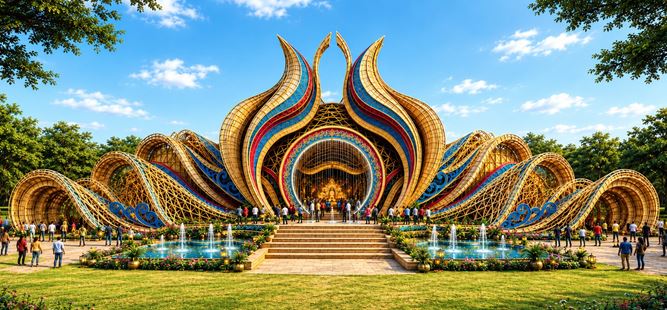
The Gulshan-Banani Sarbajanin Puja Foundation has chosen “Jalaja” (born of water) as the theme for this year’s Durga Puja, drawing inspiration from the presence of water in the life and culture of Bengal and its connection with life, creation and the supreme power.
Among the countless planets and stars of the infinite universe, Earth is the only vibrant blue cradle of life, and the first and foremost condition for life is water. Modern science links the origin of life on Earth to water. Thousands of years ago, the Vedic sages likewise saw water as the primordial principle of creation.
The Nasadiya Sukta of the Rigveda describes the state before creation as an infinite expanse of water shrouded in darkness. Among the five great elements (panchamahabhuta) of Sanatan thought, apa, or water, is the fundamental one, breathing life into all the rest.
In the Sanatan tradition, water is not merely a natural element. It is an embodiment of purity, the divine and a pillar of sacred rites. From the fluid of the mother’s womb to the last offering on the banks of the Ganges, the entire human life cycle is bound to the flow of water.
Water is the principal medium of auspicious beginnings, including ghatasthapana, tarpan, homa and self-purification. In the Sri Sri Chandi, the Goddess is not only the embodiment of power but also the very yearning that sustains life: “Trishnarupena Sansthita”. Just as the lotus blossoms through the water’s surface, Goddess Durga manifests from the thirst of the living consciousness.
This vision is taking shape in this year’s pandal of the Gulshan-Banani Sarbajanin Puja Foundation as a vast aquatic, organic form combining architecture, engineering, cottage crafts, lighting design and varied ornamentation.
Built from eco-friendly materials such as bamboo, cane, natural fibres and jute, a multi-layered, undulating landscape will envelop visitors like a vast, frozen swell of waves. The journey from the entrance to the inner sanctum will be a spiritual experience, moving from nature’s turbulent waves towards stillness at the Mother’s feet.
Waterfalls, reflection pools and light will together create a transformative environment. At the centre of the pandal will stand a large lotus-shaped structure, from which Goddess Durga, the primal power (Adyashakti), will appear radiant against a conch-shell backdrop, like a white lotus blooming from the depths of the water.
Indigo blue, terracotta red and straw beige, all colours of water and earth, have been used in the pandal aesthetics and all GBSPF design elements this year.
“Jalaja” is not confined to religious feeling. It extends its appeal to global and environmental responsibility. Today, climate change, river encroachment and water pollution have pushed the world’s water cycle into grave crisis. For riverine Bangladesh, this crisis is a question of existence.
To respect and protect water is to protect life, history and future generations. “Jalaja” is a joyful call to return to the Mother, to love nature and to safeguard the biosphere.
Water, lotus, sacred water, thirst and the supreme life: with all of these together, the organisers offer their heartfelt prayer to Goddess Durga, asking the Mother to free the world from thirst, protect life and nature, and grant humanity the power not of destruction but of creation.
Among the countless planets and stars of the infinite universe, Earth is the only vibrant blue cradle of life, and the first and foremost condition for life is water. Modern science links the origin of life on Earth to water. Thousands of years ago, the Vedic sages likewise saw water as the primordial principle of creation.
The Nasadiya Sukta of the Rigveda describes the state before creation as an infinite expanse of water shrouded in darkness. Among the five great elements (panchamahabhuta) of Sanatan thought, apa, or water, is the fundamental one, breathing life into all the rest.
In the Sanatan tradition, water is not merely a natural element. It is an embodiment of purity, the divine and a pillar of sacred rites. From the fluid of the mother’s womb to the last offering on the banks of the Ganges, the entire human life cycle is bound to the flow of water.
Water is the principal medium of auspicious beginnings, including ghatasthapana, tarpan, homa and self-purification. In the Sri Sri Chandi, the Goddess is not only the embodiment of power but also the very yearning that sustains life: “Trishnarupena Sansthita”. Just as the lotus blossoms through the water’s surface, Goddess Durga manifests from the thirst of the living consciousness.
This vision is taking shape in this year’s pandal of the Gulshan-Banani Sarbajanin Puja Foundation as a vast aquatic, organic form combining architecture, engineering, cottage crafts, lighting design and varied ornamentation.
Built from eco-friendly materials such as bamboo, cane, natural fibres and jute, a multi-layered, undulating landscape will envelop visitors like a vast, frozen swell of waves. The journey from the entrance to the inner sanctum will be a spiritual experience, moving from nature’s turbulent waves towards stillness at the Mother’s feet.
Waterfalls, reflection pools and light will together create a transformative environment. At the centre of the pandal will stand a large lotus-shaped structure, from which Goddess Durga, the primal power (Adyashakti), will appear radiant against a conch-shell backdrop, like a white lotus blooming from the depths of the water.
Indigo blue, terracotta red and straw beige, all colours of water and earth, have been used in the pandal aesthetics and all GBSPF design elements this year.
“Jalaja” is not confined to religious feeling. It extends its appeal to global and environmental responsibility. Today, climate change, river encroachment and water pollution have pushed the world’s water cycle into grave crisis. For riverine Bangladesh, this crisis is a question of existence.
To respect and protect water is to protect life, history and future generations. “Jalaja” is a joyful call to return to the Mother, to love nature and to safeguard the biosphere.
Water, lotus, sacred water, thirst and the supreme life: with all of these together, the organisers offer their heartfelt prayer to Goddess Durga, asking the Mother to free the world from thirst, protect life and nature, and grant humanity the power not of destruction but of creation.
Organised by the Gulshan-Banani Sarbajanin Puja Foundation and planned, designed and supervised by architect Amiti Kundu and artist-researcher Partho Pratim Saha, the puja mandap at Kemal Ataturk Park in Banani is open to people of every faith and background during the six-day autumn festival.
-AH

Loading...
Loading...
Also read









Editor : Iqbal Sobhan Chowdhury
Published by the Editor on behalf of the Observer Ltd. from Globe Printers, 24/A, New Eskaton Road, Ramna, Dhaka.
Editorial, News and Commercial Offices : Aziz Bhaban (2nd floor), 93, Motijheel C/A, Dhaka-1000.
Phone: PABX- 41053001-06; Advertisement: 41053012; 01793317829, 01550707291, E-mail: [email protected], [email protected] Online: email: [email protected] 41053014; 01550707297 Advertisement: 01550707296
Published by the Editor on behalf of the Observer Ltd. from Globe Printers, 24/A, New Eskaton Road, Ramna, Dhaka.
Editorial, News and Commercial Offices : Aziz Bhaban (2nd floor), 93, Motijheel C/A, Dhaka-1000.
Phone: PABX- 41053001-06; Advertisement: 41053012; 01793317829, 01550707291, E-mail: [email protected], [email protected] Online: email: [email protected] 41053014; 01550707297 Advertisement: 01550707296


