



| HEADLINE |

|

Cage cultivation boosts fish production in Sirajganj
Hundreds of young people become self-reliant through river-based farming
Published : Saturday, 17 October, 2026 at 12:00 AM
Our Correspondent


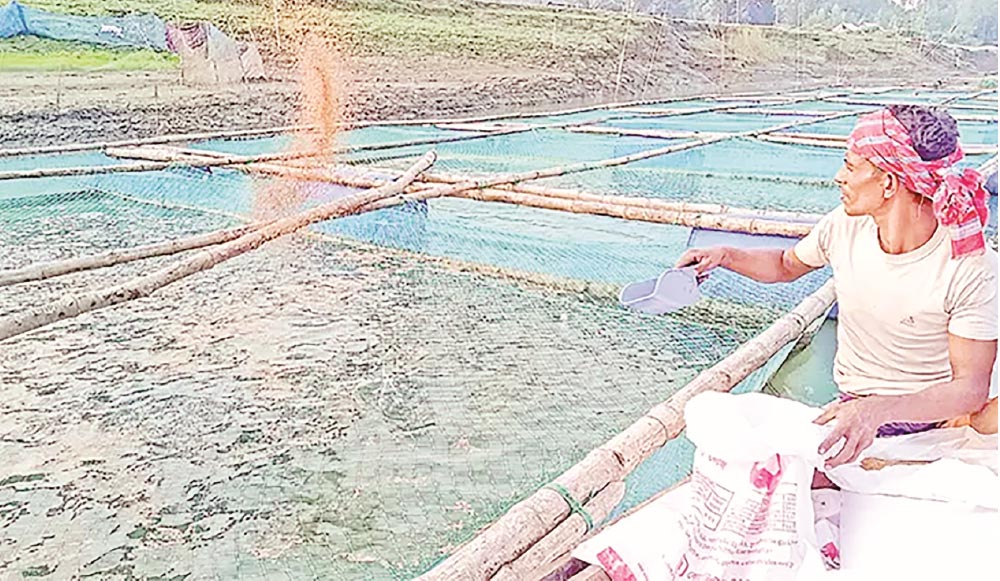 SIRAJGANJ, Oct 16: Cage fish farming in the rivers of Sirajganj has emerged as a growing source of income for hundreds of young people, with the method producing around 1,120 metric tons (mt) of fish annually in the district.
Rows of fish cages can be seen along a nearly 10-kilometre stretch of the Fuljhor River from Bhuiyaganti to Nalka in Raiganj Upazila.
Many people living along the river once depended mainly on day-labour or farming for their livelihood. But as economic needs changed, some turned to cage fish farming, opening up a new source of income.
Cage fish farming was first introduced in the Fuljhor River in 2011. Five years ago, only around 30 people were engaged in the practice in the area. The number has now increased to 90.
There are currently around 1,200 fish cages in the Fuljhor River, with more than 400 families directly or indirectly involved in the business.
A cage is made using bamboo, plastic drums, nets and wire mesh, costing around Tk 20,000 depending on its size.
Farmers said many became interested after seeing others make profits from the business. They later started building their own cages and gradually the practice spread to other parts of the district.
Monosex male tilapia fingerlings are mainly stocked in the cages. With proper feed and necessary medicines, the fish become suitable for marketing in about five months.
Farmers said the average cost of producing one kilogramme of fish is around Tk 175.
For many families, cage fish farming has now become a regular source of income.
Abdullah Al Mamun, a farmer in Raiganj, said he had no regular source of income before taking up cage fish farming.
“I saw others farming fish in cages and decided to start. I am doing well and making a profit. The income also supports my family of five,” he said.
He currently farms tilapia in 28 cages in the Fuljhor River. As there is no need to lease water bodies, he said, farmers can save a significant amount of money.
“Many people are becoming involved because fish can be produced in a small space at relatively low cost and with less labour.
If cage farming is carried out in a planned manner, production can be increased and more employment can be created,” he said.
The method has become increasingly popular in the district due to its relatively low costs, limited space requirements and strong market demand.
Apart from the Fuljhor, many farmers are also making profits from cage farming at suitable locations in the Jamuna and Baral rivers.
Lokman Hossain, another farmer from Raiganj, is farming fish in 65 cages.
“Fish grow quickly in cages if they are given adequate feed and the water remains suitable. But poor water quality can cause major losses for farmers,” he said.
He believes government support could encourage more unemployed young people to take up the profession, helping them become self-reliant while increasing fish production.
According to the district fisheries office, Sirajganj's annual demand for fish is 78,945 mt, against production of 77,320 mt. The district therefore has a deficit of 1,625 tonnes.
Of the total production, 1,120 mt come from cage farming.
A total of 1,568 cages are currently being used for fish farming in the Jamuna, Fuljhor and Baral rivers in Sadar, Raiganj, Shahjadpur and Chauhali upazilas.
The main species farmed in the cages are monosex tilapia and black carp. A total of 466 farmers and beneficiaries are involved in cage fish farming across the district.
District Fisheries Officer Md Mahbubur Rahman said around 1,200 of the district's 1,568 fish cages were in the Fuljhor River.
“Cage farming is producing 1,120 mt of fish annually, making a significant contribution to the district's and the country's overall fish production. It is also creating employment opportunities locally,” he said.
He added that the district and upazila fisheries offices were providing farmers with training and necessary advice, while senior authorities had been informed about the need to bring more farmers under government support.

Loading...
Loading...
Also read



Editor : Iqbal Sobhan Chowdhury
Published by the Editor on behalf of the Observer Ltd. from Globe Printers, 24/A, New Eskaton Road, Ramna, Dhaka.
Editorial, News and Commercial Offices : Aziz Bhaban (2nd floor), 93, Motijheel C/A, Dhaka-1000.
Phone: PABX- 41053001-06; Advertisement: 41053012; 01793317829, 01550707291, E-mail: [email protected], [email protected] Online: email: [email protected] 41053014; 01550707297 Advertisement: 01550707296


