



| HEADLINE |

|

Why Anne Carson’s Nobel Matters to the Future of Literature
Published : Saturday, 17 October, 2026 at 12:00 AM
Emran Emon


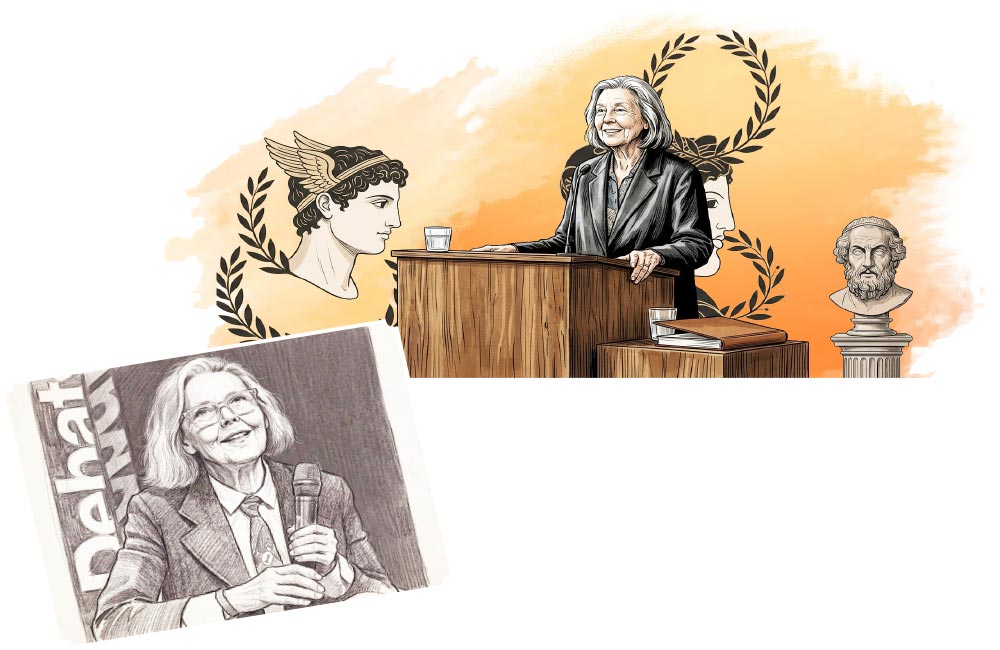 What happens when an ancient Greek myth refuses to remain ancient? What happens when poetry declines to remain poetry, when an essay begins to behave like a poem, and when translation becomes not merely the recovery of an old voice but the invention of a new one? The 2026 Nobel Prize in Literature has offered an answer: Anne Carson.
The Swedish Academy has awarded the Canadian poet, essayist, classicist and translator the Nobel Prize “for her bold and inventive oeuvre that, in playful dialogue with the classical tradition, has created new forms for contemporary literature.”
At first glance, Carson may appear an unlikely Nobel laureate in an age dominated by political novels, historical trauma and explicitly global narratives. Yet that is precisely what makes her recognition so compelling. Carson’s achievement is not simply that she has written beautiful books. It is that she has persistently challenged the categories through which we decide what literature is supposed to be.
Born in Toronto in 1950, Carson developed an early fascination with the classical world after a high-school Latin teacher agreed to teach her ancient Greek during lunch breaks. She eventually studied Classics at the University of Toronto, earning her BA, MA and PhD after leaving the university twice before completing her degrees. She later taught at universities in Canada and the United States.
Her literary journey is important because Carson has never treated the classical past as a museum. For her, Homer, Sappho, Sophocles and Euripides are not dead authors whose works belong exclusively to scholars. They are living interlocutors. She brings them into conversation with contemporary anxieties-love, sexuality, violence, loneliness, memory, grief and identity. That dialogue is at the heart of her Nobel.
Carson’s career has been defined by resistance to easy classification. She is simultaneously a poet, essayist, translator, scholar, visual artist and experimenter. Her bibliography crosses poetry, prose, criticism, translation, opera, drama and the verse novel.
Her first major book, Eros the Bittersweet (1986), already contained the intellectual DNA of the writer she would become. The work examines desire through ancient Greek literature while simultaneously functioning as literary criticism, scholarship and lyrical meditation.
Then came Glass, Irony, and God, Plainwater, Men in the Off Hours, The Beauty of the Husband, Decreation, Nox, Red Doc and Float, among other works.
But perhaps the most accessible gateway into Carson’s imagination is Autobiography of Red (1998), a novel in verse inspired by the ancient Greek myth of Geryon and Herakles. Carson takes a figure from the classical tradition and turns him into a modern, vulnerable young man navigating desire, heartbreak and identity.
The significance of Autobiography of Red lies not only in its story but in its audacity. Carson asks an apparently simple question: Why should an ancient myth belong only to the ancient world?
Her answer is radical. Myths survive because human beings survive-and human beings continue to experience love, jealousy, abandonment, desire, violence and loss. The ancient world, in Carson’s hands, therefore becomes contemporary again.
Carson’s contribution to literature also lies in her translations of classical Greek writers, including Sappho, Euripides and Sophocles. Her Grief Lessons presents four plays by Euripides, while An Oresteia brings together works associated with Aeschylus, Sophocles and Euripides.
Here Carson complicates another literary assumption: that translation is secondary to original writing. For Carson, translation is interpretation-and interpretation is creation.
That choice has sometimes generated criticism, particularly when her modern diction collides deliberately with classical grandeur. But perhaps that tension is precisely the point. A translation that makes us uncomfortable may force us to reconsider our comfortable assumptions about history, language and literary authority.
The Nobel recognition arrives at an interesting moment for literature. We live in an era of accelerated communication, shrinking attention spans, algorithmic culture and artificial intelligence capable of producing grammatically competent prose in seconds. The danger is not that machines will eliminate literature overnight. The deeper danger is that human beings may gradually lose patience with difficult, ambiguous and intellectually demanding forms of expression.
Carson’s work offers almost the opposite philosophy. She does not simplify complexity. She inhabits it. Her writing moves between genres because human experience itself does not respect genres. Grief can be philosophical. Desire can be political. History can be intimate. A myth can explain the present better than a newspaper headline. A poem can contain an argument and an argument can contain a poem. That is why her Nobel Prize is about more than one writer. It is a defence of literary freedom.
There is another important dimension to Carson’s achievement: her relationship with the classical canon. The Western literary canon has historically been accused-sometimes rightly-of privileging certain civilizations, languages and voices over others. Carson does not escape that tradition, she enters it deeply. But she also destabilizes it from within.
She takes canonical figures and subjects them to contemporary questions. She makes the supposedly monumental human. She allows vulnerability, sexuality, ambiguity and uncertainty to enter spaces traditionally occupied by heroic certainty. In doing so, Carson demonstrates that engaging with tradition does not require worshipping tradition.
Perhaps that is one of the most important lessons of her Nobel. A civilization remains intellectually alive not when it merely preserves its inheritance, but when it continues to argue with it.
The immediate effect will almost certainly be a dramatic expansion of Carson’s readership. Books that once circulated primarily among poets, classicists and literary scholars will reach a much broader international audience.
But the more important legacy may be less measurable. Young writers may feel freer to cross boundaries between poetry, fiction, criticism, scholarship and visual art. Translators may be increasingly recognized as creative literary figures rather than invisible intermediaries. Classical literature may find new readers outside universities. Publishers may become more willing to take risks on hybrid forms.
And perhaps most importantly, Carson may encourage writers to resist the pressure to become easily marketable literary identities. Her career suggests that a writer does not have to choose between intellect and emotion, scholarship and imagination, tradition and experimentation. One can inhabit all of them.
There is a temptation, whenever the Nobel Prize is announced, to ask whether the winner is the “best” writer in the world.
That is the wrong question. Literature has no laboratory in which greatness can be objectively measured. The more interesting question is: What does this choice tell us about what literature needs now?
The answer in 2026 may be this: literature needs writers who can reconnect a fragmented present with a complicated past without turning either into a cliché.
Anne Carson does precisely that. She reminds us that the oldest stories are not necessarily obsolete, just as the newest literary forms are not necessarily superficial. Between antiquity and modernity lies a vast territory of human experience-and Carson has spent decades exploring it.
Her Nobel is therefore not merely a prize for looking backward. It is a prize for showing how looking backward can help literature move forward.
In an age increasingly obsessed with speed, Carson makes us slow down. In an age of rigid categories, she crosses borders. In an age of synthetic language, she reminds us of the irreducible strangeness of the human voice.
And perhaps that is the most enduring lesson of the 2026 Nobel Prize in Literature: The future of literature may not belong to those who invent entirely new worlds, but to those who can make us see the old world-and ourselves-with new eyes.
The writer is a journalist

Loading...
Loading...



Editor : Iqbal Sobhan Chowdhury
Published by the Editor on behalf of the Observer Ltd. from Globe Printers, 24/A, New Eskaton Road, Ramna, Dhaka.
Editorial, News and Commercial Offices : Aziz Bhaban (2nd floor), 93, Motijheel C/A, Dhaka-1000.
Phone: PABX- 41053001-06; Advertisement: 41053012; 01793317829, 01550707291, E-mail: [email protected], [email protected] Online: email: [email protected] 41053014; 01550707297 Advertisement: 01550707296
Published by the Editor on behalf of the Observer Ltd. from Globe Printers, 24/A, New Eskaton Road, Ramna, Dhaka.
Editorial, News and Commercial Offices : Aziz Bhaban (2nd floor), 93, Motijheel C/A, Dhaka-1000.
Phone: PABX- 41053001-06; Advertisement: 41053012; 01793317829, 01550707291, E-mail: [email protected], [email protected] Online: email: [email protected] 41053014; 01550707297 Advertisement: 01550707296


