



| HEADLINE |

|

Teesta Irrigation: Water in canals, but fields remain dry
Siltation and missing links force farmers to pay extra
Published : Saturday, 17 October, 2026 at 12:00 AM


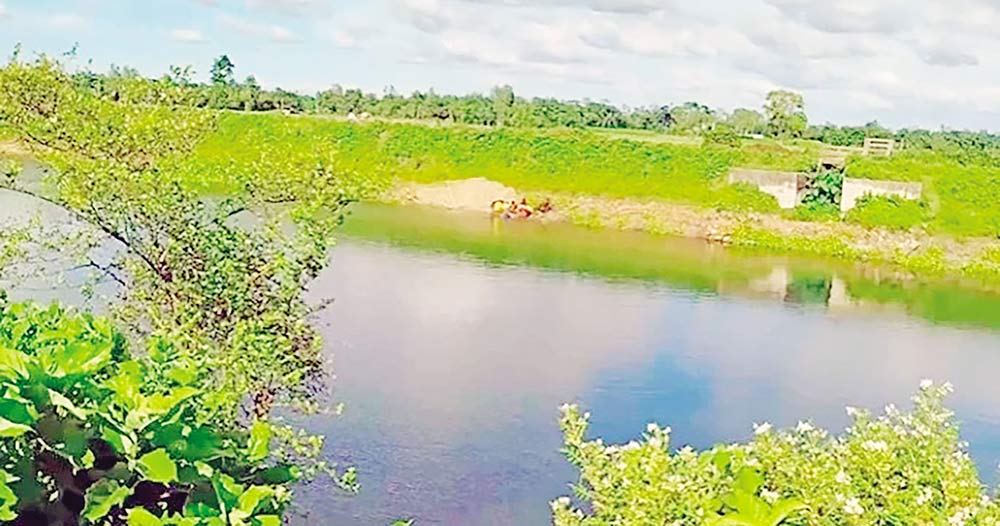 Thousands of farmers in northern Bangladesh are paying Tk 5,000 to Tk 10,000 per bigha each season for irrigation, despite water flowing through canals of the Teesta Irrigation Project. Silted canals, low water levels and inadequate pressure prevent supplies from reaching many fields, forcing farmers to use diesel-powered pumps, shallow tube wells and electric pumps.
In full operation since 2000, the project supports Boro rice, maize, wheat and vegetable cultivation, but many farmers remain unable to benefit.
The project covers six districts and 25 upazilas, but irrigation services are currently operational in 12 upazilas in Nilphamari, Rangpur and Dinajpur. Of the project’s 540,000 hectares of irrigable land, infrastructure has been developed to cover 84,565 hectares.
WATER IN CANALS, NOT FIELDS
A visit south of the Sherpur sluice gate in Taraganj found water flowing through the canal while nearby farmers irrigated thousands of acres with diesel-powered pumps.
The problem also affects farmers in Dimla, Jaldhaka, Kishoreganj, Gangachara and Badarganj. In many places, canals are silted up, water levels are below the elevation of nearby fields or supplies are too weak to reach the tail ends of the network.
Jogya Roy, a farmer from Sherpur in Taraganj, said the canal had brought little benefit despite containing water.
“Even though there is plenty of water in it, we cannot lift it to our fields,” he said, adding that irrigation costs Tk 5,000 to Tk 10,000 per bigha each season.
Another farmer, Subhash Chandra Roy, said he paid Tk 5,500 per bigha for irrigation and urged the government to install solar-powered pumps. Jabed Ali, a farmer from Soyar Kutipara, said residents had given up land for the project but had seen little improvement over the past 20 to 22 years.
PLANNING GAPS
Tuhin Wadud, a river researcher and professor at Begum Rokeya University, Rangpur, said the project had initially aimed to bring 111,000 hectares under cultivation but had never met the target. The maximum area irrigated annually was around 90,000 hectares, he said.
He blamed water shortages and planning failures, saying the problem also suggested negligence by the Bangladesh Water Development Board (BWDB).
Amolesh Chandra Roy, a BWDB agriculture officer in Rangpur, said secondary and tertiary canals had not been built in some areas south of the sluice gate, including Kazirhat and Barnihat. Near Parbatipur, canal water levels are almost the same as the surrounding land, requiring farmers to use pumps.
He said building more canals would require land acquisition, which can be time-consuming, adding that a project was being planned to address the problem.
PIPELINES AND SOLAR PUMPS PLANNED
Mizanur Rahman, superintending engineer of BWDB Rangpur Circle-2, said many planned secondary and tertiary canals had not been built because of land acquisition difficulties.
Two more canals are planned for next year, while buried pipelines are also being proposed to bring nearby farmland under irrigation. If a revised development project proposal is approved by December, tenders could be invited and work could begin in January or February, he said.
Repairs are under way at some locations, Mizanur said, adding that solar panels would be installed where higher ground makes it difficult to lift water from canals.�"UNB

Loading...
Loading...
Also read


Editor : Iqbal Sobhan Chowdhury
Published by the Editor on behalf of the Observer Ltd. from Globe Printers, 24/A, New Eskaton Road, Ramna, Dhaka.
Editorial, News and Commercial Offices : Aziz Bhaban (2nd floor), 93, Motijheel C/A, Dhaka-1000.
Phone: PABX- 41053001-06; Advertisement: 41053012; 01793317829, 01550707291, 01550707296
E-mail: [email protected], [email protected]. [email protected], [email protected], [email protected], [email protected], Online-email: [email protected]


