



| HEADLINE |

|

There is a huge market potential for expanding jute products both locally and internationally. Dr Nargis Akter, Director General of BJRI says in a talk with The Daily Observer.
Published : Thursday, 22 October, 2026 at 12:00 AM


 1. It is being said that jute products will be displayed at COP31 as an alternative to plastic. How did this issue come about?
Answer: The Bangladesh Jute Research Institute has long been conducting research on the multifarious uses of jute, improved quality jute yarn, jute-cotton blended fabric, shopping bags, food packaging, and biodegradable jute-based materials. It is very important to highlight the potential of these research-derived technologies and products in international climate discussions. If the initiative to display jute products at an international climate conference such as COP31 succeeds, an opportunity will be created to present Bangladesh’s jute sector’s environmental contribution, research capacity, and export potential before the world.
2. Jute bags that look like plastic have been seen for a long time, but why are they not getting a market?
Answer: BJRI has ongoing research activities on jute bags that look like plastic. Jute bags that look like plastic have been made in the laboratory from jute cellulose. Initial success has been achieved in the laboratory. More research is needed in this regard. Some problems have been found. If those can be solved, it will be possible to commercially produce jute bags that look like plastic from jute. What we need to do is establish the jute bag not merely as a substitute for plastic, but as a modern product with improved design, competitive price, quality production, and environmental proof. At the same time, it must be remembered that merely looking like plastic does not make a product environmentally friendly; its ingredients, production process, period of use, and disposal method must also be considered.
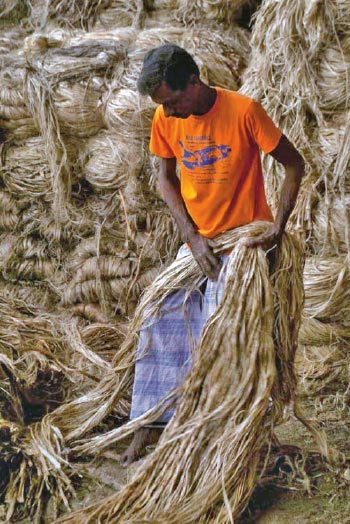 3. What is the demand for jute products in national and international markets? Have you conducted any research on this?
Answer: There is significant potential for expanding jute products in both national and international markets. However, demand is not equal for all types of products. Alongside conventional jute products, new markets are being created for environmentally friendly shopping bags, home décor items, geotextiles, fashion products, footwear, furniture, and jute-based composites used in industrial factories. According to Bangladesh Bank statistics, export earnings from jute products in the 2023�"24 fiscal year were shown at about USD 764.1 million. This indicates the international commercial importance of Bangladesh’s jute products. The main objective of BJRI’s research is to innovate new uses of jute, improve product quality, reduce production costs, and create technologies suitable for commercialization.
4. What else do you think the government should do in this regard?
Answer: Policy support from the government, investment in research, and an effective market system are very important for expanding the market for jute products. In my view, the following steps need to be taken. First, a policy on the use of alternatives to plastic should be adopted by gradually reducing single-use plastic and encouraging the use of jute and other environmentally friendly alternatives in appropriate cases. Second, investment in research and innovation should be increased by expanding BJRI’s modern laboratories, research equipment, skilled manpower, and pilot production facilities. Third, product quality and certification should be ensured by arranging verification of product quality, safety, durability, and environmental characteristics according to national and international standards. Fourth, industry-research linkage should be strengthened by transferring technology innovated in laboratories to entrepreneurs and building joint initiatives for commercial production. Fifth, priority should be given in public procurement by increasing opportunities to use domestic jute products in government institutions, educational institutions, and various government programmes, considering quality and cost rationality. Sixth, export market expansion should be pursued by strengthening international trade fairs, product exhibitions, buyer-seller conferences, and branding of Bangladesh’s jute products abroad. Seventh, environmental proof should be ensured by supporting the creation of carbon footprint, life cycle assessment, and Environmental Product Declaration (EPD) for jute products so that the environmental claims of the products are credible in international markets. Eighth, financial support to entrepreneurs should be provided through easy-term loans, technology development grants, tax benefits, and market development support. Ninth, awareness about the use of jute products should be raised through the media, educational institutions, and social campaigns.
5. What incentives do you want for marketing jute products? What are the challenges?
Answer: To increase the marketing and export of jute products, financial incentives are needed along with technical and market-based support. Information published by the Bangladesh Investment Development Authority also mentions various financial and non-financial incentives for the jute sector. The incentives we expect include export incentives in the form of competitive support considering product type, value addition, and market potential; research and innovation grants for financing new product development, pilot production, and technology commercialization; easy-term loans with low-interest credit and working capital arrangements for small and medium jute product entrepreneurs; marketing support for participation in international fairs, finding foreign buyers, e-commerce, and digital marketing; support for environmental certification to bear the costs of LCA, EPD, and international standards and testing; branding and intellectual property protection to establish the brand “Bangladesh’s jute products” and properly protect designs and innovations; and public-private partnership to create effective linkages among research institutions, jute mills, entrepreneurs, and exporters. The main challenges include higher prices than plastic, which require reducing production costs and improving technology.Our main point is that the development of jute products cannot remain confined only to agriculture or the conventional jute industry. It must be developed as an integrated sector combining research, modern textile technology, environmentally friendly materials, industrialization, and international marketing.

Loading...
Loading...
Also read



Editor : Iqbal Sobhan Chowdhury
Published by the Editor on behalf of the Observer Ltd. from Globe Printers, 24/A, New Eskaton Road, Ramna, Dhaka.
Editorial, News and Commercial Offices : Aziz Bhaban (2nd floor), 93, Motijheel C/A, Dhaka-1000.
Phone: PABX- 41053001-06; Advertisement: 41053012; 01793317829, 01550707291, E-mail: [email protected], [email protected] Online: email: [email protected] 41053014; 01550707297 Advertisement: 01550707296


