



| HEADLINE |

|

Who will save Dhaka's roads? (Last Part)



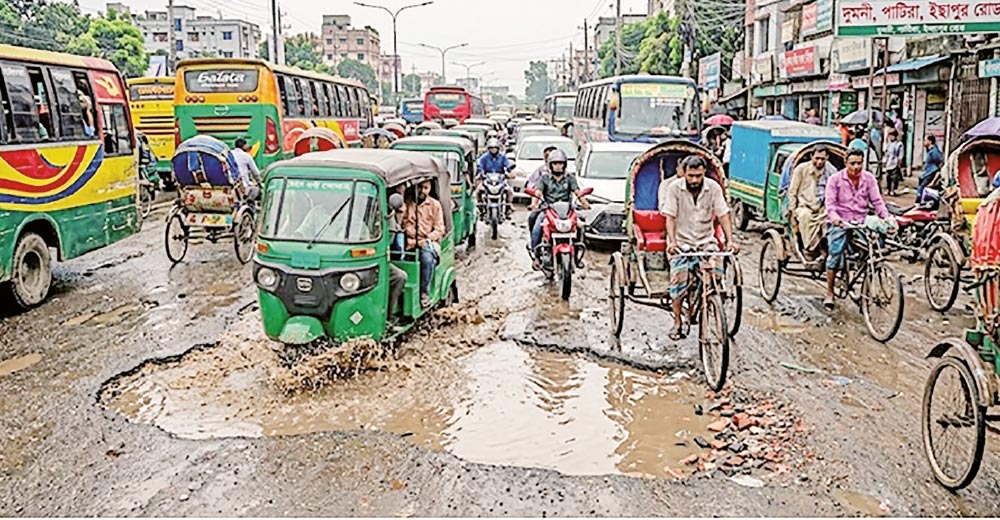 Ask who is responsible for a road in Dhaka, and the answer depends on whom you ask. City corporations, development authorities and utility agencies share responsibilities, but their lack of coordination leaves residents struggling with broken roads, stagnant water and repeated construction work.
In Dumni, a road running from Pink City past Dumni Bazar and Patira to Ichhapur resembles a muddy canal. Thousands of vehicles use it daily, but rainwater fills its potholes long after other parts of the city have drained. Rubble dumped into the holes only worsens the mud, leaving drivers unable to judge their depth. Rickshaws and auto-rickshaws overturn, while motorcycles and cars stall.
Residents say their ward was brought under the Dhaka North City Corporation (DNCC), yet development has barely reached it.
“It is worse than any village road, and it hurts to say that we live under a city corporation. We travel with our lives in our hands,” residents told this reporter.
Rahman Sheikh, a long-time auto-rickshaw driver, said people could barely walk along the road and passengers were injured when vehicles fell into ditches. A rickshaw puller said the road had remained in this condition for five years, with occasional dumping of rubble offering little relief.
Shopkeeper Saidur Rahman said the poor condition had driven away customers. He was considering leaving because business had become increasingly difficult.
In 2016, the National Implementation Committee on Administrative Reorganisation (NICAR) approved the addition of eight unions each to the north and south city corporations. The 36 newly formed wards were grouped into ten zones, but residents allege that development has yet to catch up.
Dr Adil Muhammad Khan, general secretary of the Bangladesh Institute of Planners (BIP), says Dhaka cannot become liveable without controlling population growth and density. Infrastructure must be planned against the population each area is designed to accommodate; otherwise, he warns, plans will fail.
A COSTLY BLAME GAME
The wider problem is fragmented responsibility. City corporations repair roads, only for Dhaka Wasa, Titas Gas, DESCO, DPDC or other agencies to dig them up for underground utilities. The cycle wastes public money and forces residents to endure repeated disruption.
Responsibility is further complicated by overlapping jurisdictions. RAJUK has been slow to hand over roads in some new residential areas, while major highways fall under the Roads and Highways Department (RHD), limiting city corporation intervention. RAJUK approves development plans and building designs, but the corporations must deal with the resulting pressure on roads and drainage.
Drainage systems are also poorly connected. Drains built by the RHD along highways and link roads often fail to connect with city corporation networks, causing waterlogging after relatively little rain. Major projects such as the metro rail, bus rapid transit (BRT) and expressway have added to the strain on surrounding roads, with coordination among agencies often inadequate.
Urban planner Iqbal Habib, speaking at a Bangladesh Poribesh Andolon (BAPA) event, said waterlogging was not simply a consequence of rainfall but also of poor planning and institutional failure.
“Waterlogging is not nature's creation. It is the product of poor coordination and gaps in planning,” he said, calling for integrated planning and accountability.
Dhaka has numerous agencies overseeing its development, including RAJUK, city corporations, Dhaka Wasa, the Water Development Board, BIWTA and several ministries. Yet no single body effectively coordinates their work, Habib said.
He called for participatory urban governance involving public agencies, professional organisations and citizens, arguing that no single institution could resolve the city's problems alone.
THE WAY FORWARD
Experts propose an integrated utility duct�"a shared underground passage for gas, water and electricity lines�"to end repeated road excavation. They also want stronger enforcement powers for the Dhaka Transport Coordination Authority (DTCA) to ensure projects comply with the master plan and traffic management requirements.
Another proposal is to establish a city government, supported by sustained consultations with stakeholders and studies of governance models in cities such as Delhi, Bangkok, Kuala Lumpur and Manila. A commission could examine the options. Until a legally constituted city government becomes possible, experts suggest forming a Dhaka Development Coordination Committee to align the work of the ten principal service agencies.
Without coordinated planning, clear responsibility and accountability, road repairs will remain temporary fixes. Every monsoon, potholes will fill with water, residents will face the same dangers, and agencies will continue passing the blame.

Loading...
Loading...
Also read



Editor : Iqbal Sobhan Chowdhury
Published by the Editor on behalf of the Observer Ltd. from Globe Printers, 24/A, New Eskaton Road, Ramna, Dhaka.
Editorial, News and Commercial Offices : Aziz Bhaban (2nd floor), 93, Motijheel C/A, Dhaka-1000.
Phone: PABX- 41053001-06; Advertisement: 41053012; 01793317829, 01550707291, E-mail: [email protected], [email protected] Online: email: [email protected] 41053014; 01550707297 Advertisement: 01550707296


