



| HEADLINE |

|

Govt pushes LNG terminal into UNESCO-listed Sundarbans
Scientists say the damage would be permanent, Ministers say wait for studies



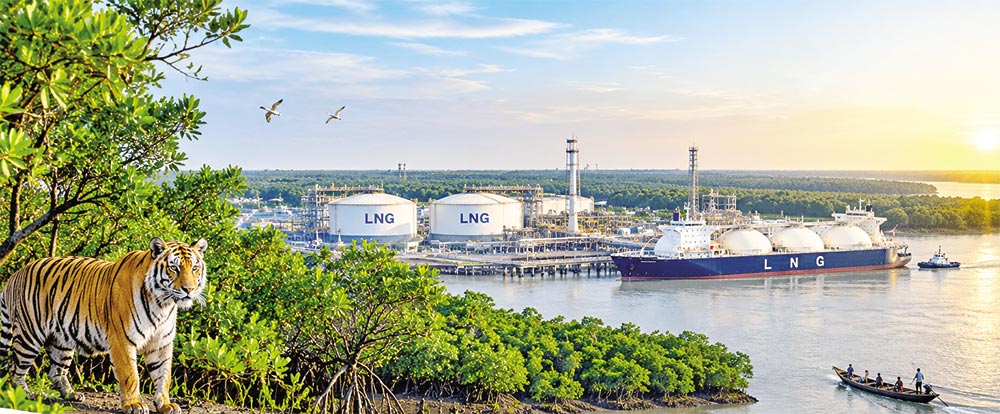 The government is pressing ahead with a floating LNG terminal at Akram Point inside the Sundarbans, and it has done so without telling the one institution legally responsible for protecting the forest.
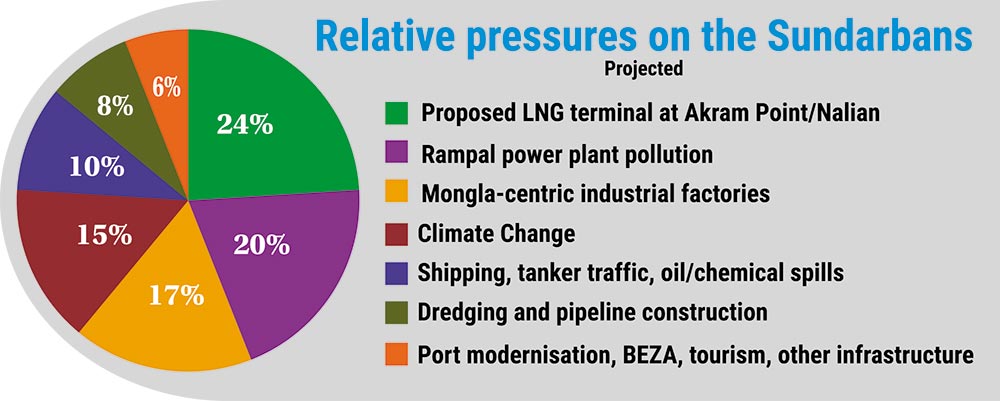
Due to various reasons, including climate change, Mongla-centric industrial factories, and the pollution from the Rampal power plant, the Sundarbans-the world's largest mangrove forest-is in multifaceted crisis. In such a situation, Akram Point, an ecologically important area within the Sundarbans, and the village of Nalian adjacent to the Sundarbans, are being considered as potential sites for establishing an floating LNG (Liquefied Natural Gas) terminal to address the energy crisis.
Akram Point is the estuary where the Shibsa and Pashur rivers of the Sundarbans meet. Within two kilometers of this point, on one side is the Sundarbans South Wildlife Sanctuary and on the other side is the Sundarbans East Wildlife Sanctuary. Both of these sanctuaries are part of the UNESCO-declared World Heritage Site.
Across from Nalian village, adjacent to the Shibsa River, within two kilometers, lies another sanctuary. Although Nalian is not part of the Sundarbans, it is part of the Ecologically Critical Area (ECA) comprising a 10-kilometer area surrounding the Sundarbans. This village is located along the Shibsa River.
Chief Conservator of Forests Md. Amir Hossain Chowdhury confirmed as much: nothing, he said, had been communicated to his department from the ministry on the terminal. He would say no more. He did not need to. The silence is the story.
Meanwhile the Khulna Forest Conservator's office - the field arm that actually walks this forest - has written to headquarters in protest after learning of the plan from the newspapers. That is the sequence: ministers announce, delegations tour, a pipeline route gets sketched, and the guardians of a World Heritage Site find out from the press.
Akram Point is where the Shibsa and Pashur rivers meet. Within two kilometres of it stand the Sundarbans South Wildlife Sanctuary on one side and the Sundarbans East Wildlife Sanctuary on the other. Both are part of the UNESCO World Heritage Site. A second site under consideration, Nalian village on the Shibsa, is not inside the forest - but it sits in the 10-kilometre Ecologically Critical Area wrapped around it, and within two kilometres of another sanctuary. There is no version of this map in which the terminal is "outside" the Sundarbans.
The march to this point has been brisk. On 13 August, Power, Energy and Mineral Resources Minister Iqbal Hasan Mahmud announced three floating LNG terminals - Hiron Point, Mongla and Payra. On 19 October, Finance Minister Amir Khosru Mahmud Chowdhury told a Foreign Investors' Chamber of Commerce and Industry gathering in Dhaka that a terminal would be built near Khulna where the draft is 20 metres. On 16 August, a delegation including the Prime Minister's Finance and Planning Adviser Rashed Al Mahmud Titumir, Energy Minister Iqbal Hasan Mahmud, Shipping, Roads, Bridges and Railways Minister Sheikh Rabiul Alam, BEZA Chairman Ashik Chowdhury and the Mongla Port Authority chairman toured Akram Point, the Shibsa, the Sundarbans and Mongla Port.
That same afternoon, at a reception at Mongla Port bus stand, Sheikh Rabiul Alam did not hedge: a floating LNG station would be built at Akram Point, a 23-kilometre pipeline would run to Mongla, and gas would fire power generation.
State Minister Anindya Islam Amit's defence is that the southwest has been starved of development and needs industry. Studies will come first, he says; environmental assessments will be done; discussion will follow only if everything is favourable.
The scientists are not waiting for the photographs. A forest expert, speaking on condition of anonymity, said the pipeline method would settle the matter: an open-cut trench would slice through the breathing roots that keep mangroves alive and kill trees in numbers, while tunnelling beneath the root zone is so costly that the government will not pay for it. The cheap option is the deadly one.
"If something is done within the forest, no matter how much it is said that there will be no impact, there will definitely be an impact," A.M. Feroz Ahmed, former professor of civil engineering at BUET said. Gas burns. Ships spill - they already have. More traffic means more pollution. None of this is speculation; it is arithmetic.
The Forest Department's letter reads like an indictment. LNG tankers would bring noise and vibration that drive out the endangered Irrawaddy and Ganges River dolphins, and propellers that kill them. Converting LNG to gas would dump cold or hot water into the river, wreck photosynthesis and destroy fish eggs and fry.
Construction and artificial light would scramble the breeding of tigers, spotted deer and wild boars; the mudflats that host migratory birds and amphibians would be bulldozed. Dredging to keep the channel open would stir heavy metals off the riverbed into the water and bury mangrove roots under silt - Sundari, Goran and Gewa dying of suffocation - while burnt oil and chemical waste could shut down natural regeneration for good.
UNESCO objected to the Rampal coal plant, considered putting the Sundarbans on the List of World Heritage in Danger, and sent a joint mission with IUCN in March 2016 that called Rampal a serious threat and recommended moving it. Dhaka handed over data and refused to move. In 2018 it was warned not to approve industrial plants before a strategic environmental impact assessment.
At the World Heritage Committee's latest meeting in Busan on 21 July, the World Heritage Centre criticised Bangladesh for failing to carry out the detailed Sundarbans research promised in its own Strategic Environmental Assessment, and demanded a strategic environmental management plan against the threats identified over the next 20 years.
It reminded Dhaka that decisions on large industries near the forest must follow World Heritage guidelines protecting its Outstanding Universal Value. A report was due by 1 December 2027; Azerbaijan proposed an amendment at the session and the deadline slid to February 2029. On 16 October in Baku, State Minister for Foreign Affairs Humayun Kabir met Azerbaijani Foreign Minister Jeyhun Bayramov, who expressed interest in investing in Bangladesh's energy sector.
Environmental and forest experts now warn the terminal could get the Sundarbans struck off the World Heritage list entirely. Wildlife and ecosystem are already bruised by pollution from Mongla's factories and Rampal. Adding an LNG terminal to that ledger is not development planning. It is piling risk on risk.
The government's position is that studies will decide. The Forest Department's position is that nobody has asked it. Between those two sentences sits the world's largest mangrove forest - and a decision that, once made in concrete and steel, cannot be taken back.

Loading...
Loading...
Also read



Editor : Iqbal Sobhan Chowdhury
Published by the Editor on behalf of the Observer Ltd. from Globe Printers, 24/A, New Eskaton Road, Ramna, Dhaka.
Editorial, News and Commercial Offices : Aziz Bhaban (2nd floor), 93, Motijheel C/A, Dhaka-1000.
Phone: PABX- 41053001-06; Advertisement: 41053012; 01793317829, 01550707291, 01550707296
E-mail: [email protected], [email protected]. [email protected], [email protected], [email protected], [email protected], Online-email: [email protected]


