



| HEADLINE |

|

Tilion: How an experiment by four friends grew into a Silicon Valley startup backed by YC
Tilion has been accepted into Y Combinator (YC), the Silicon Valley accelerator behind companies such as Airbnb and Stripe. YC invests $500,000 in each company it accepts—and receives applications from thousands of startups around the world
Published : Monday, 2 November, 2026 at 12:00 AM
Rabbi Majumder


 Today, you can ask ChatGPT to write an essay, summarise a document, or answer a question in seconds. But what if artificial intelligence could go a step further-log into websites, gather information, fill out forms, monitor pages, and complete thousands of routine tasks on its own?
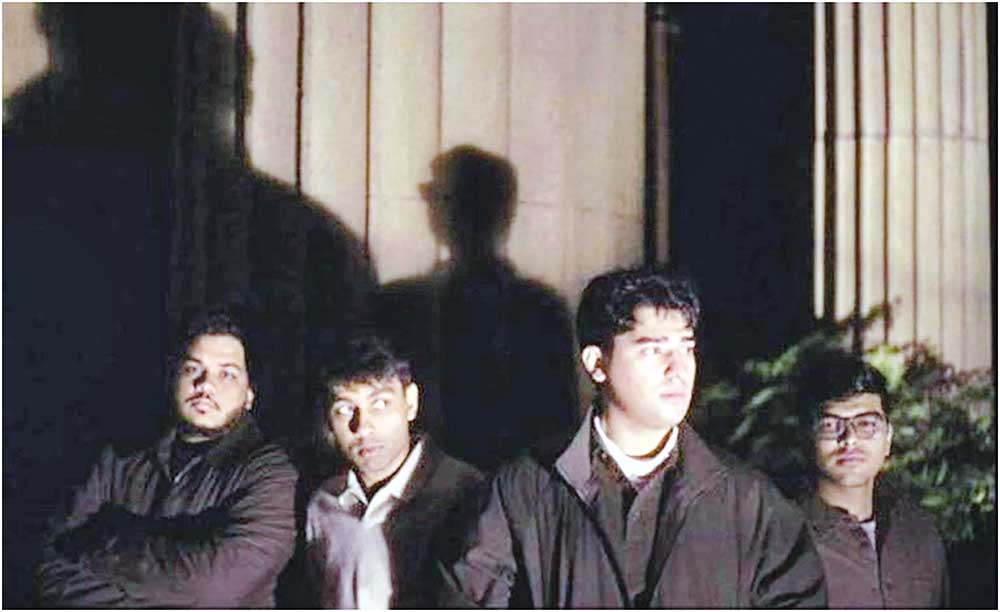
Arman Luthra, Md Shahrier Islam Arham, Kazi Fardinul Hoque, and Abdul Basit Tonmoy met as students at Wabash College, a small liberal-arts college in Indiana, United States. Three are Bangladeshis; one is Indian. Together, they have founded Tilion, an AI infrastructure company that aims to make it easier for AI agents to interact with the web. Their idea has already caught the attention of one of the world's most prestigious startup accelerators.
Tilion has been accepted into Y Combinator (YC), the Silicon Valley accelerator behind companies such as Airbnb and Stripe. YC invests US$500,000 in each company it accepts-and receives applications from thousands of startups around the world.
For four young friends who began experimenting with technology in a college dorm room, the achievement marks a remarkable journey.
"We see a world where agents handle the mundane work, so people can put their time into creativity instead," Arman said. "And agents unlock a kind of growth for a business that used to take entire teams."
The Problem With AI and the Web: AI models have become remarkably capable at understanding and generating information. But getting an AI agent to actually do things on the internet is far harder.
The reason is simple: websites are designed to tell humans apart from automated systems. They can analyse devices, browsing behaviour, typing patterns, and other signals before allowing a user to proceed.
That is useful for fighting spam, fraud, and malicious bots. But it can also stop legitimate AI agents from completing ordinary tasks.
Imagine an AI assistant trying to book a doctor's appointment. It may know exactly what to do�"but the website may not recognise the AI as a legitimate user.
Tilion is building infrastructure designed to solve that problem.
The company gives AI agents access to browsers they can control much as a person controls a web browser. If one browser is blocked or runs into trouble, the system can switch to another and continue the task.
According to the founders, companies can integrate the technology with a single line of code. Tilion's infrastructure is already being used to process millions of tasks a day across thousands of websites. The potential applications are enormous�"from collecting information and monitoring websites to completing forms and automating repetitive online work.
Four Friends, Four Very Different Talents: The story of Tilion, however, is not simply a story about technology. It is also a story about four young people who began achieving extraordinary things long before they founded a company together.
Their backgrounds are strikingly diverse. Arman combined technology with a passion for art. He has been painting since childhood, and some of his work has received international recognition and appeared in textbooks. At the same time, he developed sophisticated algorithms related to remittances, worked as a data engineer in biotechnology, and later contributed to solving complex data problems at a Washington think tank.
Arham built a reputation for creating technology that solved practical problems. He developed software that helped thousands of students find employment, and later worked on browser infrastructure capable of competing with technology built by far larger companies�"all while he was still a student.
Fardinul Hoque, known as Fardin, went on to work at Amazon Web Services, where he tackled a technically demanding challenge: enabling a single machine to serve hundreds of AI models rather than only a handful. He also worked on bringing advanced AI models into production.
Tonmoy, meanwhile, sharpened his skills through hackathons, artificial intelligence research, and independent projects. He has won competitions across the United States and built AI models that he made freely available to others. He also founded and ran his own technology lab.
Yet their achievements are not limited to computers. Arham remains closely connected to cultural activities and has helped organise programmes in the United States, carrying elements of the culture he grew up with to a new audience. Fardin is an enthusiastic footballer. Tonmoy is passionate about photography. And Arman's artistic interests have remained a vital part of his life alongside technology.
In many ways, they are easier to imagine as four close friends than as the founders of a Silicon Valley startup. And that may be the most interesting part of the story.
From a College Dorm Room to Silicon Valley: Wabash College has fewer than 1,000 students. It is a long way�"geographically and culturally�"from the technology ecosystem of San Francisco. Yet it was there, in a college dorm room, that the four friends began working on the idea that would eventually become Tilion.
The project has since grown into a San Francisco-based company with more than 100,000 users, according to the founders. Their ambition is much larger than simply building another software company.
A huge amount of modern knowledge work still involves repetitive digital tasks: logging into websites, moving information between browser tabs, copying data, filling out forms, and repeatedly checking whether a webpage has changed.
If AI agents can reliably perform those tasks, the founders believe, businesses could redirect human effort towards work that requires creativity, judgement, and innovation. In other words, the goal is not simply to make computers faster. It is to give people back their time. That vision is now receiving backing from one of the world's best-known startup accelerators.
For Bangladesh, the story offers another reminder that young Bangladeshis can compete at the highest levels of global technology�"not only as employees of international companies, but also as founders building technology for a worldwide market.
Four friends started with an idea in a small college dormitory. Today, they are trying to build the infrastructure that could allow the next generation of AI agents to navigate the internet.
And if they succeed, some of the most repetitive work people do every day may eventually disappear�"not because people are working harder, but because machines are finally able to do the work for them.

Loading...
Loading...
Also read



Editor : Iqbal Sobhan Chowdhury
Published by the Editor on behalf of the Observer Ltd. from Globe Printers, 24/A, New Eskaton Road, Ramna, Dhaka.
Editorial, News and Commercial Offices : Aziz Bhaban (2nd floor), 93, Motijheel C/A, Dhaka-1000.
Phone: PABX- 41053001-06; Advertisement: 41053012; 01793317829, 01550707291, 01550707296
E-mail: [email protected], [email protected]. [email protected], [email protected], [email protected], [email protected], Online-email: [email protected]


