



| HEADLINE |

|

ABANDONING A CAT
Published : Saturday, 7 November, 2026 at 12:00 AM
Haruki Murakami


 Reviewed by Christine Runyon
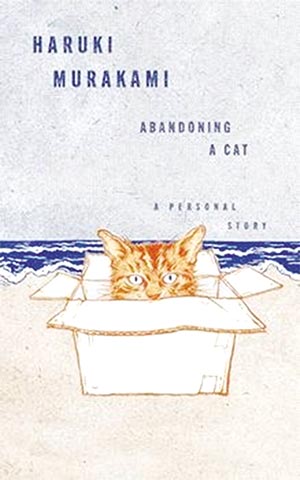
How well can we ever know our parents? How do we grapple with the accidental incidents and the "what ifs" that make up a life? These are just a few of the questions novelist Haruki Murakami explores in his long essay, Abandoning a Cat: A Personal Story. First published in the Japanese magazine Bungeishunj in 2019 (and translated into English for The New Yorker that same year by Murakami's frequent collaborator Philip Gabriel), the essay is now being released for the first time in a hardcover edition with stunning illustrations by Yuko Shimizu. As Murakami shows, through writing a parent's history, it is possible to understand them better, even if they are long gone.
The essay begins with the event referred to in the title, when he and his father Chiaki took a bike ride and attempted to leave a cat behind at the beach. Murakami's memory of the day is hazy; he cannot recall why they needed to abandon that particular cat when so many felines passed through their household, though he believes his father must have had a good reason. Yet, what transpired next was as unusual and magical as any plotline from his fiction: the cat beat them back to the house, and waited at the door when they returned.
Murakami wanted to know how his father's wartime experiences changed him, but put off writing about him for years after his death in 2008. When he finally did, it was the memory of the cat that became the catalyst for how he viewed his father in the years to come, for he "never forgot the look of blank amazement" on his father's face that day. It was "[a]dmiration and, finally, an expression of relief"�"therefore the cat was allowed to stay.
Crucially, Murakami's father wrote haiku while serving in the Imperial Japanese Army, which may have been his "sole consolation," where "he was able to bare his true feelings honestly." Murakami uses the same tool�"writing�"to discover the past, since he is "the kind of person who can only think about things by physically writing them down." We join him on his journey to knowing his father, as he relays the emotional distance he felt in his youth, the feeling they had little in common, through the discovery of inherited traits and their shared habits. Because Murakami never got to ask his father about the wartime events directly before their twenty-year estrangement, he reconstructs a portrait of his father that is fundamentally shaped by youthful memories, filling in the historical blanks with creative empathy.
As the son of a priest, Chiaki was sent away as a boy to become a temple apprentice, an experience that Murakami believes scarred his father permanently. Later, he was drafted three times, though he did have a life after war, publishing his haiku and becoming a beloved teacher. Murakami writes:
"I think my father wanted nothing more than to spend a quiet life as a scholar, but the violent flow of events wouldn't allow him such a luxury."
The first time he was drafted it was the result of a clerical error, and Chiaki was narrowly saved from a potentially fatal deployment�"a moment of chance, just one of many, upon which Murakami's entire existence hinged. Through this realization, the reader comes to understand how Murakami feels as though his identity as a novelist is a "fleeting illusion" born of coincidence. This idea clearly influenced Murakami's surreal, dream-like stories, which operate much like his recollections in this essay: foggy and fragmented. But reality is essentially the accumulation of such half-remembered moments.
"Everything that happened in my father's life and in my life was accidental. In the end we live our lives this way: through viewing things that came about through accident and happenstance as the sole possible reality."
The way Murakami remembers his father may come from the somewhat objective distance of years of estrangement, but he also captures the heavy guilt a teenager carries when failing to meet their parents' expectations, and the regret of that fractured relationship. In trying to solve the mystery of his father's wartime experiences, Murakami learns even more about himself, realizing that his father's cool, quiet distance is the reason he became the specific novelist he is today.
In the end, an appreciation for everything that transpired, the good and the bad, sits at the core of the essay. Another, more tragic memory involving a kitten stuck in a tree provides a permanent lesson: "Going down is much harder than going up." For Murakami, the anecdote serves as an allegory for the irreversible momentum of choices and history: of how easily a path is set in motion, and how difficult it is to descend from those consequences once the years have passed.
Courtesy: BookBrowse

Loading...
Loading...



Editor : Iqbal Sobhan Chowdhury
Published by the Editor on behalf of the Observer Ltd. from Globe Printers, 24/A, New Eskaton Road, Ramna, Dhaka.
Editorial, News and Commercial Offices : Aziz Bhaban (2nd floor), 93, Motijheel C/A, Dhaka-1000.
Phone: PABX- 41053001-06; Advertisement: 41053012; 01793317829, 01550707291, 01550707296
E-mail: [email protected], [email protected]. [email protected], [email protected], [email protected], [email protected], Online-email: [email protected]


