



| HEADLINE |

|

China's trade surplus crosses $1 trillion amid AI boom
Published : Tuesday, 10 November, 2026 at 6:03 PM
Observer Online Report


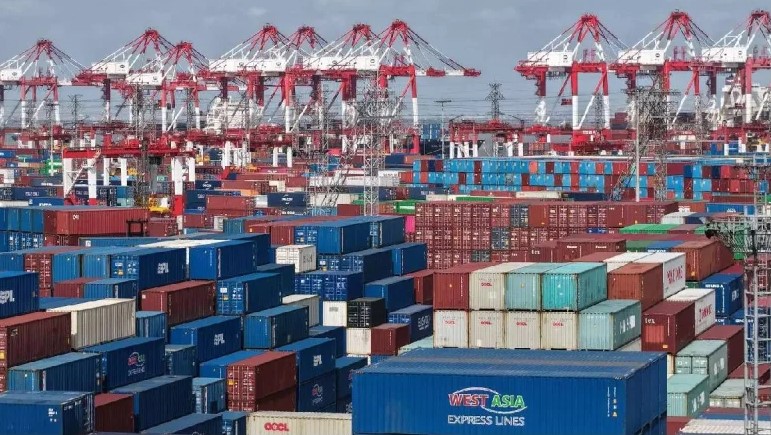
China's exports have hit record levels amid rising global demand for artificial intelligence (AI) technology, pushing the country's trade surplus above US$1 trillion in the first 10 months of this year despite weak domestic demand. However, the widening surplus could further escalate trade tensions with its major international trading partners.
The development comes ahead of next week's Asia-Pacific Economic Cooperation (APEC) summit in Shenzhen, where Chinese President Xi Jinping and US President Donald Trump are expected to discuss bilateral economic relations and tariff policies.
China's economy has become increasingly dependent on overseas markets as a prolonged property sector downturn and sluggish consumer spending continue to weigh on domestic demand. Economists have warned that although the global AI investment boom could benefit China through 2027, excessive reliance on foreign markets may expose the country to protectionist trade barriers and conceal underlying economic weaknesses.
Chinese exports surged 35.2 per cent in October compared with the same month last year, exceeding economists' expectations. The growth was largely driven by strong demand for AI-related and high-tech products.
This marks the second consecutive year that China's trade surplus has crossed the US$1 trillion threshold. The country reached the milestone a month earlier than it did in 2025.
The widening surplus could intensify trade tensions with the European Union (EU). Chinese companies are reportedly accelerating shipments to European markets ahead of stricter EU measures targeting imports of Chinese hybrid vehicles.
Economists have also warned that trade imbalances with the United States remain a major concern despite a two-month extension of the temporary tariff truce between Washington and Beijing. China has said it would increase purchases of American agricultural products only if Washington reduces tariffs on Chinese goods.
Joe Peissel, lead macroeconomist at research firm Trivium China, warned that the risk of additional tariffs and other trade barriers would remain high in 2027, particularly as Chinese manufacturers continue expanding their presence in overseas markets.
China's trade surplus with the United States narrowed slightly to US$32.71 billion in October from US$34.01 billion in September. Nevertheless, the broader trade imbalance between the world's two largest economies remains a major source of friction.
Meanwhile, China's imports increased 41.6 per cent year-on-year in October, surpassing the 32 per cent growth forecast in a Reuters poll and September's 31 per cent increase.
Customs data also showed that rare earth exports edged up from the previous month, while crude oil imports reached their highest level since March following disruptions in Middle Eastern supplies.
Nguyen Hoang Nam, a China economist at Capital Economics, said the slower contraction in rare earth exports suggested that Beijing might have started easing enforcement of some export restrictions, possibly in response to continued pressure from Washington.
Despite the strong trade figures, Chinese stock markets showed little reaction. During the midday break, the blue-chip CSI300 index and the Shanghai Composite Index were both up just 0.1 per cent.
Weak consumer spending remains a major concern for Beijing. The prolonged property sector downturn has eroded household wealth and economic confidence, weighing on domestic consumption.
As a result, sales of Chinese-made vehicles at home have declined for 12 consecutive months, even as overseas shipments continue to grow rapidly.
Meanwhile, semiconductor exports surged 111.1 per cent year-on-year, while exports of high-tech products increased 47.9 per cent.
Analysts expect demand for AI-related products to remain strong over the coming months, potentially giving China an advantage in global trade competition despite temporary uncertainties in financial markets.
- MaT

Loading...
Loading...
Also read






Editor : Iqbal Sobhan Chowdhury
Published by the Editor on behalf of the Observer Ltd. from Globe Printers, 24/A, New Eskaton Road, Ramna, Dhaka.
Editorial, News and Commercial Offices : Aziz Bhaban (2nd floor), 93, Motijheel C/A, Dhaka-1000.
Phone: PABX- 41053001-06; Advertisement: 41053012; 01793317829, 01550707291, 01550707296
E-mail: [email protected], [email protected]. [email protected], [email protected], [email protected], [email protected], Online-email: [email protected]


