



| HEADLINE |

|

Behind student suicides: When grades become a matter of survival
Published : Thursday, 12 November, 2026 at 12:29 PM
Evan Mollah


Collected Photo
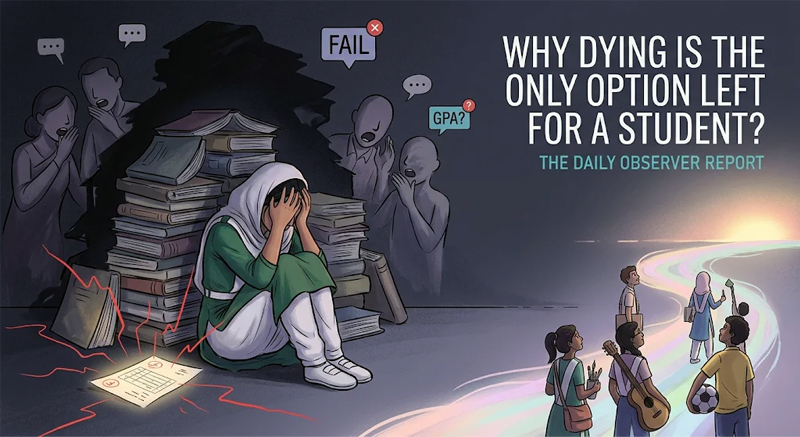
Behind every post-examination suicide lies a quiet, crushing reality where relentless parental expectations, social shame, and a grade-obsessed education system convince young minds that death is the only escape from academic disappointment.
Following the publication of the 2026 Secondary School Certificate (SSC) and Higher Secondary Certificate (HSC) results, at least 20 students took their own lives across Bangladesh, according to data compiled by the Aachol Foundation. Eleven died after the SSC results, while nine ended their lives within just 10 days of the HSC announcement.
Mental health experts, sociologists, and educators warn that these tragedies are rarely impulsive acts triggered by a single mark sheet. Instead, they are the final outcome of years of accumulated psychological pressure that strips adolescents of self-worth and leaves them feeling entirely alone when they fall short.
When Grades Define Human Worth
In Bangladesh, public examinations are widely treated not as routine academic assessments, but as final verdicts on a young person's value and future. From early childhood, students are conditioned to believe that a GPA-5 is the sole gateway to respect, financial stability, and social acceptance.
When a student fails or misses an expected grade, the setback does not feel temporary. To an adolescent brain still developing emotional regulation, failing an exam feels like failing at life itself. Without adults reminding them that alternative paths exist, many young people view their future as permanently closed.
The Weight of Parental Expectations and Comparison
For many students, home ceases to be a safe harbour during examination seasons. Parents often invest heavy financial and emotional sacrifices into coaching centres, private tutors, and study materials, unintentionally turning a child’s education into a high-stakes family debt.
Constant comparisons with neighbours' children, cousins, or top-scoring classmates deepen the sense of inadequacy. Many students fear facing their parents' disappointment, anger, or silence far more than the examination itself. When home offers judgement instead of comfort, a struggling student has nowhere left to turn.
Social Stigma and Public Humiliation
The release of board results in Bangladesh has increasingly become a public spectacle. Neighbours, relatives, and community members routinely ask for grades within minutes of publication, turning a private academic outcome into a public verdict on family prestige.
Social media further amplifies this distress. While high achievers are celebrated online with congratulatory posts, those who underperform experience acute shame, isolation, and fear of ridicule. For vulnerable teenagers, avoiding public humiliation can feel more urgent than staying alive.
Lack of Mental Health Support and Safe Spaces
Despite rising rates of youth depression and anxiety, psychological support remains virtually absent across most schools and colleges in the country. Aachol Foundation data shows that 224 students died by suicide in the first eight months of 2026 alone, following 403 student suicides in 2025, with depression and emotional distress identified as leading drivers.
Most educational institutions lack trained counsellors, and mental health struggles are still dismissed by many families as weakness, ingratitude, or lack of discipline. Because adolescents are rarely taught how to process grief, failure, or panic, emotional pain builds in silence until it becomes unbearable.
Rebuilding a Culture of Empathy
Psychologists and educationists stress that preventing future tragedies requires dismantling the toxic equation that ties a child's right to love and dignity to exam scores.
Experts urge parents to offer unconditional reassurance before and after results are published, ensuring children know they are valued regardless of their grades. Alongside institutional reforms—such as deploying school counsellors and establishing post-exam crisis helplines—society must shift away from public grade-shaming and remind young people that an examination is merely one chapter, never the whole story.
If you or someone you know is struggling with emotional distress or thoughts of self-harm, confidential help is available in Bangladesh through Kaan Pete Roi at 01779-554391 or 01779-554392, and the National Emergency Service at 999.
-EM

Loading...
Loading...
Also read








Editor : Iqbal Sobhan Chowdhury
Published by the Editor on behalf of the Observer Ltd. from Globe Printers, 24/A, New Eskaton Road, Ramna, Dhaka.
Editorial, News and Commercial Offices : Aziz Bhaban (2nd floor), 93, Motijheel C/A, Dhaka-1000.
Phone: PABX- 41053001-06; Advertisement: 41053012; 01793317829, 01550707291, 01550707296
E-mail: [email protected], [email protected]. [email protected], [email protected], [email protected], [email protected], Online-email: [email protected]


