



| HEADLINE |

|

Emergency alerts in over 20 countries; natural disaster or nuclear deterrence?
Published : Thursday, 5 November, 2026 at 4:14 PM
Shahman Abir


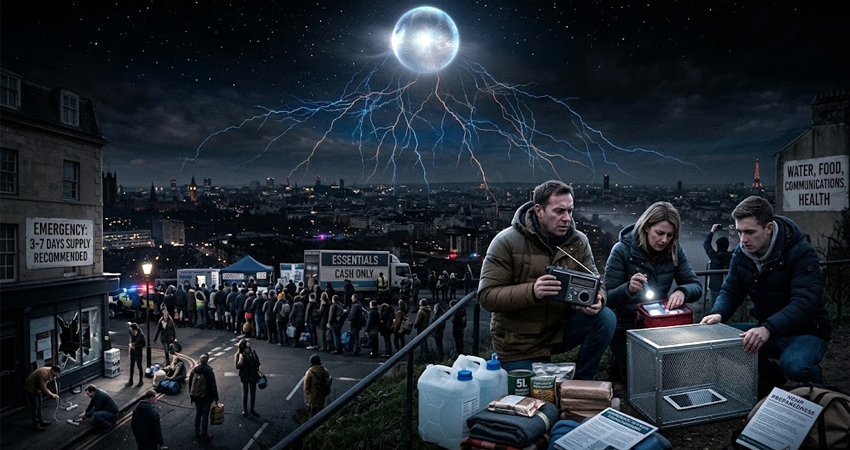
AI Illustration
Citizens around the globe are afraid of superpowers using nuclear strikes to blast off entire region. Panics have surged in European countries as severe cyber attacks were recorded after the PHP bug.
Citing natural disaster and cyber attacks, more than 17 European countries have already issued emergency alert–prompting residents to store food and emergency supplies ranging from three to seven days.
Even so, Tucker Carlson’s analysis over potential nuclear strike on the Pickaxe mountain of Iran raised fresh concerns about using devastating nuclear weapons to wipe out civilisations.
However, nuking a country might be less effective than a high-altitude electromagnetic nuclear warfare.
High-altitude electromagnetic pulse, which is generally known as HEMP, is probably the worst weapon manufactured in the history of human civilisation. And all of it, started with the 1961 test.
A test over the Pacific
9th of July 1962. The United States conducted a major nuclear weapon test high on the atmosphere. The test was done over the Pacific Ocean. This operation was given a code name, Starfish Prime.
No cities were gutted. No grounds were flattened. Marine lives were unharmed. Yet about 1448 kilometres away from the test zone, in Hawaii, 36 strings of streetlights went dark and burglar alarms began to sound.
Not just the US, Russia (then Soviet Union) too, conducted such high-altitude tests over Kazakhstan in 1961 and 1962.
Those scattered failures remain the best public evidence of what a high-altitude electromagnetic pulse, or HEMP, can do. More than sixty years later, modern societies depend on far more electronics than Hawaii did in 1962, and the question of what a repeat would mean has moved from military circles into utility boardrooms and government policy.
How the pulse is made
HEMP is created when a nuclear weapon is exploded far above the atmosphere. Gamma rays from the blast strike the thin upper air and knock electrons loose through a process known as Compton scattering. Those electrons spiral along the Earth's magnetic field and produce a powerful, fast-moving burst of electromagnetic energy that travels down to the surface.
Engineers divide the pulse into three parts. The first, E1, is extremely fast and can damage or disrupt electronic circuits directly. The second, E2, resembles the surge from a nearby lightning strike. The third, E3, is slow and long-lasting, and behaves much like the disturbance caused by a severe solar storm. It induces currents in long conductors such as power lines.
The area affected is vast. The Electric Power Research Institute (EPRI), the utility industry's research body in the United States, says a detonation about 125 miles up can produce an E1 field covering roughly three million square miles. A single weapon, in other words, could reach across an area the size of the contiguous United States.
What it does to people
The pulse itself is not believed to injure people directly. The danger is what stops working. Electric power underpins water supply, fuel distribution, communications, banking, hospitals and food transport, and failure in one system can spread into others.
The picture changes if a weapon is exploded at or near ground level. The US Federal Emergency Management Agency (FEMA) warns that in such a case the pulse can damage electronics several kilometres from the detonation and cause temporary disruption further out, alongside blast, fire and radioactive fallout.
A high-altitude burst, by contrast, is a threat to equipment rather than to people in the open.
What households can do
Personal protection has narrower limits. Most guidance for ordinary people mirrors advice for any long power cut. Emergency agencies advise keeping stored drinking water, non-perishable food, essential medicines, a first-aid kit and some cash.
A battery-powered or hand-crank radio is the usual recommendation for getting information when phone networks and the internet fail, while nuclear guidance stresses sheltering indoors and listening for official instructions. Families are advised to agree on a meeting point and a way to contact one another that does not depend on mobile phones.
Surge protectors and unplugging devices offer some defence against weaker events. Metal enclosures meant to act as Faraday cages are widely sold for small electronics, but the claims made for consumer products are mostly untested against real HEMP.
What remains unknown
No HEMP has struck a modern power system, and the Starfish Prime evidence comes from an era of far simpler electronics. EPRI says more work is needed on power plants, distribution networks, renewable energy systems and other sectors that depend on the grid, including water and telecommunications. Until that work is done, the range of expert opinion, from a regional outage to a national catastrophe, is likely to stay wide.
What the agencies and utilities agree on is that the damage can be reduced. Hardened substations, spare equipment and tested recovery plans cost far less than rebuilding after the fact, and the same measures also guard against solar storms, which arrive without any human decision to attack.
Why alert now
Citing numerous reasons, authorities are urging to follow the public guidance in the following countries: Austria, Belgium, Canada, Denmark, Finland, France, Germany, Japan, Netherlands, Poland, Thailand, United Kingdom, United States, Austria, Belgium, Canada, Denmark, Finland, France, Germany, Japan, Netherlands, Poland, Thailand, United Kingdom, United States and many more countries.
Ironically, the public directive stated by governments–resonate with the preemptive measures of HEMP disaster.
A nod is as good as a wink.

Loading...
Loading...
Also read








Editor : Iqbal Sobhan Chowdhury
Published by the Editor on behalf of the Observer Ltd. from Globe Printers, 24/A, New Eskaton Road, Ramna, Dhaka.
Editorial, News and Commercial Offices : Aziz Bhaban (2nd floor), 93, Motijheel C/A, Dhaka-1000.
Phone: PABX- 41053001-06; Advertisement: 41053012; 01793317829, 01550707291, 01550707296
E-mail: [email protected], [email protected]. [email protected], [email protected], [email protected], [email protected], Online-email: [email protected]


