



| HEADLINE |

|

DNCRP vows crackdown on hoarding ahead of Ramadan
Published : Monday, 16 November, 2026 at 6:02 PM
Observer Online Report


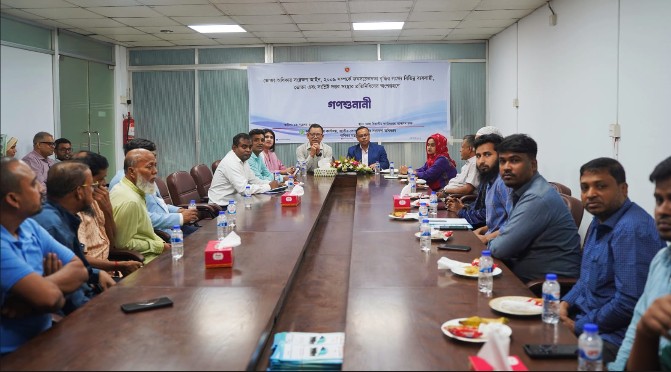
The Directorate of National Consumer Rights Protection (DNCRP) has vowed to take strict action against traders who hoard essential commodities, create artificial shortages, or attempt to raise prices unreasonably ahead of the upcoming holy month of Ramadan.
The directorate will intensify market monitoring to ensure an adequate supply of essential commodities, market stability, and fair prices for consumers, said DNCRP Director General Mohammad Zahirul Islam.
He made the remarks at a public hearing held at the directorate's Dhaka divisional office on Monday afternoon.
The hearing was organized to raise awareness about the Consumer Rights Protection Act, 2009, with traders, consumers, students, and representatives of relevant government agencies taking part.
Zahirul Islam said demand for essential commodities, including chickpeas, lentils, sugar, edible oil, and dates, usually increases significantly during Ramadan.
Taking advantage of the seasonal demand to hoard products or create an artificial supply crisis would invite strict action, he warned.
He said the directorate would regularly monitor the markets to prevent illegal stockpiling and ensure that essential commodities remain available at reasonable prices.
The watchdog would also keep a close eye on product quality and expiry dates, particularly dates, which see a sharp rise in demand during Ramadan.
Measures would be taken to prevent expired dates and other unsafe products from being sold in the market, he added.
At the hearing, a leader of a pharmacy traders' association proposed involving representatives of business organizations in the DNCRP's market inspection drives.
He said representatives of traders' associations could accompany enforcement teams and assist officials during inspections. Such cooperation would help raise awareness among traders about consumer rights laws and make enforcement activities more effective, he suggested.
Students attending the hearing called for regular awareness programs, meetings, and seminars at colleges and universities to educate young people about consumer rights and the Consumer Rights Protection Act.
They said such initiatives would help students understand their rights, learn how to seek redress for violations, and spread awareness among their families and communities.
Consumers at the hearing called for stronger market monitoring to keep the prices of essential commodities reasonable, ensure product quality, prevent weight manipulation, and stop the sale of expired goods.
They also stressed the need to make the complaint-handling process easier and faster so that consumers can seek remedies against market irregularities without unnecessary delays.
Representatives of business organizations highlighted the need for more awareness programs on consumer protection laws, addressing practical challenges faced by traders and improving coordination between the DNCRP and business associations during enforcement drives.
Participants stressed that effective market regulation would require greater cooperation among the consumer rights watchdog, traders, and consumers.
Officials at the hearing listened to the views and recommendations of participants, with discussions focusing on strengthening consumer awareness, ensuring compliance with the law, and preventing irregularities in the market.
Among those present were DNCRP Director (Administration and Finance) Sebastian Rema, Director (Operations and Laboratory) Atia Sultana, Dhaka Divisional Office Deputy Director Nayan Kumar Saha, and Dhaka District Office Assistant Directors Mohammad Hasanu Zaman, Md Abdul Jabbar Mondal, and Abdus Salam.
Representatives of the Bangladesh Standards and Testing Institution (BSTI) and the Directorate General of Drug Administration, as well as members of various business associations, students, and consumers, also attended the hearing.
sks

Loading...
Loading...
Also read








Editor : Iqbal Sobhan Chowdhury
Published by the Editor on behalf of the Observer Ltd. from Globe Printers, 24/A, New Eskaton Road, Ramna, Dhaka.
Editorial, News and Commercial Offices : Aziz Bhaban (2nd floor), 93, Motijheel C/A, Dhaka-1000.
Phone: PABX- 41053001-06; Advertisement: 41053012; 01793317829, 01550707291, 01550707296
E-mail: [email protected], [email protected]. [email protected], [email protected], [email protected], [email protected], Online-email: [email protected]


