



| HEADLINE |

|

Bangladesh eyes slashing business service time from 55-day to 14 with WB support
Published : Tuesday, 17 November, 2026 at 3:07 PM
Observer Online Report


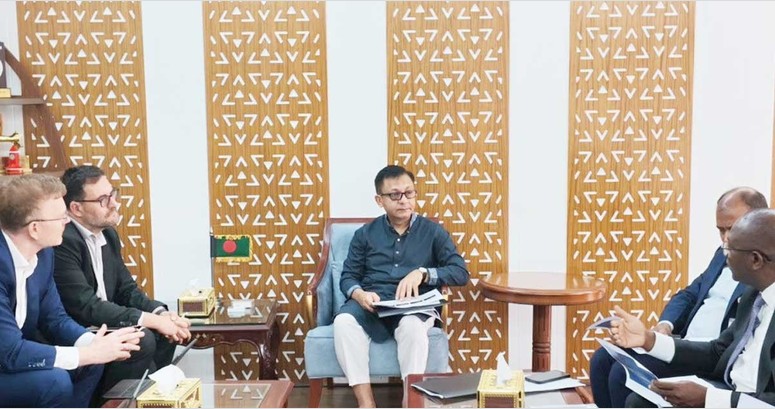
Bangladesh is planning sweeping reforms to cut the time required to obtain key government approvals for businesses from the current 50-55 days or more to just 14 days, seeking policy and technical assistance from the World Bank.
The proposed reforms will focus on digitising public services and strengthening one-stop service facilities to simplify business registration, licensing and investment procedures.
The government is also preparing a comprehensive three-year action plan ahead of Bangladesh's graduation from the Least Developed Country (LDC) category, while seeking to diversify exports beyond the ready-made garment (RMG) sector.
Commerce Minister Khandaker Abdul Muktadir outlined the plans during a meeting with an eight-member World Bank delegation led by Jean Pesme, Division Director for Bangladesh and Bhutan, at the Ministry of Commerce in the Secretariat on Tuesday morning.
The minister said the government was digitising procedures for trade licences, environmental and fire safety clearances, and Import Registration Certificates (IRCs), which currently take 50 to 55 days or longer to obtain.
Through the National Single Window and the one-stop service portal of Invest Bangladesh, the government aims to reduce the processing time to 14 days.
To reduce this dependence, the government is prioritising the development of leather and leather goods, non-leather footwear, shipbuilding and ship recycling, and light engineering industries.
To expand the international market for leather products, the government plans to ensure environmental compliance and improve standards at the Savar Tannery Industrial Estate.
Plans are also underway to establish a new Central Effluent Treatment Plant (CETP) and pursue certification from the Leather Working Group (LWG) to improve the sector's acceptance in international markets.
Discussions are underway on Economic Partnership Agreements (EPAs) with Japan and South Korea, and Free Trade Agreements (FTAs) with the United Arab Emirates, Malaysia, Singapore and the European Union.
The meeting was also informed that Bangladesh had received in-principle approval for joining the Regional Comprehensive Economic Partnership (RCEP), a major regional trade bloc.
He said the World Bank Group and the International Finance Corporation (IFC) were interested in working together to strengthen Bangladesh's private sector and industrial productivity.
Sebastian Eckardt, the World Bank's Regional Practice Director for Prosperity, said the next three to four years would be particularly important for Bangladesh ahead of its LDC graduation.
He stressed that reforms in trade policies, the removal of tariff and non-tariff barriers, and stronger integration into global value chains could significantly boost foreign investment and employment.
Eckardt also expressed the World Bank's interest in providing training and technical assistance to strengthen the negotiating capacity of Bangladeshi officials involved in FTA discussions with different countries.
The proposed reforms will focus on digitising public services and strengthening one-stop service facilities to simplify business registration, licensing and investment procedures.
The government is also preparing a comprehensive three-year action plan ahead of Bangladesh's graduation from the Least Developed Country (LDC) category, while seeking to diversify exports beyond the ready-made garment (RMG) sector.
Commerce Minister Khandaker Abdul Muktadir outlined the plans during a meeting with an eight-member World Bank delegation led by Jean Pesme, Division Director for Bangladesh and Bhutan, at the Ministry of Commerce in the Secretariat on Tuesday morning.
The minister said the government was digitising procedures for trade licences, environmental and fire safety clearances, and Import Registration Certificates (IRCs), which currently take 50 to 55 days or longer to obtain.
Through the National Single Window and the one-stop service portal of Invest Bangladesh, the government aims to reduce the processing time to 14 days.
The initiative is expected to lower business costs, save entrepreneurs' time and improve the country's investment climate.
At the meeting, the commerce minister identified export diversification as a major economic priority, noting that Bangladesh's export earnings have long been heavily dependent on the RMG sector.
To reduce this dependence, the government is prioritising the development of leather and leather goods, non-leather footwear, shipbuilding and ship recycling, and light engineering industries.
To expand the international market for leather products, the government plans to ensure environmental compliance and improve standards at the Savar Tannery Industrial Estate.
Plans are also underway to establish a new Central Effluent Treatment Plant (CETP) and pursue certification from the Leather Working Group (LWG) to improve the sector's acceptance in international markets.
The minister also outlined plans to bring the country's gold industry under a formal institutional framework and develop it into an export-oriented jewellery industry over the coming years.
Bangladesh is also advancing negotiations on trade agreements with several countries to strengthen its access to international markets.
Discussions are underway on Economic Partnership Agreements (EPAs) with Japan and South Korea, and Free Trade Agreements (FTAs) with the United Arab Emirates, Malaysia, Singapore and the European Union.
The meeting was also informed that Bangladesh had received in-principle approval for joining the Regional Comprehensive Economic Partnership (RCEP), a major regional trade bloc.
Other priorities of the Ministry of Commerce include eliminating duplication and coordination gaps in development projects, improving the skills of project directors and transforming the Bangladesh Foreign Trade Institute into a specialised institution.
Jean Pesme expressed the World Bank's willingness to support Bangladesh in trade facilitation, implementation of the National Single Window, skills development in the leather and light engineering sectors, and research related to FTAs.
He said the World Bank Group and the International Finance Corporation (IFC) were interested in working together to strengthen Bangladesh's private sector and industrial productivity.
Sebastian Eckardt, the World Bank's Regional Practice Director for Prosperity, said the next three to four years would be particularly important for Bangladesh ahead of its LDC graduation.
He stressed that reforms in trade policies, the removal of tariff and non-tariff barriers, and stronger integration into global value chains could significantly boost foreign investment and employment.
Eckardt also expressed the World Bank's interest in providing training and technical assistance to strengthen the negotiating capacity of Bangladeshi officials involved in FTA discussions with different countries.

Loading...
Loading...
Also read







Editor : Iqbal Sobhan Chowdhury
Published by the Editor on behalf of the Observer Ltd. from Globe Printers, 24/A, New Eskaton Road, Ramna, Dhaka.
Editorial, News and Commercial Offices : Aziz Bhaban (2nd floor), 93, Motijheel C/A, Dhaka-1000.
Phone: PABX- 41053001-06; Advertisement: 41053012; 01793317829, 01550707291, 01550707296
E-mail: [email protected], [email protected]. [email protected], [email protected], [email protected], [email protected], Online-email: [email protected]


