



| HEADLINE |

|

Dr. Matin Rahman to receive special honor for contribution to Bengali cinema
Published : Tuesday, 17 November, 2026 at 3:28 PM
Observer Online Report


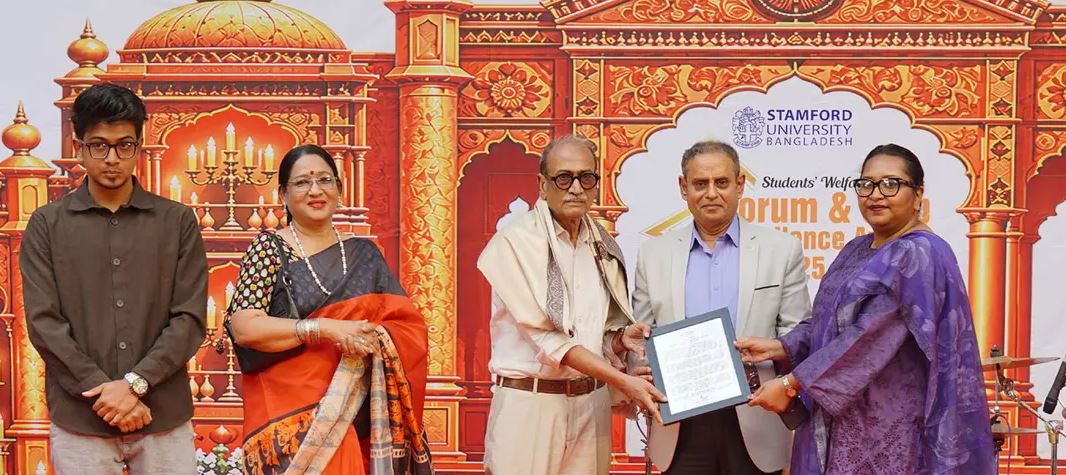
Professor Dr. Matin Rahman, a National Film Award-winning filmmaker and educator, has received a special honor in recognition of his long-standing contributions to Bengali cinema and his significant role in promoting higher education in the field of film studies. He currently serves as the Chairman of the Department of Film and Media Studies at Stamford University Bangladesh.
The honor was presented to him during the ‘Forum and Club Excellence Award 2025’ ceremony, held recently at the university, by Professor Dr. Farahnaz Firoze, Chairperson of the Board of Trustees, and Professor Dr. Md. Sharif Nafe As-Saber, Vice-Chancellor of the university. This recognition acknowledges his decades-long engagement in filmmaking, research, and teaching.
As a filmmaker, alongside establishing a distinct identity in commercial cinema, he has been actively involved in acting, research, and formal film education. His career spans two primary domains: crafting stories for the screen and introducing the next generation, within the classroom, to the language and technical processes of filmmaking.
He was born on March 18, 1952, in the village of Shahpur in the Naogaon district. He is the eldest among seven brothers and two sisters. After growing up in Santahar and completing his undergraduate studies, he moved to Dhaka in 1973 to pursue formal education in cinema. At that time, opportunities for film education in the country were limited. He enrolled at the Dhaka Film Institute, founded by the legendary filmmaker Alamgir Kabir, where he received his foundational training in filmmaking. This training later served as the cornerstone of his professional journey.
He had a deep passion for cinema from a very young age. He was captivated by the way the screen portrayed human joys and sorrows, conflicts, and the realities of life. This initial interest, which began as a viewer, eventually evolved into an aspiration to become a filmmaker. His move to Dhaka to study cinema was a crucial step in transforming his personal passion into professional preparation.
He made his feature film directorial debut in 1982 with *Lal Kajol*. Later on, he directed several other films, including *Ranga Bhabi*, *Andha Bishwash*, *Tomake Chai*, *Biyer Phul*, *Matir Phul*, and *Rang Number*.
His work explores themes such as family, romance, social tensions, the complexities of human relationships, and the struggles of everyday life. A recurring feature in his films is the integration of emotional narratives, which resonate with audiences, with broader social experiences. While his films cover diverse subjects, the dynamics of human relationships remain a central focus; his stories are often driven by family conflicts, emotional crises, or tensions stemming from social standing. A notable aspect of his craft is his ability to present accessible stories to mainstream audiences while effectively translating the inner feelings of his characters into a visual language.
In 1992, Matin Rahman received the National Film Award for Best Director for his work on the film *Andha Bishwash*, a significant milestone in his career as a filmmaker. Through his long-standing engagement with a wide variety of stories and characters, he became a well-known figure in the country’s mainstream film industry.
Beyond directing, he has also been involved in acting. His acting career began with the role of 'Kazi' in the film *Atithi*, directed by Azizur Rahman. He also appeared in *Sneher Bandhon*, a film he directed himself, playing the role of Shabana’s husband. Later, he portrayed a teacher in *Narir Mon*, a doctor in *Bou Shashurir Juddho*, and the father of Purnima’s character in *Rakshushi*.
He also portrayed a villainous character in the film *Leader*, directed by Dilshadul Haque Shimul. Matin Rahman views cinema not merely as entertainment, but as a vital medium for understanding society and culture, a perspective that led him to pursue advanced research. His research on the presence and application of folk elements in Bangladeshi cinema is particularly noteworthy.
The integration of creative practice with academic inquiry has added a new dimension to his career. His scholarly explorations of cinema have centered on local culture and the experiences of ordinary people; through his research on the use of folk elements, he has sought to uncover the profound connection between cinema and society. His practical experience in filmmaking has enriched his research, while the insights gained from his research have, in turn, informed his teaching and discourse on cinema.
On September 17, 2006, he joined the Department of Film and Media at Stamford University Bangladesh as a faculty member. Since then, he has consistently bridged his practical filmmaking experience with theoretical analysis in his teaching. Currently, as the department chair, he plays a key role in overseeing the curriculum, academic instruction, and departmental operations. His extensive experience in production has also provided students with valuable insight into the real-world working environment of the film industry.
For students, learning from an experienced filmmaker holds special significance. It allows for the integration of field-based experience with the theoretical discussions found in textbooks, covering everything from screenwriting and character development to shot planning and the practical challenges encountered during a shoot. Matin Rahman’s approach to teaching highlights this essential synthesis of theory and practice.
Over the past few decades, film technology, exhibition systems, and audience habits have undergone significant transformation. Throughout these changes, a consistent commitment to the study and practice of cinema has served as the unifying thread in Matin Rahman’s work as both a filmmaker and an educator. The special honor recently bestowed upon him by the university recognizes his contributions across both spheres: his creative work in filmmaking and his dedicated involvement in higher education and research.
- NS

Loading...
Loading...
Also read








Editor : Iqbal Sobhan Chowdhury
Published by the Editor on behalf of the Observer Ltd. from Globe Printers, 24/A, New Eskaton Road, Ramna, Dhaka.
Editorial, News and Commercial Offices : Aziz Bhaban (2nd floor), 93, Motijheel C/A, Dhaka-1000.
Phone: PABX- 41053001-06; Advertisement: 41053012; 01793317829, 01550707291, 01550707296
E-mail: [email protected], [email protected]. [email protected], [email protected], [email protected], [email protected], Online-email: [email protected]


