



| HEADLINE |

|

Climate Risk Index 2027: Bangladesh ranks 16th most affected nation
Published : Tuesday, 17 November, 2026 at 10:21 PM
Shahnaj Begum from Antalya, Turkey


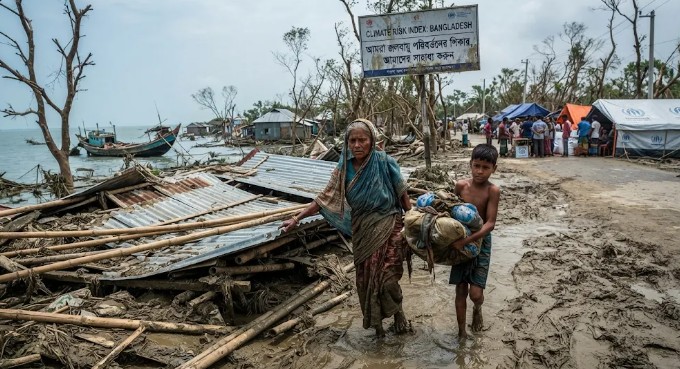
Collected Photo
Bangladesh ranks 16th among the countries most affected by extreme weather events over the past three decades, according to the Climate Risk Index (CRI) 2027 published by Germanwatch, an international organisation working on environment and development.
The country has slipped from 13th position in the previous edition of the index, which assessed the 30-year period, while it ranked 13th in the 2024 index.
The latest report analyses the impacts of extreme weather events in 2025 and over the 30-year period from 1996 to 2025. It was released by Germanwatch at the COP31 climate conference in Antalya, Türkiye, on Tuesday.
The index ranks countries based on six indicators: absolute number of fatalities, fatalities per 100,000 people, absolute number of people affected, affected people per 100,000, absolute economic losses, and economic losses as a percentage of gross domestic product (GDP).
Bangladesh is among seven lower-middle-income countries in the list of the 20 most affected countries over the past three decades. The other six are Haiti, Honduras, India, Myanmar, Nicaragua and Pakistan.
However, the report does not provide a separate breakdown of disaster-related deaths, affected people or economic losses for Bangladesh.
More than 916,000 deaths worldwide
Nearly 10,000 climate-related extreme weather events worldwide between 1996 and 2025 killed more than 916,000 people, affected around 5.5 billion people, including those displaced, and caused direct economic losses exceeding $4.7 trillion, according to the report.
The economic losses are almost equivalent to Germany's current GDP.
Dominica, Myanmar and Honduras were the three most affected countries over the period, followed by Libya, Haiti and Grenada. The Philippines ranked seventh, Nicaragua eighth, the Bahamas ninth and India tenth.
Laura Schäfer, one of the report's authors, said the Bahamas was the only high-income country among the 10 most affected countries over the past 30 years.
The other nine countries at the top of the list had been particularly hard hit by devastating tropical cyclones, often repeatedly, with subsequent storms destroying infrastructure that had already been rebuilt, she said.
The report identifies two broad patterns among the countries most affected by extreme weather. Some, such as Dominica, Myanmar and Honduras, have suffered exceptionally devastating disasters, while others, including the Philippines and India, face recurring extreme weather events.
Vera Künzel, another co-author of the index, said climate change was increasing the risks for countries in both groups.
“Disasters that were once considered exceptional are increasingly becoming continuous threats, creating a new normal,” she said, adding that this made it harder to cope with such events, particularly for countries with limited capacity to adapt and rebuild.
Jamaica, Sri Lanka and Spain worst hit in 2025
A total of 367 extreme weather events were recorded worldwide in 2025, causing nearly 35,000 deaths, affecting more than 100 million people and generating direct economic losses of over $158 billion, the report said.
Jamaica, Sri Lanka and Spain were the most affected countries that year, followed by Thailand, the Philippines and Pakistan.
In 2025, Category 5 Hurricane Melissa killed 62 people in Jamaica and caused economic damage equivalent to almost half of the country's GDP for the year.
Cyclone Ditwah killed 823 people in Sri Lanka and affected more than 1.7 million. The storm caused economic losses of $4.1 billion, triggered landslides and led to the country's worst flood disaster in 20 years.
Spain's experience illustrates how different types of extreme weather can affect a country within a single year. The country experienced what was then its hottest summer, along with a heatwave, three storms and three wildfires. The report notes that 2026 was even hotter in Spain.
Heatwaves cause most deaths
Heatwaves accounted for nearly 70 percent of reported deaths from extreme weather events worldwide in 2025, claiming more than 24,000 lives.
Over the past three decades, heatwaves accounted for 40 percent of all reported fatalities from extreme weather events, the report said.
It also warned that heat-related deaths are substantially underreported, particularly in developing countries, due to weaknesses in data collection and monitoring systems.
Lisa Schultheiß, another co-author of the CRI, said the human cost of inaction on climate change was alarming.
Although the current index does not include the severe heatwaves of 2026, it already confirms that heatwaves have claimed the most lives among extreme weather events over the past 30 years, she said. The number of unreported deaths, particularly in the Global South, remains extremely high.
Poorer countries bear a disproportionate burden
The report highlights the unequal distribution of climate impacts across the world. Although countries across all income groups face extreme weather events, lower-income countries that have contributed relatively little to the global climate crisis continue to bear some of the heaviest consequences.
Limited financial resources and weaker capacity to cope with disasters make developing countries particularly vulnerable, Germanwatch said.
Citing climate science, the report says human-induced climate change is making extreme weather events more frequent and intense, increasing risks to lives, economies and livelihoods.
David Eckstein, another co-author of the index, said climate adaptation was one of the most cost-effective investments in human security and prosperity, including in Europe.
-EM

Loading...
Loading...
Also read








Editor : Iqbal Sobhan Chowdhury
Published by the Editor on behalf of the Observer Ltd. from Globe Printers, 24/A, New Eskaton Road, Ramna, Dhaka.
Editorial, News and Commercial Offices : Aziz Bhaban (2nd floor), 93, Motijheel C/A, Dhaka-1000.
Phone: PABX- 41053001-06; Advertisement: 41053012; 01793317829, 01550707291, 01550707296
E-mail: [email protected], [email protected]. [email protected], [email protected], [email protected], [email protected], Online-email: [email protected]


