



| HEADLINE |

|

Rohingya genocide verdict: ICJ must apply the same justice to Israel
Published : Friday, 20 November, 2026 at 7:02 PM
Aamir Al Hamza


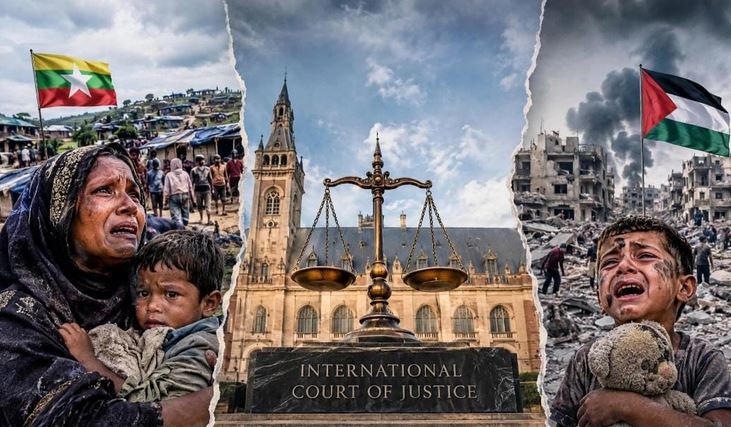
The International Court of Justice’s historic judgment holding Myanmar responsible for genocide against the Rohingya has renewed global attention on the equal application of international law. While the ruling marks a major step towards justice for one of the world's most persecuted communities, it raises another crucial question: will the court apply the same legal standards to Israel over genocide allegations in Gaza?
Decades of discrimination and statelessness
The Rohingya crisis did not begin in 2017. For decades, the Muslim minority in Myanmar's Rakhine State faced systematic discrimination, restrictions on movement, limited access to education and healthcare, and denial of citizenship rights.
A major turning point came with Myanmar's 1982 Citizenship Law, which linked citizenship to officially recognised ethnic groups. The Rohingya were excluded from the 135 recognised national ethnic groups, effectively leaving most of them stateless and without full citizenship rights.
Violence intensified in 2012, forcing thousands from their homes. In August 2017, Myanmar's military launched so-called “clearance operations” in northern Rakhine State following attacks by the Arakan Rohingya Salvation Army on security posts. The operations involved mass killings, rape, torture and the destruction of villages. More than 700,000 Rohingya fled to Bangladesh within months. The ICJ later examined evidence indicating at least 10,000 Rohingya deaths during the 2017 operations.
At present, around 1.2 million Rohingya refugees remain in Bangladesh, particularly in Cox's Bazar, creating a prolonged humanitarian, economic and security challenge for the country. (ICJ judgment; Reuters)
A landmark verdict, but justice remains incomplete
On November 19, 2026, the ICJ ruled by nine votes to six that Myanmar committed genocide against the Rohingya during the 2017 military operations. The court found that Myanmar's security forces committed prohibited acts with the specific intent to destroy a substantial part of the Rohingya population.
The case was brought by The Gambia in November 2019 under the 1948 Genocide Convention, with support from the Organisation of Islamic Cooperation. It marks the first time the ICJ has held a state responsible for committing genocide.
The court also found that Myanmar failed to fulfil its obligations to prevent and punish genocide. It ordered the country to investigate and prosecute those responsible, prevent further violations and provide reparations. The measures also address the safe, voluntary and dignified return of displaced Rohingya, protection from discrimination and persecution, and restitution or compensation for losses. Myanmar must report on restitution and compensation within two years.
However, a legal victory does not guarantee justice on the ground. The Rohingya still need security, citizenship rights, freedom of movement and protection from persecution before meaningful repatriation can take place. Continuing conflict in Rakhine State also raises concerns about whether a safe return is currently possible.
For Bangladesh, the verdict should strengthen international pressure on Myanmar to address the root causes of displacement and create conditions for repatriation rather than leaving Bangladesh to carry the burden indefinitely. (ICJ judgment; UN Secretary-General's statement)
Gaza: A humanitarian catastrophe and genocide findings
Gaza presents another major test for international law. Following the Hamas-led attacks on Israel on October 7, 2023, Israel launched a large-scale military campaign in the Palestinian territory. The war has devastated homes, hospitals, schools and essential infrastructure, while mass displacement and restrictions on humanitarian supplies have created an extreme humanitarian crisis.
According to figures from Gaza's Ministry of Health, 74,702 Palestinians had been reported killed and 176,105 injured by November 16, 2026. The reported death toll included 21,976 children and 12,500 women. These are reported figures from local health authorities, not independently verified counts of every individual casualty. (Gaza casualty data; UN OCHA)
On September 16, 2025, the UN Independent International Commission of Inquiry concluded that Israeli authorities and security forces had committed four of the five acts of genocide defined under the Genocide Convention. These included killing members of the protected group, causing serious bodily or mental harm, deliberately inflicting destructive conditions of life and imposing measures intended to prevent births. The Commission based its findings on military operations, destruction of infrastructure, restrictions on humanitarian assistance and statements by Israeli officials. It concluded that these acts were committed with genocidal intent.
This was a significant finding by a UN-mandated investigative body, but it was not a final judgment by the ICJ. (UN Commission of Inquiry report, September 16, 2025)
The ICJ case against Israel
On December 29, 2023, South Africa filed a case against Israel at the ICJ, alleging violations of the Genocide Convention in Gaza. The court subsequently issued legally binding provisional measures requiring Israel to prevent acts prohibited under the Convention, prevent and punish direct and public incitement to genocide, and facilitate humanitarian assistance. Further orders reinforced the need to protect Palestinians and preserve evidence.
These measures are not a final ruling that Israel has committed genocide. The court must still examine the evidence and determine whether the legal requirements, particularly the specific intent to destroy a protected group in whole or in part, have been established.
Under the ICJ's order of May 21, 2026, South Africa has until November 22, 2027, to submit its reply, while Israel has until May 22, 2029, to file its rejoinder. The final judgment is therefore not imminent. (ICJ case page; ICJ order of May 21, 2026)
US protection and the limits of international pressure
The United States remains Israel's strongest international ally, providing military assistance and diplomatic support. Its position has also limited efforts to secure stronger action through the UN Security Council.
On June 4, 2025, Washington vetoed a Security Council draft resolution calling for an immediate and permanent ceasefire in Gaza, despite the other 14 members voting in favour. The United States argued that the text did not adequately address Israel's security concerns and the release of hostages. The veto prevented the resolution from being adopted. (United Nations, June 4, 2025)
Such decisions have raised questions about the international community's ability to respond collectively. However, political protection at the Security Council should not be confused with control over the ICJ. The court is independent, and its decisions must be based on evidence and international law. No powerful state should be able to determine the outcome of a legal case through diplomatic influence.
The international community must go beyond statements of concern by supporting humanitarian access, respecting binding court orders and using available legal and diplomatic mechanisms to prevent further violations.
One standard for all
The Myanmar judgment demonstrates that a state can be held legally responsible for genocide, regardless of its political influence or military strength. The Rohingya deserve justice, and Palestinians in Gaza deserve the same protection under international law.
The ICJ must independently examine the evidence against Israel and apply the same rigorous legal standards it applied to Myanmar. It must neither prejudge the case nor allow political pressure to undermine its independence.
The credibility of international justice depends on consistency. If accountability is pursued against one country but weakened when a powerful ally is involved, public confidence in the international legal system will suffer.
No country should stand above international law, and no victim should be denied justice because of politics.

Loading...
Loading...
Also read






Editor : Iqbal Sobhan Chowdhury
Published by the Editor on behalf of the Observer Ltd. from Globe Printers, 24/A, New Eskaton Road, Ramna, Dhaka.
Editorial, News and Commercial Offices : Aziz Bhaban (2nd floor), 93, Motijheel C/A, Dhaka-1000.
Phone: PABX- 41053001-06; Advertisement: 41053012; 01793317829, 01550707291, 01550707296
E-mail: [email protected], [email protected]. [email protected], [email protected], [email protected], [email protected], Online-email: [email protected]


