



| HEADLINE |

|
Cover Story
Designed by the Desire of Male Viewers
Women in Bangladeshi mainstream cinema
Published : Thursday, 9 March, 2017 at 12:00 AM
Nazmun Naher Shishir & Ahmed Tahsin Shams


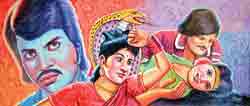 The representation of women in Bangladeshi cinema has changed over the years. But, how far? In Bangladesh, a male dominated country, women in cinema are always shown from male point of view, either submissive, passive, tortured, evil or the epitome of beauty and sacrifice. These are the archetype of their characters --- designed by the desire of male viewers.
 Male dominant economic-social-political-cultural power structure constructs this image of women. This way of looking at women in cinema not only portrays the passive role of women in society but also works as a catalyst to continue the dominant ideology of patriarchal society.
What we see in cinema is the representation of reality, believed by many makers and viewers, or it can also be said --- 'imposed or cast reality'. And according to Stuart Hall's theory of "representation" --- all texts represent a 'constructed reality'. And of course, we, the viewers, perceive the constructed reality as the real.
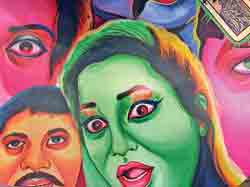
 'Subject of male gaze' and 'to-be-looked-at-ness' of women characters are two focal points of feminist film theory. Laura Mulvey asserts, "In their traditional exhibitionist role, women are simultaneously looked at and displayed, with their appearance coded for strong visual and erotic impact so that they can be said to connote to-be-looked-at-ness, and for that in film women are the bearers of meaning, not the creators of meaning".
In most of the cases, the Bangladeshi mainstream movies give birth of the same type of women. Whether the beloved of the male protagonist, sister, mother, or friend --- most of the time they play the passive role, as the doer is the male protagonist.
Whether the female protagonist is economically solvent or not, she changes her existing perception after meeting her 'hero'. Whether the 'hero' is a member of the upper class or working class, whether decent, or rude, most of the time, it is the heroines who are convinced by the male --- and the love-journey sets off. Male, doesn't matter of which economic class he belongs, is the active doer on which the plot of the cinema depends. And female, to whatever economic class she exists, changes her course of action depending on the male characters.
Let's divide the cinema eras of Bangladesh into five categories: a) Contemporary decade b) Women in the early 21st century cinema c) Women in '90s' films d) Women in '80s' films e) Women in '70s' films
a) Contemporary decade:
The most acclaimed film of 2016 in Bangladesh was Aynabaji, directed by Amitabh Reza where the female protagonist is presented as a graduate of English Literature, yet has no intention to do any job, except spending time with the male protagonist Ayna, and playing with the children of Ayna's drama school.
Furthermore, most of the time it is the ultimate dream of a female protagonist to be the 'wife' of the 'hero', whether the 'hero' is a criminal or a jobless. Other films of 2016 that either makes women as 'sexual object to look at', or 'passive role' compared to men, or women having features as desired by the patriarchal viewers: Krishnopokkho, directed by Meher Afroz Shaon; Angaar, a film by Jaaz Multimedia; Musafir, directed by Ashiqur Rahman; Ostitto, directed by Anonno Mamun; Shikari, a film by Jaaz Multimedia; Samraat: The King Is Here; directed by MM Kamal Raj; Badsha The Don, a film by Jaaz Multimedia; Mental, directed by Shamim Ahamed.
Between 2005 to 2012, films mostly portrayed women as a 'beautiful trophy' which the heroes intend to win. For instance: Koti Takar Kabin, Kotha Dau Shathi Hobe, Mon Jekhane Hridoy Shekhane, Priya Amar Priya, Amar Jaan Amar Praan, Amar Praner Shami, Ek Takar Bou, Valobasar Lal Golap, and Ek Buk Jala.
Women as commodities, or products, to please the two eyes: Male characters in the film, and the male viewers of big screen. Keeping pace with the stream of Bollywood, or South Indian films, item songs in Bangladeshi film industry also got hype in this decade: 'Magic Mamony', 'Mehbooba', 'Pan Jorda', 'Dhakaya Sari', and 'Digital Prem'.
However, films like Agnee or Agnee 2, Action Jesmin, Blackmail, Rakta, attempted a change on the surface level presenting women in lead roles: active doers. Yet, they are expressed as epitomes of sexual attraction in which case male characters hardly happen.
b) Women in the early 21st century cinema:
In 2000 to 2002 most films depict women as mother figures. For instance, Itihas, Premer Tajmohol, Juari, Shoshurbari Jindabad, Moner Majhe Tumi, and Meghla Akash, actors like Mousumi, Shabnur, Purnima, and Popy played the roles to serve others as mother figures, as if only for nursing women are born.
The early 21st century film industry also faced nudity in a broad scale. Actors like Munmun, Poly, Jhumka, Shanu, Moyuri, Shahara exposed their own bodies without any rational demand of the scripts. Such films are: Nishiddho Nari, Mohila Hostel, Seven Murder, Last Border, Meyerao Mastan, Nosta Meye, Daku Fulon, and Avishopto Raat.
c) Women in '90s' films:
From 1994-1997, films like Aguner Poroshmoni, Hangor-Nodee-Grenade, Baghini Konna, Konnadan, Jibon Shongsar, and Palabi Kothay portrayed women as same as now: submissive, passive, serving men, or mother figures.
d) Women in '80s' films:
The early 1980s film industry was not different in case of presenting women. Soki Tumi Kar, Kolmi Lota, Devdas, and Lal Kazol sketched women from men's desires. Most of the films never portrayed women as individual human identity. The mid 1980s' films: Princess Tina Khan, Talak, Ovizan, Rajbari, Noyoner Alo, Dohon, Saheb, Ma o Chele were no different as well in this regard. And the late 1980s' films: Siri Forhad, Fulsojja, Chapa Dangar Bou, Chondidas o Rojokini, Bheja Chok, Stri also presented women as today's.
e) Women in '70s' films:
In the cinemas after war like Jeebon Theke Neya, Ora 11 Jon, Arunodoyer Agniswamkhi, Sangram, Aabar Tora Manush Haw, Alor Michhil, Megher Anek Rong --- women are either the nurse of men, victims of rape, fantasize about the war, or mirror image of the mother country --- innocent.
To complement hero's actions, female characters in Bangladeshi mainstream cinema are present as objects. And always passive, as Laura Mulvey said, "In a world ordered by sexual imbalance, pleasure in looking has been split between active/male and passive/female" which is always reflected in mainstream cinema.
The leading heroine is being devoted towards the male viewers (the most of the viewers of Bangladeshi cinema are men). Heroines are the most influential archetype always revolving around the leading 'hero'.
To conclude, it is not about equal rights of women in films sharing screens, but it is about women not to be portrayed as men's desire, rather as individual human identity. Such representation will pull over our viewers from the patriarchal control.
Loading...
Loading...



Editor : Iqbal Sobhan Chowdhury
Published by the Editor on behalf of the Observer Ltd. from Globe Printers, 24/A, New Eskaton Road, Ramna, Dhaka.
Editorial, News and Commercial Offices : Aziz Bhaban (2nd floor), 93, Motijheel C/A, Dhaka-1000.
Phone: PABX- 41053001-06; Advertisement: 41053012; 01793317829, 01550707291, 01550707296
E-mail: [email protected], [email protected]. [email protected], [email protected], [email protected], [email protected], Online-email: [email protected]
Published by the Editor on behalf of the Observer Ltd. from Globe Printers, 24/A, New Eskaton Road, Ramna, Dhaka.
Editorial, News and Commercial Offices : Aziz Bhaban (2nd floor), 93, Motijheel C/A, Dhaka-1000.
Phone: PABX- 41053001-06; Advertisement: 41053012; 01793317829, 01550707291, 01550707296
E-mail: [email protected], [email protected]. [email protected], [email protected], [email protected], [email protected], Online-email: [email protected]


