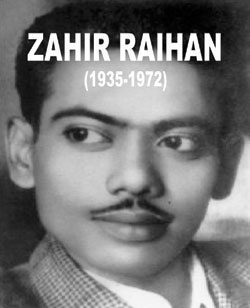
Zahir Raihan is a true genius in Bengali literature. Muhammad Jahirullah was born on 19 August, 1935 in Majupur, Feni. As a member of the banned Communist Party, he was given a pseudo name 'Raihan', which he would ultimately prefer for his writing career. He was one of those first 10 students, who violated the Section 144 on 21 February, 1952, and protested against the repressive decree of the West Pakistani oligarch that Urdu would be the official language of Pakistan. He later portrayed these events into his many works, such as "Topu", a short story, and Arek Falgun, a novel.
He was a novelist, journalist and filmmaker - a luminary with all these identities. A graduate in Bengali literature, he wrote the first collection of stories with the title "Suryagrahan", which was published in 1955. His prolific literary career began and he produced almost a dozen novels: the epic Hajar Bochor Dhore; Borof Gola Nodi, Arek Falgun, Sesh Bikeler Meye, Trishna, Ar Koto Din, Mrittu, and Ekushey February. Class struggle, the plight of peripheral ethnicity and the tyranny of patriarchy were leitmotifs of these works.
In Borof Gola Nodi, he depicted the troubles and predicaments of a Bengali middle class family. The protagonist Mahmud wanted to be an ideal journalist but his dream was soon shattered by the grim reality of oligarchy-controlled state. The editor of his office asked him to distort news for the benefit of big guns and thus he was forced to report "oil as butter and elephant as bunny." Even within his own family, his parents and siblings did not recognize his struggle due to some external influence, so Mahmud started questioning even the foundations of relationships, such as parents to offspring and siblings to siblings. His doubt and struggle revealed the entire class struggle and existential crisis of Bengali middle class family.
The rule of patriarchy and its repercussions among the peripheral ethnicity were clearly drawn in his fiction Hajar Bochor Dhorey. Patriarchy was challenged by an apparently impossible love affair between Montu and Tuni, two central characters of the novel. Myth, superstition and magical belief also played an important role in the life of the characters. But perhaps for the novelist's adherence to realist narrative, we do not see any transcendental behaviour. The central characters failed to transcend their boundary and limitations, and establish their love affair by marriage; rather, they bade farewell to each other. Their life's eddy was small, repetitive, as the title as well as the last line of the novel suggested: "The night progressed; the same old night of thousand years."
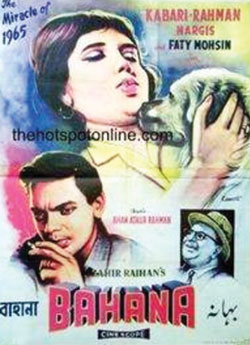
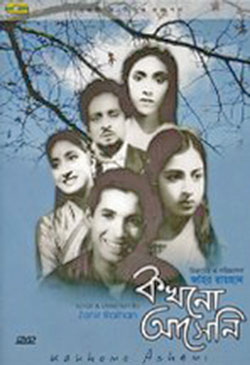
As a filmmaker, Zahir Raihan was very successful. He started his career in film as an assistant with Jago Hua Savera (1950). He ventured into directing films himself with Kokhono Asheni, which was released in 1961. It was him who made the first colour film in Pakistan named Sangam (1964), and in the following year he also directed the first Cinemascope movie, Bahana.
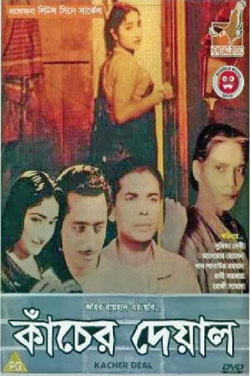
In '60s, Zahir Raihan produced his best films, such as Sonar Kajol (1962), Kancher Deyal (1963), Behula (1966), Anowara (1966), Dui Bhai (1968) and Jibon Theke Neya (1969). The authoritarian shrew in the film Jibon Theke Neya symbolized the political dictatorship of Ayub Khan and the ongoing national movement in the erstwhile East Pakistan. It was a very wise direction of Jahir Raihan to portray the repressive rule of a dictator, as he had to get the release certificate of the Censor Board which was directly controlled by the dictatorial authority. He understood that a revolution should truly start at home, where many repressive incidents occur every day. If there exists mutual understanding and equality in family, only then will people be able to succeed in their revolution against a repressive regime. An active participant in the 1969 Uprising, Zahir Raihan thus sowed the spirit of revolution among people - at home and on street. This movie was highly acclaimed by Satyajit Ray, Tapan Sinha, Mrinal Sen and Ritwik Ghatak.
Perhaps Zahir Raihan is best remembered for his 20 minutes documentary film Stop Genocide, produced in less than a month in Kolkata after the military crackdown of 25 March in 1971. The profound patriotic statements, footage and pictures in the documentary showed the mass killings and atrocities carried out by the Pakistani army on Bangladeshi people. It also depicted refugee plight and Bangladesh government's activities in exile.
Sadly, Zahir Raihan never came back after he went out to look for his brother Shahidullah Kaiser, a celebrated novelist, on 30 January, 1972, shortly after the independence of Bangladesh. We can never know what happened to this great novelist and filmmaker, though it is believed that he and many others were attacked by the Biharis when they went to Mirpur, one of the last strongholds of Pakistani collaborators. Since then, 30th January is observed as the day of his disappearance.





