



| HEADLINE |

|
Tribute
Munier Choudhury, scholar of Bengal
Published : Thursday, 30 November, 2017 at 12:00 AM
Khalid Hasan


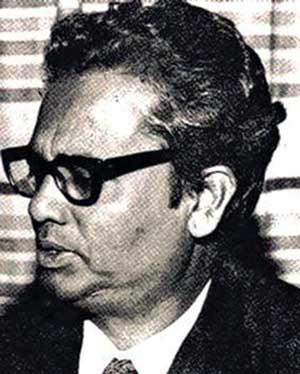
 Munir Choudhury was one of the most discussed and critically acclaimed personalities of then East Pakistan from the partition of 1947 to the 1971 liberation war. In his university life, he was the centre of attention of his teachers and fellow friends for his amazing expression of speech, and power of humorous remarks.
 Not to mention that due to these characteristics, a person does not remain at the centre of a state's discussion. It requires the person's socio-political roles, political activities, and contributions in the transformation of the state. All of these attributes have fully performed to prove his statement wrong "Manush more gele ponche jay" in his own case. He is still alive, sometimes more alive than living, through his strong influence and inspiration on his successor scholars, politicians, teachers and literary personas.
He matriculated from Dhaka Collegiate School in 1941 and completed his ISC from Aligarh Muslim University. Then, he enrolled at University of Dhaka and completed his bachelor's degree with honours in 1946 and master's in 1947. He was a resident student of Salimullah Muslim Hall. Because of his involvement in leftist politics, he was expelled from his residential dorm.
Later, he was imprisoned for two years by the Pakistan government for his active participation in the Language Movement of 1952. While in jail, in 1954, he appeared at the master's examination in Bengali Literature and completed his second MA degree securing first position in the first class. In 1958, he obtained an MA in Linguistics from Harvard University.
During his imprisonment, he wrote famous symbolic drama Kabar, a play in one act that bears strong influence of Irwin Shaw's Bury the Dead (1936). The political prisoners confined for their involvement in the Language Movement performed the play at the jail at the night of 21 February, 1953, as a mechanism of reflexivity that assessed the situation of the crisis of 21 February of 1952 and the human agents involved there in.
 He was associated with cultural movements and fought against any type of cultural repressions during the late 1950s and 1960s. He was the first person to write a letter to the then Pakistan Government protesting the ban on Tagore's song on radio and television in 1967. He also fought against the government's move of replacing the Bengali language alphabet with the Arabic alphabet to undermine the native language of East Pakistan. Moreover, he actively participated in the non-cooperation movement during the early part of 1971.
 Even then, many questions were raised for his activities after the Language Movement especially for his winning the Daud Award, his name in the list of the Pakistan government's foreign tour and his nomination for the title 'Sitara-e-Imtiaz'. However, he renounced Sitara-e-Imtiaz awarded by the Government of Pakistan in 1966.
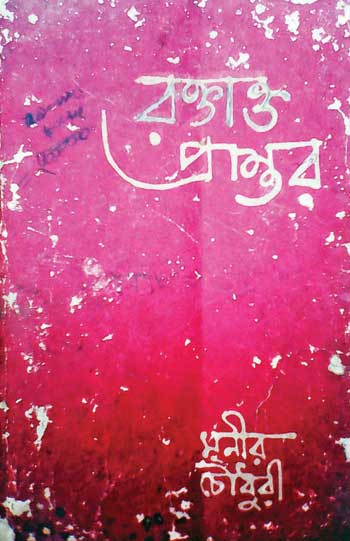
Munir Choudhury had immense enthusiasm for drama and literature. In addition, to the two basic plays in Raktakto Prantor and Chithi, he composed plays like Kabar, Dandakaranya, Palashi Barrack o Anyanyo, etc. First ever Bengali drama telecast on Bangladesh Television Ektala-Dotala was written by him. But, the biggest test for him was Shakespeare's translation where he is unique. Besides writing drama, he has compiled several essays including 'Tulanamulak Samalochana', 'Bangla Gadyariti', 'Ranangan', and 'Mir-Manas'.
He was a great linguist. His article 'The phonemes of Bengali' in collaboration with the world famous linguist Charles Ferguson had stirred the attention of the linguists all over the world. His writings on literature, numerology, and linguistics are the manifestations of his knowledge, intellect, and affection for Bengali language. He wrote a grammar book which is considered as the 'Bible' of Bangla grammar.
Munier Choudhury's colossal contribution is the revision of the Bengali alphabet and the modern type writer. He developed a keyboard which is known as 'Munier Optima' for type writer. Professor Munier Choudhury was an outstanding teacher in the history of Bangladesh. He has achieved the heart of the people of Bangladesh through his veridical dramas, scholarly essays, and heart-warming speeches.
Drama
RaktaktoPrantor, (1962)
Chithi, (1966)
Kabar, (1966)
Dandakaranya, (1966)
Palashi Barrack o Anyanyo, (1969)
Translated Drama
Keu kisubolte pare na, (1969)
RuparKouta, (1969)
Mukhra Ramani Bashikoron, (1970)
Television Drama
Ektala-Dotala, (1965)
Essays
Tulanamulak Samalochana, (1969)
Bangla Gadyariti, (1970)
Ranangan, (1966)
Mir-Manas, (1965)
Others
An Illustrated Brochure on Bengali Typewriter, (1965)
Loading...
Loading...



Editor : Iqbal Sobhan Chowdhury
Published by the Editor on behalf of the Observer Ltd. from Globe Printers, 24/A, New Eskaton Road, Ramna, Dhaka.
Editorial, News and Commercial Offices : Aziz Bhaban (2nd floor), 93, Motijheel C/A, Dhaka-1000.
Phone: PABX- 41053001-06; Advertisement: 41053012; 01793317829, 01550707291, E-mail: [email protected], [email protected] Online: email: [email protected] 41053014; 01550707297 Advertisement: 01550707296
Published by the Editor on behalf of the Observer Ltd. from Globe Printers, 24/A, New Eskaton Road, Ramna, Dhaka.
Editorial, News and Commercial Offices : Aziz Bhaban (2nd floor), 93, Motijheel C/A, Dhaka-1000.
Phone: PABX- 41053001-06; Advertisement: 41053012; 01793317829, 01550707291, E-mail: [email protected], [email protected] Online: email: [email protected] 41053014; 01550707297 Advertisement: 01550707296


