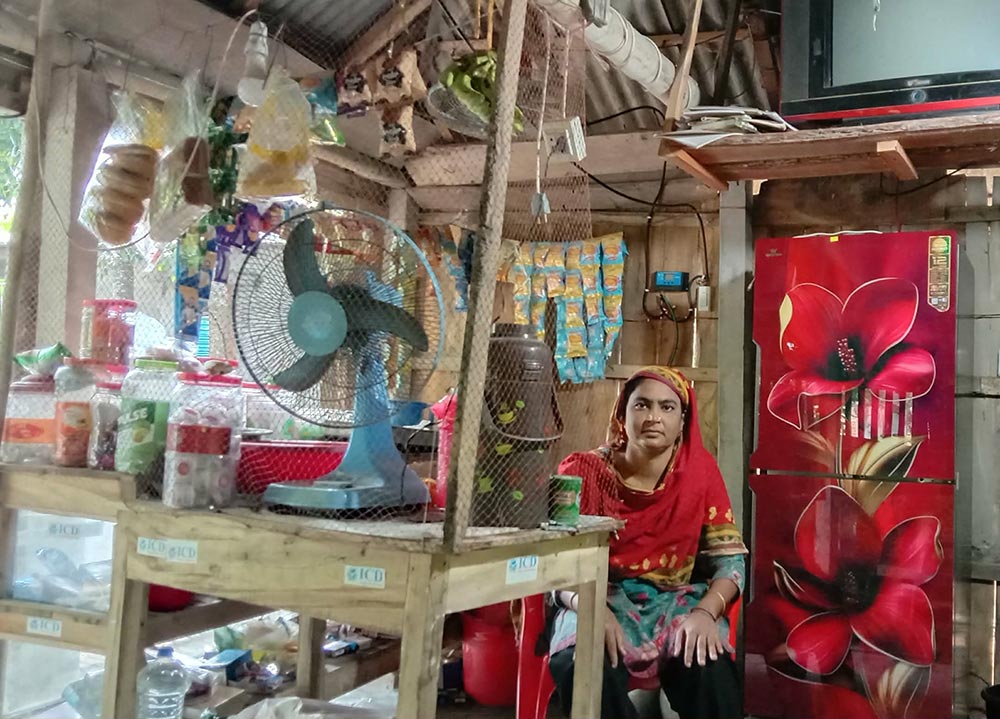
KHULNA, Jan 16: Halima Khatun, 32, a tiger widow, locally known as Bagh Bidhoba, has turned her life around over the last two decades.
Women whose husbands are killed in attacks by the Royal Bengal Tigers in the Sundarban are known as 'Tiger Widows'. They live in villages adjacent to the forest.
These women are considered ill-fated or unlucky. As a result, they are ostracised and forced to make their living through hardship and isolation.
When Halima Khatun was barely 12 years and 3 months old, she was married off to a forest worker, locally known as Bawali, from Koyra in Khulna in 2006.
Just seven months into her marriage, her husband, Alamgir Hossain, was killed in a tiger attack deep inside the Sundarban while he was cutting wood in 2007.
Three months pregnant at the time, Halima found herself widowed before she was even a teenager.
With no shelter in her in-laws' house, she left for Khulna City, hoping to rebuild her life. But fate struck again, a road accident left her badly injured, forcing her to return to her village empty-handed.
Back in Koyra Sadar, Halima rented a tiny room and worked as a domestic helper to feed herself and her daughter, she told The Daily Observer on Thursday in a grieving voice.
But soon after, she was diagnosed with a heart condition and had to give up her job. "It felt like the world had collapsed around me," Halima recalled.
Desperate to stand on her own feet, she knocked on many doors for support, only to be turned away, but she tried in vain.
Halima passed hardship days for around two decades with her little kid, without any shelter, food. She became frustrated and wanted to kill herself.
At one stage, a local voluntary organisation, the Initiative for Coastal Development Foundation (ICD), stepped forward to help her start a small tea stall in Koyra.
Today, Halima is self-reliant and respected in her community. The once "tiger widow" from Maharajpur Village is now seen as a symbol of courage and determination among coastal women.
"People who once pitied me now buy tea from my shop," she said with a smile. "I can eat properly, save a little every day, and live with dignity."
Halima's story has become an inspiration in Koyra, a story of how even after losing everything, a woman from the coast found her way back to hope.
Like Halima, around 740 tiger widows' life stories are intertwined with tigers.
Although the exact figures are unavailable, around 1,155 tiger widows are also found in forest-adjacent areas of Mongla, Morrelganj, and Sharankhola upazilas in Bagerhat, as well as in Dakope Upazila of Khulna and Shyamnagar Upazila in Satkhira under Khulna East and West Division in Sundarban.
The situation of all these bereaved women is equally deplorable.
Like Halima, thousands of women in villages around the Sundarban endure such harsh lives under the label of 'Tiger Widows'.
Local representatives and officials from the government and non-governmental organizations say that the rate of women becoming widows due to tiger attacks has declined in recent years.
However, the plight of those who became tiger widows has not been resolved. Efforts are underway to rehabilitate them through imparting training on sewing and through other means.
The women known as 'tiger widows' say that since the death of their husbands, they have faced an uphill struggle to run their households and thus continuing education to their children.
Most of them are surviving by catching fish fry in rivers and canals, working as day-labourers, or doing jobs in other homes.
Halima Khatun said, "Since my husband's death, I have had to work extremely hard to raise my daughter, sometimes working as domestic help, sometimes working as a day-labourer."
Another tiger widow from Koyra, Zahanara Begum, said, "Twenty years ago, my husband, Md Shajahan Molla, went into fishing in the Sundarban. A tiger attacked and killed him. Since then, I have been fighting a new battle with my three daughters and a son, a battle that continues for one and a half decades."
She added that neither she nor any other tiger widow in her area has ever received a government allowance.
Forest sources said that forest-dependent people can no longer enter the Sundarban as freely.
As a result, deaths of forest workers from tiger attacks have decreased while the rate of new tiger widows has also gone down.
However, some non-governmental organizations (NGOs) and groups have recently stepped forward to help change the fate of tiger widows.
One such organization is the Initiative for Coastal Development (ICD), which recently provided sewing machines and fabric to some 140 tiger widows, after a month-long training programme.
Md Ashikuzzaman, the founder of ICD, said that the idea of helping tiger widows inspired their initiative.
Their activities first began in Koyra, providing sewing training, sewing machines, and tiny shop to widows as part of the project.
Imran Ahmed, Conservator of Forest in Khulna Region, said that strict restrictions are now in place on entering the Sundarban.
"Forest workers cannot enter the jungle easily, so we don't receive as many reports of tiger attacks," he said.
While talking to the Observer, Abdullah Al Baki, UNO of Koyra, said that work is underway to prepare a list of tiger widows.





