



| HEADLINE |

|
Where every sunrise means survival
Over 26,000 fishermen in Sirajganj depend on the Jamuna River; Declining catches and lack of financial support keep families in persistent hardship
Published : Monday, 15 June, 2026 at 12:00 AM
Ashok Benarjee


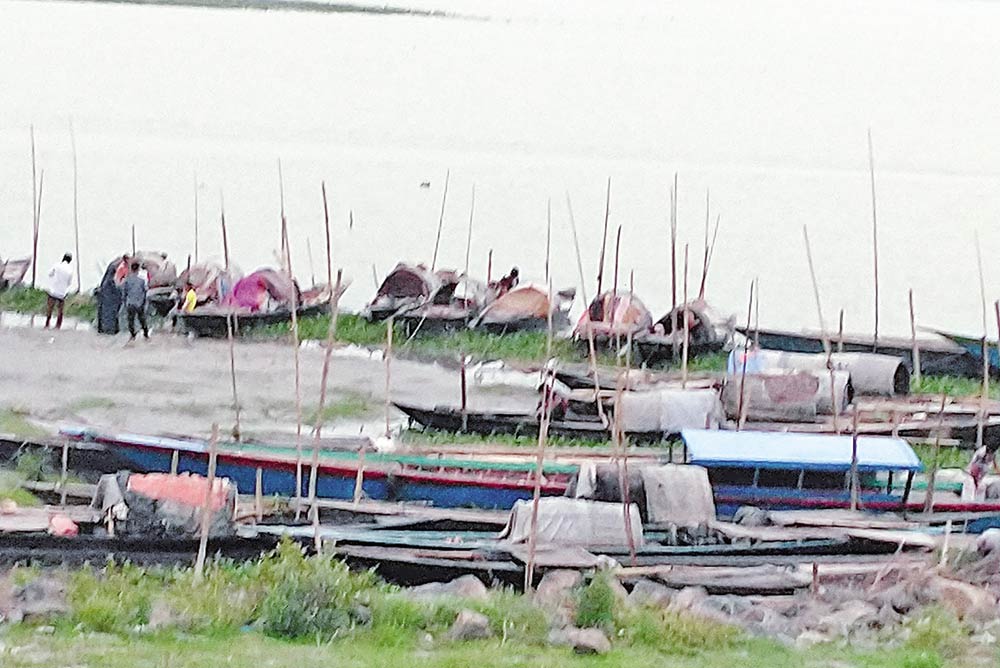 SIRAJGANJ, June 14 : For hundreds of fishing families along the Jamuna River in Sirajganj, the river and their boats remain the only means of survival, as generations continue to depend on fishing despite persistent poverty and hardship.
Sixty-year-old Md Monsher Ali of Chowdhury Para in Sirajganj municipality spends his days repairing fishing nets on his dinghy boat anchored by the Jamuna riverbank. He plans to head into the river at dawn the next day for fishing, as he does almost every day of his life.
Every morning, he sets out to the river before Fajr prayers and returns around 3 to 4pm with his catch. He lives with seven family members and earns around Tk 700 to Tk 800 daily from selling fish. On better days, his income rises to Tk 1,000�"1,200, bringing rare moments of relief. But such days are not guaranteed.
Rain, wind and storms are part of their daily struggle, yet poverty remains unchanged. For many of these families, hardship appears to have become a generational reality passed down like fate.
Monsher Ali is not alone. Hundreds of fishing families in areas such as Kataowabada and Chowdhury Para depend entirely on the Jamuna River and their boats for survival. Fishing boats remain tied along the riverbank in rows, and at dawn, fishermen set out together, returning in the afternoon with their catch to sell either in local markets or directly at the riverside.
Their daily life revolves around the river�"morning, day and night�"leaving little connection with the world beyond. For them, the possibility of financial stability or a better life often feels distant.
They say their struggle intensifies during most parts of the year when fish availability declines, while the monsoon season brings comparatively better catches, making it the most important period for their survival.
However, lack of institutional support, especially access to low-interest loans, has pushed many fishermen into the hands of moneylenders, forcing them to borrow at high interest rates to buy and repair boats and nets. As a result, many fishing families remain trapped in poverty throughout the year.
Suman Chowdhury, 35, of Chowdhury Para said his family of five depends entirely on fishing. “My father and grandfather also lived the same way. We continue the same profession. But due to lack of government loans, we are forced to take money from local lenders at high interest to buy and repair nets and boats. That is why we remain in hardship all year round,” he said.
According to sources, Sirajganj has about 78 kilometres of the Jamuna River flowing through it. The river passes through Kazipur, Sirajganj Sadar, Belkuchi, Chowhali and Shahjadpur upazilas. In addition, around 13 rivers including the Fuljhor, Bangali, Gohala, Baral, Korotoa, Ichamati and Hurasagar flow through the district, most of which are connected to the Jamuna.
The district has 26,873 registered permanent fishermen and around 5,000 seasonal fishermen. These communities depend primarily on rivers for their livelihood.
Sirajganj produces around 71,069 tonnes of fish annually against a demand of 70,536 tonnes, leaving a surplus of 533 tonnes, with fishermen playing a key role in sustaining local supply.
Amol Das, a fisherman from Natunpara Char in Kazipur, said fishing is the only livelihood they know. “We depend entirely on the river. We have no other skills. We survive somehow by fishing, but poverty remains constant and life never improves,” he said.
Khalil Sheikh from Kawakola Char in Sadar Upazila said fish availability has declined compared to earlier years. “Income is not stable anymore, yet we cannot leave this inherited profession. No one seems to care about improving our lives,” he said.
Haji Abdul Sattar, Director of Sirajganj Chamber of Commerce and Industries, said fishermen work hard to meet protein demand but remain deprived of proper development support. He said access to low-interest loans could significantly improve their condition, along with government patronage for fishing communities.
District Fisheries Officer Mahbubur Rahman said fish production drops during dry seasons due to shrinking water bodies, affecting fishermen’s income. He said vulnerable fishermen are being provided with VGF support cards, and lists are being prepared for those yet to receive assistance.
Water Development Board Executive Engineer Md Mokhlesur Rahman said rivers are a blessing and support thousands of livelihoods. He added that monitoring is conducted to ensure fishermen can carry out fishing activities safely and without disruption.
Loading...
Loading...
Also read



Editor : Iqbal Sobhan Chowdhury
Published by the Editor on behalf of the Observer Ltd. from Globe Printers, 24/A, New Eskaton Road, Ramna, Dhaka.
Editorial, News and Commercial Offices : Aziz Bhaban (2nd floor), 93, Motijheel C/A, Dhaka-1000.
Phone: PABX- 41053001-06; Advertisement: 41053012; 01793317829, 01550707291, E-mail: [email protected], [email protected] Online: email: [email protected] 41053014; 01550707297 Advertisement: 01550707296
Published by the Editor on behalf of the Observer Ltd. from Globe Printers, 24/A, New Eskaton Road, Ramna, Dhaka.
Editorial, News and Commercial Offices : Aziz Bhaban (2nd floor), 93, Motijheel C/A, Dhaka-1000.
Phone: PABX- 41053001-06; Advertisement: 41053012; 01793317829, 01550707291, E-mail: [email protected], [email protected] Online: email: [email protected] 41053014; 01550707297 Advertisement: 01550707296


