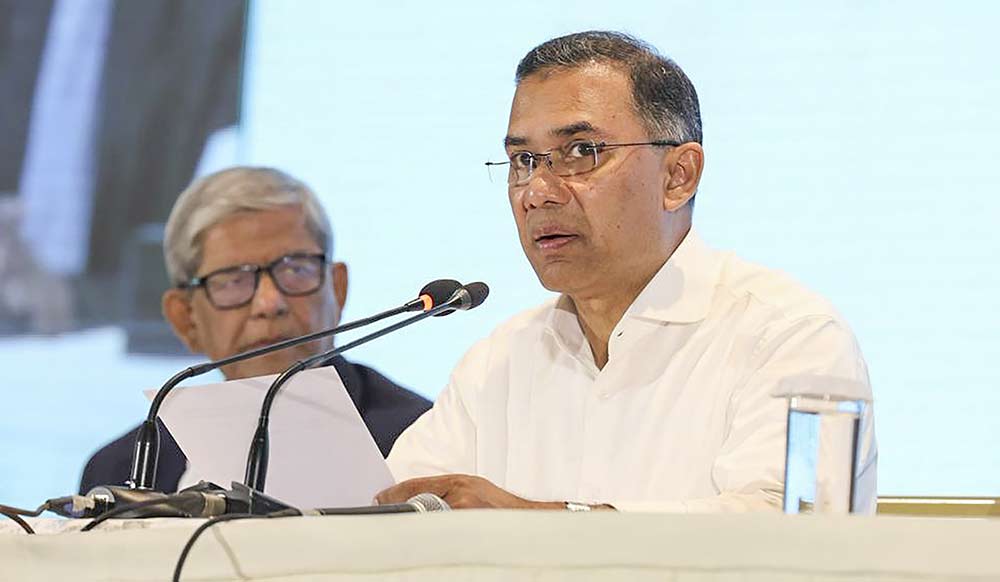
Bangladesh's prime minister-designate, Tarique Rahman, has placed economic revival, law and order, and institutional reform at the top of his agenda following his party's sweeping parliamentary election victory.
In his first public remarks since the polls, Rahman acknowledged the scale of the challenges ahead.
"We have very serious challenges to face … to tackle the economy of the country … and to ensure good governance," he told a media briefing on Saturday noting that his incoming administration will begin its work to fix a fragile economy that's beset by weakened institutions and deteriorating law and order.
"We have to ensure good governance in the country," Rahman said Saturday at his first press conference since his Bangladesh Nationalist Party secured a decisive victory in an election Thursday. "Peace and order must be maintained at any cost. No wrongdoing or unlawful activity will be tolerated."
The Bangladesh Nationalist Party (BNP) secured a decisive two-thirds majority in the 13th National Election, marking its return to power after nearly two decades in opposition. The landslide result, announced on Friday, follows months of political and economic turbulence triggered by the ousting of former Prime Minister Sheikh Hasina in a Gen Z-led uprising in 2024.
Rahman signaled that restoring investor confidence and stimulating private sector growth would be central to his administration's strategy. He pledged to foster a business-friendly climate and prioritise job creation, at a time when Bangladesh is grappling with inflationary pressures, foreign exchange constraints and slowing industrial output.
On foreign policy, the BNP chief described China as a "development friend", expressing hope that bilateral cooperation would deepen in the coming years. Analysts suggest that economic pragmatism will shape Dhaka's external engagement, with infrastructure financing, trade access and investment flows likely to drive stronger ties with Beijing.
The interim administration led by Nobel Peace Prize laureate Muhammad Yunus, which has overseen the country since Hasina's removal, formally congratulated Rahman on Saturday. In a statement, it described the election outcome as a milestone in Bangladesh's democratic transition.
International observers offered measured praise. The U.S.-based International Republican Institute said the vote had been peacefully and competently administered, while cautioning that the broader political environment remains fragile. It urged the incoming government to move swiftly on reforms to consolidate democratic gains and restore public trust in state institutions.
Alongside the parliamentary election, voters endorsed a constitutional referendum introducing a two-term limit for prime ministers, strengthening judicial independence and enhancing women's representation in politics. The reforms drew strong participation, underscoring public appetite for structural change.
With a commanding parliamentary majority, the BNP is widely seen by analysts as having a rare opportunity to restore political stability and implement overdue economic reforms. The Islamist party Jamaat-e-Islami is expected to assume the role of principal opposition.
Rahman, 60, is the son of former Prime Minister Khaleda Zia and former President Ziaur Rahman, the BNP's founder and a key figure in Bangladesh's independence struggle. His immediate challenge will be to translate electoral momentum into credible economic recovery and durable governance reform.





