



| HEADLINE |

|

Cashless Classrooms
Govt orders digital payments in all private schools and colleges
Published : Wednesday, 18 February, 2026 at 12:00 AM
Jibon Islam


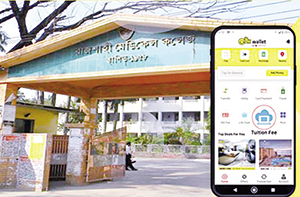 In a sweeping reform aimed at tightening financial discipline across the education sector, the Ministry of Education has made cashless transactions mandatory in all private schools, colleges, madrasas and technical institutions.
The new directive, titled Financial Transparency and Accountability Policy of Private Educational Institutions, 2026, marks one of the most far-reaching governance overhauls in the sector in recent years.
Signed by Rehena Parveen, Secretary of the Secondary and Higher Education Department, on 9 February, the notification will be delivered soon to all schools and colleges across the country, ministry officials said.
From now on, all institutional income - including tuition fees, admission fees and session charges - must be collected exclusively through scheduled banks or the Sonali Payment Gateway (SPG). Once the online gateway becomes operational, direct cash payments will not be accepted under any circumstances, the notification says.
Institutions are required to deposit all collected funds into their designated bank accounts within two working days. The policy also strictly prohibits the imposition or collection of fees under any new head without prior approval from the ministry, it noted.
The move imposes joint responsibility on the head of the institution and the chairman of the managing committee for ensuring compliance.
"In cases of irregularities, stringent penalties have been prescribed, including suspension or cancellation of Monthly Pay Order (MPO) benefits and dissolution of the managing committee", the notification warns.
Education officials say the measure is designed to curb financial opacity, reduce the risk of misappropriation and ensure greater accountability in institutions that receive public support through MPO funding.
The reform comes at a time when Bangladesh is navigating a high-growth transition, with digital financial services expanding rapidly - yet cash remains deeply entrenched in everyday transactions.
According to the latest payment system report from Bangladesh Bank, more than 71 per cent of total monetary transactions in December 2024 were conducted in cash. Of the Tk 19.58 lakh crore transacted during the month, 71.72 per cent occurred through physical currency. More than 45 crore cash transactions were recorded, accounting for 53 per cent of the total transaction volume.
Nevertheless, digital usage is accelerating. Internet banking transactions surged 47.5 per cent year-on-year by August 2025 to reach Tk 1.12 trillion. Credit card spending climbed to Tk 3,524 crore in June 2025, up from Tk 2,653 crore a year earlier.
A recent study by the Policy Research Institute of Bangladesh, supported by the Gates Foundation, noted that while Bangladesh has made notable strides in mobile financial services, QR payments and online banking, the economy remains heavily cash-dependent.
The study identified key obstacles, including limited interoperability among platforms, infrastructure deficiencies, cyber security risks and low levels of digital literacy.
Against this backdrop, the government's decision to enforce a cashless regime in educational institutions represents a decisive push towards formalisation and transparency.
If implemented effectively, analysts say, it could not only strengthen financial governance in schools and colleges but also accelerate Bangladesh's broader transition towards a more accountable and digitally integrated economy.
Loading...
Loading...
Also read



Editor : Iqbal Sobhan Chowdhury
Published by the Editor on behalf of the Observer Ltd. from Globe Printers, 24/A, New Eskaton Road, Ramna, Dhaka.
Editorial, News and Commercial Offices : Aziz Bhaban (2nd floor), 93, Motijheel C/A, Dhaka-1000.
Phone: PABX- 41053001-06; Advertisement: 41053012; 01793317829, 01550707291, E-mail: [email protected], [email protected] Online: email: [email protected] 41053014; 01550707297 Advertisement: 01550707296
Published by the Editor on behalf of the Observer Ltd. from Globe Printers, 24/A, New Eskaton Road, Ramna, Dhaka.
Editorial, News and Commercial Offices : Aziz Bhaban (2nd floor), 93, Motijheel C/A, Dhaka-1000.
Phone: PABX- 41053001-06; Advertisement: 41053012; 01793317829, 01550707291, E-mail: [email protected], [email protected] Online: email: [email protected] 41053014; 01550707297 Advertisement: 01550707296


