



| HEADLINE |

|
Extortion surged 20-50pc under interim govt: DCCI president
Published : Tuesday, 24 February, 2026 at 12:00 AM
Business Correspondent


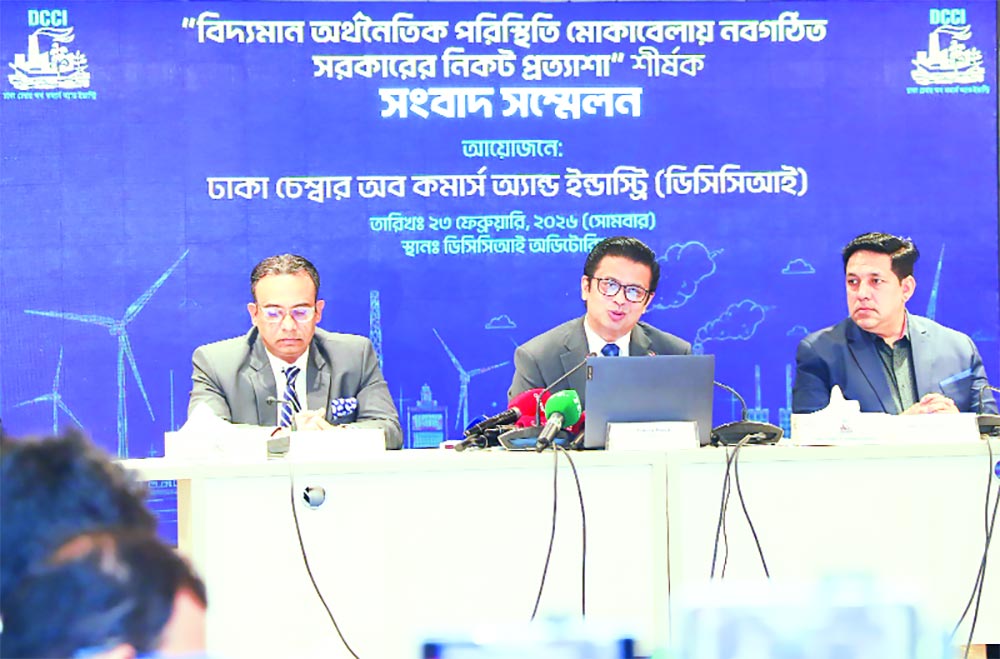 High lending rates, a fragile law and order situation marked by rising extortion, gas supply uncertainty and weak coordination in revenue management are posing serious risks to the economy, leaders of the Dhaka Chamber of Commerce and Industry (DCCI) warned on Monday.
 Extortion in the business sector surged by 20 to 50 percent during the tenure of the previous interim government after the fall of the Awami League government, Dhaka Chamber of Commerce and Industry (DCCI) President Taskeen Ahmed has alleged.
He made the claim during a press conference titled "Expectations of the Newly Formed Government to Deal with the Prevailing Economic Situation", held at the DCCI Auditorium on Monday.
Responding to queries about the extortionists, Taskeen alleged that ruling party members, police, and revenue officials are among the key actors in the extortion business.
"They come and claim to be from the ruling party. Whoever is in power, people show up claiming government affiliation and demand tolls for local events or under other pretexts," he said.
The DCCI chief noted that corruption and extortion have become "embedded in the blood" of the nation.
"If this does not stop, we will be forced to shut down our businesses and leave," he warned.
He added that corruption did not stop for a single day after the political upheaval of August 2024, increasing in some sectors instead.
Taskeen outlined four key priorities to stabilise the economy, the first one being to restore the law and order situation and bring an end to extortion.
DCCI President Taskeen Ahmed also outlined concerns relating to the financial sector, energy security, industrialisation, customs procedures, logistics infrastructure, employment and skills development, LDC graduation and the recently signed trade agreement with the United States.
With the policy rate remaining unchanged, businesses are borrowing at interest rates of 16-17 per cent, he said, at a time when rising defaulted loans and the tightening of loan classification rules-from nine months to three months-have added further strain to the financial sector, creating instability in industry.
Energy shortages have compounded the crisis. Industries and factories are not receiving gas as per demand, while new industries and captive power users face gas price hikes of Tk 40 and Tk 42 per unit respectively. This, he said, has severely disrupted production, undermined the ability to meet domestic demand and export targets, and weakened overall commercial activity.
Ahmed also pointed to the absence of continuity in industrial policy and deteriorating law and order, particularly "intolerable extortion", as factors discouraging both local and foreign investment.
On revenue management, he noted that the lack of full automation is causing harassment for taxpayers while allowing many to remain outside the tax net, depriving the government of much-needed revenue and slowing collection growth.
Rising logistics costs are further squeezing businesses. He cited prolonged land acquisition processes, high land prices, and a reported 41 per cent average increase in service charges by the Chittagong Port Authority, alongside the underutilisation of inland waterways. These factors, he said, are driving up production and distribution costs, fuelling inflation.
Regarding Bangladesh's graduation from Least Developed Country (LDC) status, Ahmed referred to estimates by United Nations Conference on Trade and Development (UNCTAD) suggesting a potential 5.5-7 per cent decline in exports-equivalent to around US$2.7 billion-following transition.
Given global economic uncertainty and domestic challenges, he urged the government to seek a three-year deferment of LDC graduation.
DCCI Senior Vice-President Rajib H Chowdhury, Vice-President Md Salim Solaiman and members of the Board of Directors were also present at the press conference.
Loading...
Loading...
Also read



Editor : Iqbal Sobhan Chowdhury
Published by the Editor on behalf of the Observer Ltd. from Globe Printers, 24/A, New Eskaton Road, Ramna, Dhaka.
Editorial, News and Commercial Offices : Aziz Bhaban (2nd floor), 93, Motijheel C/A, Dhaka-1000.
Phone: PABX- 41053001-06; Advertisement: 41053012; 01793317829, 01550707291, E-mail: [email protected], [email protected] Online: email: [email protected] 41053014; 01550707297 Advertisement: 01550707296
Published by the Editor on behalf of the Observer Ltd. from Globe Printers, 24/A, New Eskaton Road, Ramna, Dhaka.
Editorial, News and Commercial Offices : Aziz Bhaban (2nd floor), 93, Motijheel C/A, Dhaka-1000.
Phone: PABX- 41053001-06; Advertisement: 41053012; 01793317829, 01550707291, E-mail: [email protected], [email protected] Online: email: [email protected] 41053014; 01550707297 Advertisement: 01550707296


