



| HEADLINE |

|

Fuel shortages force daytime power cuts across country
BPDB warns of further outages after Ramadan


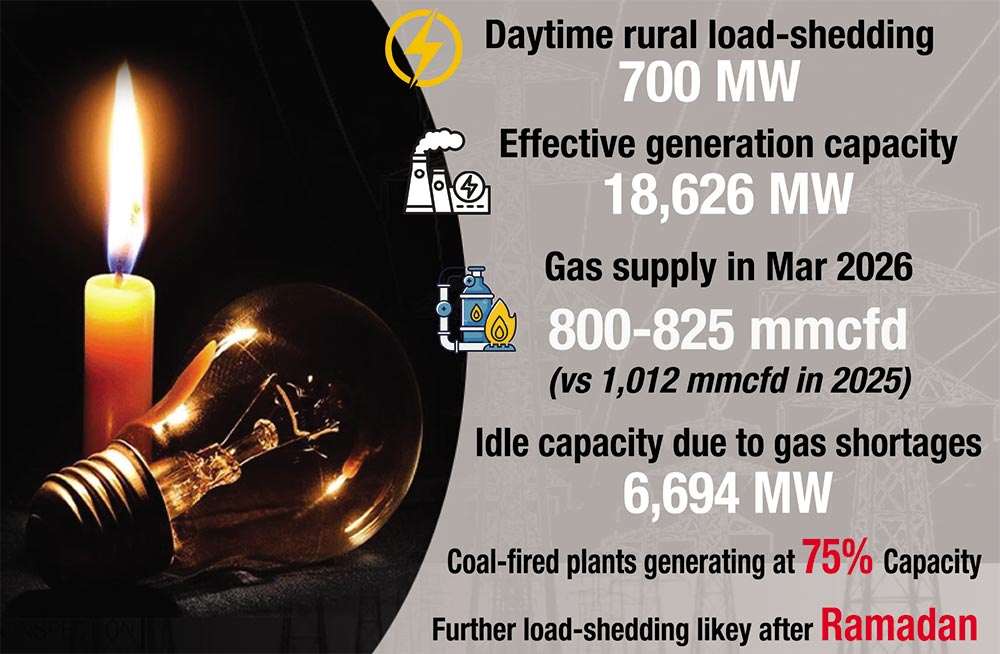 Electricity shortages are affecting Bangladesh, with daytime load-shedding in rural areas reaching around 700 MW, not including peak evening and night demand. Authorities warned that additional outages may occur due to technical faults and ongoing fuel constraints.
"We have received only 800-825 million cubic feet per day of natural gas in March 2026, which allows us to produce a maximum of 4,000-4,500 MW from gas-fired plants," said Rezaul Karim, chairman of the Bangladesh Power Development Board (BPDB). This is down from an average of 1,012 mmcfd in the same period last year.
BPDB records show that the country's power plants cannot operate at full capacity because of gas shortages, while coal supplies are also insufficient to run all coal-fired plants.
Around 6,694 MW of capacity remains idle due to gas shortages, and 1,626 MW is unavailable for routine maintenance. Solar power generation of about 769 MW is unavailable at night, and approximately 768 MW of diesel power is rarely used. These factors reduce effective generation capacity to roughly 18,626 MW.
Current electricity generation stands at 14,565 MW against an installed capacity of 28,494 MW. Gas-fired plants are producing about 4,700 MW from a capacity of 12,472 MW, while coal-fired plants are generating 4,500-4,700 MW against an installed capacity of 6,273 MW. The BPDB had projected 16,500 MW for this period.
The Bangladesh Independent Power Producers' Association (BIPPA) has raised concerns about fuel reserves for 5,641 MW of furnace-oil-fired private power plants. BPDB has requested around 2,000 MW from private producers to meet demand. BIPPA President KM Rezaul Hasanat said roughly 23 percent of private power plants remain idle due to gas shortages, creating a serious challenge for the sector. Former BIPPA president Imran Karim said the government is trying to maximize coal-fired generation to compensate for the natural gas shortfall.
BPDB officials warned that further load-shedding could be introduced after Ramadan if the fuel crisis persists. Authorities are also seeking to reduce production costs and limit subsidies in the power sector.
"Electricity generation from gas-fired plants has dropped to about 4,700 MW, and we cannot run coal-based plants at full capacity due to shortages," a BPDB official said. "We are being forced to impose 200-300 MW of daytime load-shedding due to the fuel crisis."

Loading...
Loading...
Also read



Editor : Iqbal Sobhan Chowdhury
Published by the Editor on behalf of the Observer Ltd. from Globe Printers, 24/A, New Eskaton Road, Ramna, Dhaka.
Editorial, News and Commercial Offices : Aziz Bhaban (2nd floor), 93, Motijheel C/A, Dhaka-1000.
Phone: PABX- 41053001-06; Advertisement: 41053012; 01793317829, 01550707291, E-mail: [email protected], [email protected] Online: email: [email protected] 41053014; 01550707297 Advertisement: 01550707296
Published by the Editor on behalf of the Observer Ltd. from Globe Printers, 24/A, New Eskaton Road, Ramna, Dhaka.
Editorial, News and Commercial Offices : Aziz Bhaban (2nd floor), 93, Motijheel C/A, Dhaka-1000.
Phone: PABX- 41053001-06; Advertisement: 41053012; 01793317829, 01550707291, E-mail: [email protected], [email protected] Online: email: [email protected] 41053014; 01550707297 Advertisement: 01550707296


