



| HEADLINE |

|

106th birth anniversary of Sheikh Mujib observed
Published : Wednesday, 18 March, 2026 at 12:00 AM
Staff Correspondent


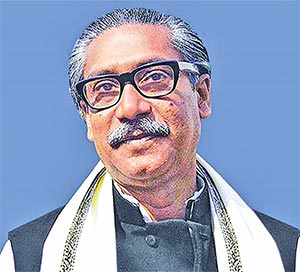 Bangladesh on Tuesday commemorated the 106th birth anniversary of Bangabandhu Sheikh Mujibur Rahman, with tributes, discussion programmes, and reflections on the life and legacy of the architect of the country's independence.
Previously observed nationwide as National Children's Day, the day has been re-designated following political changes after the removal of the Awami League government on August 5, 2024.
Marking the day, food was distributed among the poor and needy by former Chhatra League leaders in Agargaon, Dhaka. Former Chhatra League Joint General Secretary Muhammad Anwar Hossain, present at the event, urged the government to immediately lift the ban on the Awami League, emphasizing the importance of respecting the party that led the country's freedom struggle.
Also, special prayers were offered at Ramna Kali Mandir in the capital.
With the party's political activities suspended, no large public gatherings were held this year, though small-scale events, indoor discussions, and local tributes were organised by party supporters to honour Bangabandhu's contributions.
Born on March 17, 1920, in Tungipara, Gopalganj district, Bangabandhu was the third of six children of Sheikh Lutfur Rahman and Sayera Khatun.
Affectionately called "Khoka" as a child, he grew up witnessing the hardships, inequalities, and exploitation faced by ordinary citizens, which shaped his lifelong commitment to justice, equality, and human dignity. The communal harmony in his village also inspired his enduring ideals of secularism and social coexistence.
Bangabandhu entered politics at a young age, joining anti-colonial movements while studying at Gopalganj Mission School and experiencing his first arrest as a student. Over his lifetime, he spent nearly 14 years in prison and faced death sentences twice, yet remained steadfast in the struggle for Bengali rights.
He played a pivotal role in historic movements including the Language Movement of 1952, the United Front election of 1954 and the Six-Point Programme of 1966. He helped establish the Bangladesh Chhatra League in 1948 and was instrumental in founding the Awami League in 1949, which would later lead the Bengali nationalist movement.
Bangabandhu's leadership reached a historic milestone on March 7, 1971, when he delivered his landmark speech at the then Racecourse Ground, urging the Bengali people to prepare for the struggle for freedom. On March 26, 1971, he declared Bangladesh's independence before being arrested by Pakistani forces, sparking the nine-month Liberation War that culminated in the country's independence in December 1971.
Returning to an independent Bangladesh in January 1972, he embarked on rebuilding the nation. His life was tragically cut short on August 15, 1975, when he and most of his family were assassinated in a coup by some misguided Army officers, marking one of the darkest chapters in the nation's history.
Bangabandhu's legacy endures as a symbol of courage, leadership, and the unwavering struggle for the rights and dignity of the Bengali people.

Loading...
Loading...
Also read



Editor : Iqbal Sobhan Chowdhury
Published by the Editor on behalf of the Observer Ltd. from Globe Printers, 24/A, New Eskaton Road, Ramna, Dhaka.
Editorial, News and Commercial Offices : Aziz Bhaban (2nd floor), 93, Motijheel C/A, Dhaka-1000.
Phone: PABX- 41053001-06; Advertisement: 41053012; 01793317829, 01550707291, E-mail: [email protected], [email protected] Online: email: [email protected] 41053014; 01550707297 Advertisement: 01550707296
Published by the Editor on behalf of the Observer Ltd. from Globe Printers, 24/A, New Eskaton Road, Ramna, Dhaka.
Editorial, News and Commercial Offices : Aziz Bhaban (2nd floor), 93, Motijheel C/A, Dhaka-1000.
Phone: PABX- 41053001-06; Advertisement: 41053012; 01793317829, 01550707291, E-mail: [email protected], [email protected] Online: email: [email protected] 41053014; 01550707297 Advertisement: 01550707296


