BARISHAL, Mar 27: More than five decades after independence, Barishal's Liberation War landmarks remain largely neglected, with little effort to preserve the region's historic role.
Even the Barishal Museum holds no significant artefacts or memorabilia from 1971, leaving a vacuum in collective memory.
When Pakistani forces launched their brutal crackdown in Dhaka on 25 March 1971, district after district fell under occupation. Barishal, however, resisted for a month, finally succumbing on 25 April. During that time, the city became the cradle of organised resistance in the south.
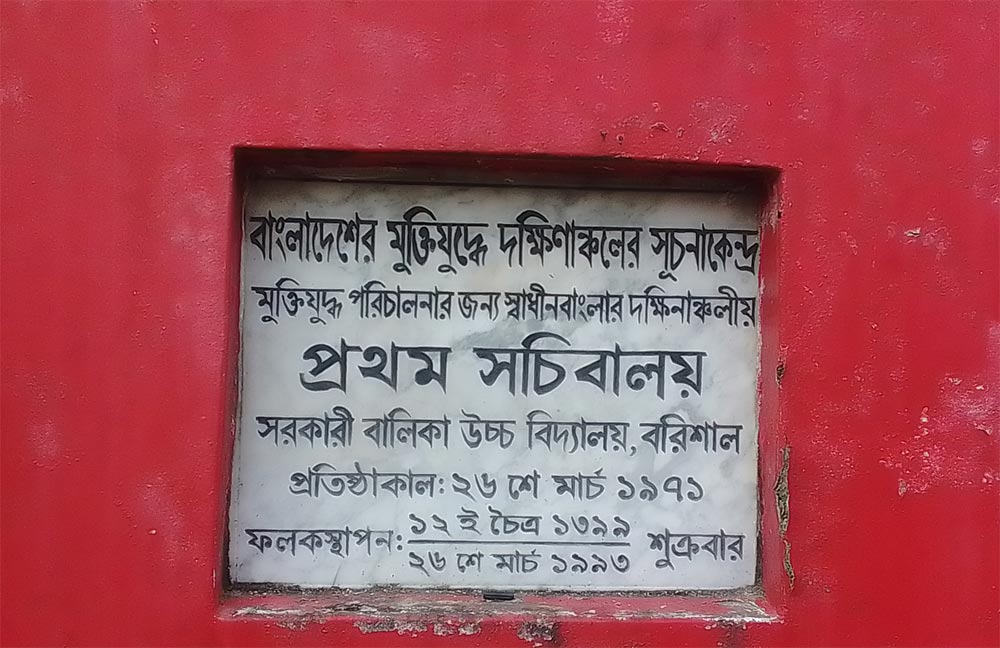
Barishal Government Girls' School housed the 'first secretariat of southern Bangladesh', established even before the Mujibnagar government was formed. Nurul Islam Manzur, then MNA for Barishal Sadar, served as one of its key civilian organisers. The military wing was led by Major Jalil, who set up his office in the 'Chara Banglo' near Bell Park.
From this modest base, Jalil later commanded Sector 9, organising guerrilla fighters across the south and southwest. It was from here that freedom fighters launched a daring raid on Khulna's Gallamari radio station, killing Pakistani guards and seizing weapons.
The secretariat also hosted summary courts. On 17 April 1971, a captured Pakistani collaborator was sentenced to death and executed by firing squad at Barishal Outer Stadium. The following day, Pakistani aircraft bombed the city, killing scores.
A week later, Pakistani forces launched a massive assault by river and air. At Talatli's Junahar, freedom fighters resisted from two steamers, but the gunboats retaliated with indiscriminate bombing. Villagers, from infants to the elderly, were massacred. A memorial plaque listing 47 martyrs still stands in Talatli market, but it lies in disrepair, erected by locals without official preservation.
In 1993, a plaque was installed at Barishal Government Girls' School to mark the first secretariat. The building of Major Jalil's office still stands, but no memorial has been placed there.
In 2003, authorities identified a mass grave at the CSD godown area near the Kirtankhola River and built some structures. Over time, however, the site has been reduced to a hangout spot for youths. Only on 26 March and 16 December does the administration clean the area and organise wreath laying ceremonies.
Nearby, the former torture cell inside the WAPDA colony - once the southern headquarters of the Pakistani army - still bears silent witness, but without proper preservation.
Despite Barishal's central role, the city's museum contains no Liberation War artefacts. There are no photographs of Sector 9 Commander Major Jalil, nor of the organisers who mobilised resistance. Even the Department of Archaeology has yet to establish a divisional office in Barishal.
Asked about the absence, officials at the divisional museum offered no clear answer, only saying the matter might be addressed in future.
Deputy Commissioner Md Khairul Alam Sumon acknowledged the neglect. He said initiatives would be taken to preserve the first secretariat, Major Jalil's office, and other Liberation War landmarks.
For now, however, the city that once symbolised southern resistance remains without a proper archive. Its plaques are fading, its memorials neglected, and its museum empty - leaving the story of Barishal's sacrifice at risk of being forgotten.





