Bangladesh Jamaat-e-Islami secretary general and former MP Mia Golam Parwar has cautioned that imposing unjust decisions on the public in the name of majority power will lead to undesirable consequences while questioning the government’s role in handling electoral and political processes.
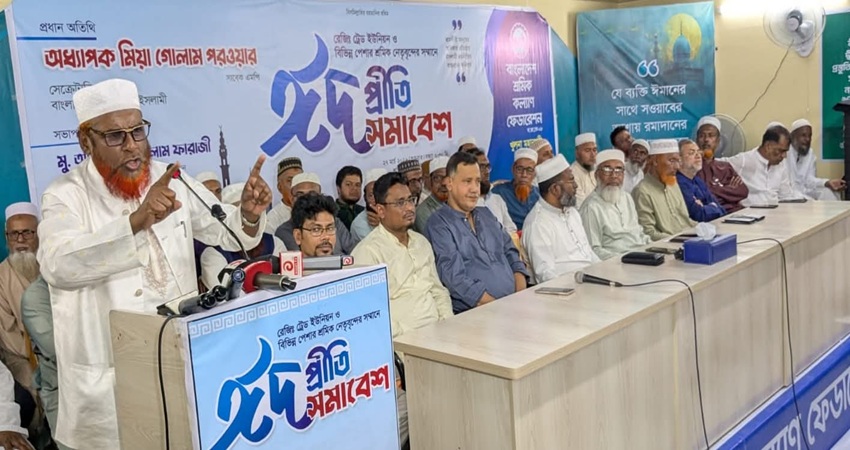
Speaking as the chief guest at an Eid reunion programme organised by the Khulna Metropolitan Workers’ Welfare Federation on Saturday, held at the Workers’ Welfare Trust auditorium in Khalishpur, Parwar criticised the government’s approach to conducting both referendums and parliamentary elections through the same process while labelling one legitimate and the other illegitimate, describing it as contradictory and deceptive.
He alleged that such practices undermine public trust and warned that any attempt by the government to force decisions on the people through majority dominance would not yield positive outcomes.
Referring to historical examples, he said authoritarian regimes that relied on numerical strength to suppress public opinion ultimately failed.
Parwar further stated that resolving the country’s ongoing political deadlock is the sole responsibility of the government. He warned that if the crisis persists, the government must bear the consequences and urged authorities not to push the country toward confrontation or compel citizens to take to the streets again.
Highlighting Jamaat-e-Islami’s political stance, he said the party does not support disorder or violence but remains uncompromising in opposing injustice. Citing religious principles, he added, “We will cooperate in good deeds and strongly resist wrongdoing.”
He also cautioned that the upcoming parliamentary session scheduled for March 29 should remain within constitutional and legal boundaries, warning that any deviation could further deepen the political crisis.
Parwar noted that Jamaat-e-Islami now holds a position in the opposition with a significant number of seats, adding that Dr Shafiqur Rahman is serving as the opposition leader, reflecting a new political reality in the country.
Reiterating his demand, he urged swift implementation of the “July Charter”, claiming it has the backing of millions of people. He warned that failure to formalise it into law could intensify political instability.
Special guest Baboo Krishno Nandi, a leader of the Hindu Mahajot, echoed similar concerns, stating that an 11-party alliance may launch protests if the charter is not implemented. He also expressed concern over recent remarks from India.
Addressing party activists, Nandi emphasised preparedness ahead of the March 29 parliamentary session, stating that members should be ready to act according to instructions from opposition leader Dr Shafiqur Rahman.
He also urged political leaders, including Tarique Rahman, to take immediate steps toward implementing the charter, warning that failure to do so could shift responsibility for any ensuing unrest onto them.
SMS/AM