



| HEADLINE |

|

Cyber Security Act to be amended to curb rumors, misinformation: Home Minister
Published : Monday, 8 June, 2026 at 9:35 PM
Staff Correspondent


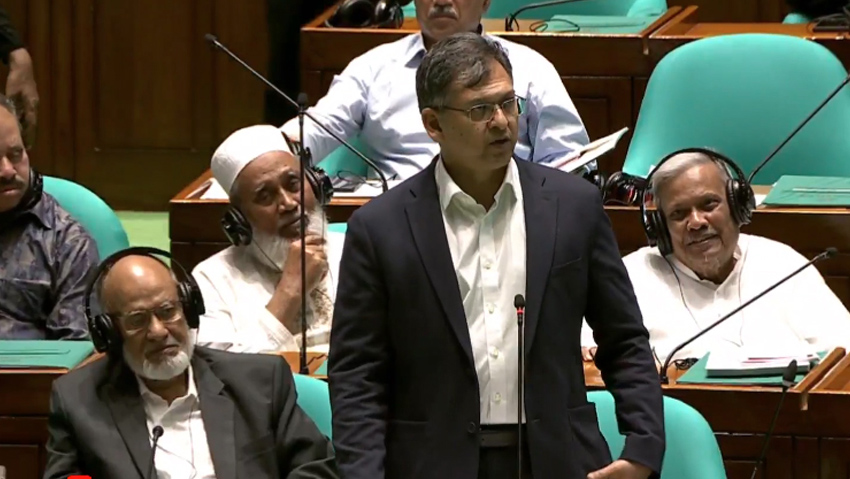
Home Minister Salahuddin Ahmed has said that the government is taking steps to amend the Cyber Security Act to tackle rumors, misinformation, defamatory content, and misleading images, videos, and audio generated using artificial intelligence (AI) on social media.
He also stated that the amended law will include provisions requiring international technology platforms, including Meta, Facebook’s parent company, to remove harmful content within a specified timeframe.
The minister made these remarks on Monday in the National Parliament while responding to a discussion under Rule 71 of the Rules of Procedure following a notice on a matter of urgent public importance raised by reserved-seat Member of Parliament Helen Jerin Khan.
In her statement, Helen Jerin Khan highlighted concerns regarding fake social media accounts, bot networks, AI-generated false content, online harassment of women and children, and smear campaigns against political figures.
She noted that numerous accounts and pages are being operated under false identities on social media platforms, particularly Facebook. According to her, organized bot networks are being used to artificially influence public opinion, while AI-generated fake images, videos, and audio are being utilized to conduct targeted propaganda against individuals, institutions, political parties, and the state.
Responding to the concerns, Home Minister Salahuddin Ahmed said that in recent times various types of content targeting the head of government, his wife and daughter, as well as political figures and the families of prominent members of society, have been circulating on social media.
He added, “It is necessary to redefine whether the content being published on social media in the name of freedom and freedom of expression truly falls within the scope of freedom of expression.”
The minister said the definition of cyberspace is being revised and that social media, virtual media, and related digital platforms will be brought more clearly under the law. He noted that he had already begun working on a draft legal reform proposal on Monday morning, even before knowing that the issue would be raised in Parliament that day.
According to the minister, amendments are being drafted to prevent the spread of rumors and misinformation in cyberspace, as well as the creation and dissemination of misleading, offensive, and defamatory content through AI technologies. He said the revised legislation will be presented as the Cyber Security Act, 2026.
He further stated that rumors, misinformation, and defamatory content will be newly defined under the law, and that fresh punitive provisions will be introduced to deter the publication and dissemination of such material.
In a supplementary question, Helen Jerin Khan asked whether the government would take effective measures to engage with international social media platforms, including Meta. In response, Salahuddin Ahmed said that Bangladesh currently lacks legal provisions that would compel Meta to remove content within a specified period.
He noted that neighboring countries have enacted legal frameworks that require Meta to take action within 24 hours, whereas Bangladesh’s telecommunications and cyber laws do not currently contain such provisions.
The minister explained that although the Bangladesh Telecommunication Regulatory Commission (BTRC) and other authorities may request Meta to remove content, the company often does not respond promptly. “They say that your legal framework is not adequately established. Without a proper legal basis, it is difficult to exert pressure,” he said.
He added that the proposed amendments would include provisions for coordination with international technology platforms, time-bound content removal mechanisms, and more effective and accountable procedures for handling reported content.
The Home Minister also said that, in addition to law enforcement agencies, the Cyber Security Agency, the BTRC, and other authorized bodies would be granted powers to remove, block, or relocate harmful online content.
Turning to gambling laws, he noted that Bangladesh is still relying on legislation dating back to 1867 to address gambling-related offenses. To address modern realities, the government is preparing a new law covering online gambling, offline gambling, and crimes committed through various digital platforms.
“The Gambling Prevention Act is now in its final stage. We hope to place it before Parliament during this session,” he said.
The minister also announced plans to amend the Narcotics Control Act. He noted that officers involved in anti-drug operations often lack adequate weapons, training, laboratory facilities, and dog squads, while drug traffickers are frequently equipped with modern weapons.
To strengthen enforcement capacity, he said, legal proposals would be introduced to transform the Department of Narcotics Control into a fully self-sufficient organization.
JB
The minister made these remarks on Monday in the National Parliament while responding to a discussion under Rule 71 of the Rules of Procedure following a notice on a matter of urgent public importance raised by reserved-seat Member of Parliament Helen Jerin Khan.
In her statement, Helen Jerin Khan highlighted concerns regarding fake social media accounts, bot networks, AI-generated false content, online harassment of women and children, and smear campaigns against political figures.
She noted that numerous accounts and pages are being operated under false identities on social media platforms, particularly Facebook. According to her, organized bot networks are being used to artificially influence public opinion, while AI-generated fake images, videos, and audio are being utilized to conduct targeted propaganda against individuals, institutions, political parties, and the state.
Responding to the concerns, Home Minister Salahuddin Ahmed said that in recent times various types of content targeting the head of government, his wife and daughter, as well as political figures and the families of prominent members of society, have been circulating on social media.
He added, “It is necessary to redefine whether the content being published on social media in the name of freedom and freedom of expression truly falls within the scope of freedom of expression.”
The minister said the definition of cyberspace is being revised and that social media, virtual media, and related digital platforms will be brought more clearly under the law. He noted that he had already begun working on a draft legal reform proposal on Monday morning, even before knowing that the issue would be raised in Parliament that day.
According to the minister, amendments are being drafted to prevent the spread of rumors and misinformation in cyberspace, as well as the creation and dissemination of misleading, offensive, and defamatory content through AI technologies. He said the revised legislation will be presented as the Cyber Security Act, 2026.
He further stated that rumors, misinformation, and defamatory content will be newly defined under the law, and that fresh punitive provisions will be introduced to deter the publication and dissemination of such material.
In a supplementary question, Helen Jerin Khan asked whether the government would take effective measures to engage with international social media platforms, including Meta. In response, Salahuddin Ahmed said that Bangladesh currently lacks legal provisions that would compel Meta to remove content within a specified period.
He noted that neighboring countries have enacted legal frameworks that require Meta to take action within 24 hours, whereas Bangladesh’s telecommunications and cyber laws do not currently contain such provisions.
The minister explained that although the Bangladesh Telecommunication Regulatory Commission (BTRC) and other authorities may request Meta to remove content, the company often does not respond promptly. “They say that your legal framework is not adequately established. Without a proper legal basis, it is difficult to exert pressure,” he said.
He added that the proposed amendments would include provisions for coordination with international technology platforms, time-bound content removal mechanisms, and more effective and accountable procedures for handling reported content.
The Home Minister also said that, in addition to law enforcement agencies, the Cyber Security Agency, the BTRC, and other authorized bodies would be granted powers to remove, block, or relocate harmful online content.
Turning to gambling laws, he noted that Bangladesh is still relying on legislation dating back to 1867 to address gambling-related offenses. To address modern realities, the government is preparing a new law covering online gambling, offline gambling, and crimes committed through various digital platforms.
“The Gambling Prevention Act is now in its final stage. We hope to place it before Parliament during this session,” he said.
The minister also announced plans to amend the Narcotics Control Act. He noted that officers involved in anti-drug operations often lack adequate weapons, training, laboratory facilities, and dog squads, while drug traffickers are frequently equipped with modern weapons.
To strengthen enforcement capacity, he said, legal proposals would be introduced to transform the Department of Narcotics Control into a fully self-sufficient organization.
JB

Loading...
Loading...
Also read







Editor : Iqbal Sobhan Chowdhury
Published by the Editor on behalf of the Observer Ltd. from Globe Printers, 24/A, New Eskaton Road, Ramna, Dhaka.
Editorial, News and Commercial Offices : Aziz Bhaban (2nd floor), 93, Motijheel C/A, Dhaka-1000.
Phone: PABX- 41053001-06; Advertisement: 41053012; 01793317829, 01550707291, E-mail: [email protected], [email protected] Online: email: [email protected] 41053014; 01550707297 Advertisement: 01550707296
Published by the Editor on behalf of the Observer Ltd. from Globe Printers, 24/A, New Eskaton Road, Ramna, Dhaka.
Editorial, News and Commercial Offices : Aziz Bhaban (2nd floor), 93, Motijheel C/A, Dhaka-1000.
Phone: PABX- 41053001-06; Advertisement: 41053012; 01793317829, 01550707291, E-mail: [email protected], [email protected] Online: email: [email protected] 41053014; 01550707297 Advertisement: 01550707296


