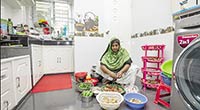
Every day, millions of women across Bangladesh rise before dawn, cook meals, clean homes, care for children and elders, fetch water and fuel, and manage the invisible emotional labour that keeps families and communities functioning. Yet, despite the immense contribution this labour makes to society and the economy, it remains largely invisible, undervalued, and unpaid. Women's domestic and care work, which sustains households and indirectly fuels the formal economy, is rarely acknowledged in economic statistics or public policy. According to the Bangladesh Bureau of Statistics' Time Use Survey 2021, women spend six to seven hours each day on unpaid care and domestic work. Using replacement cost estimates, this is equivalent to BDT 550-650 per day per woman or more than BDT 200,000 annually. When scaled nationally, the total economic value of women's unpaid work is estimated at between BDT 10 and 15 trillion per year, which could equal 70-90 percent of Bangladesh's GDP.
International research supports these findings. The International Labour Organization (ILO) and UN Women note that unpaid care work can account for 10 to over 60 percent of GDP in developing countries, highlighting the disproportionate burden on women and the limits on their participation in formal employment.
Women's unpaid work is not just economic, it is the backbone of family welfare, child development, eldercare, and social cohesion. By performing these tasks, women enable other household members to engage in paid work, indirectly contributing to national productivity. Yet, the workload comes with a high cost, limiting access to education, career opportunities, political participation, and financial independence, locking women into cycles of economic dependency and social invisibility.
The reason this work remains absent from GDP is tied to how economic performance is measured. Conventional accounting captures only market transactions, classifying domestic labour as "non-market production." Beyond measurement difficulties, systemic bias has historically valued formal, male-dominated work while disregarding domestic labour. Policy neglect, social norms, and underuse of time-use data reinforce the invisibility of women's contributions, leaving unpaid labour largely unsupported by government programs or social protection measures.
Around the world, countries have begun to recognize the value of unpaid care work. In South Korea, caregiver allowances are provided for childcare, eldercare, and support for persons with disabilities. Norway credits caregiving periods toward pensions, ensuring retirement security for those who spend years out of the formal workforce. Canada provides caregiver tax credits and provincial allowances, while Germany recognizes child-rearing and eldercare through pension entitlements. Singapore ensures local authorities manage budgets, staffing, and project implementation independently, while Members of Parliament serve only in advisory capacities, supported by strong citizen oversight and digital monitoring. These examples, drawn from international reports by UN Women (Progress of the World's Women 2019-2020) and the ILO (Care Work and Care Jobs for the Future of Decent Work, 2018), demonstrate that unpaid care work can be formally recognized through pensions, stipends, or social protection credits, particularly for long-term caregiving responsibilities.
Bangladesh must take urgent steps to bridge the recognition gap. Integrating unpaid work into national accounts through satellite accounts and Time Use Survey data is a crucial first step, as highlighted in the BBS Time Use Survey 2021. Expanding public childcare and eldercare services would reduce women's domestic workload and enable broader participation in the labour market. Paid parental leave and flexible work policies would formally acknowledge caregiving as productive labour. Public awareness campaigns promoting shared household responsibilities between men and women are also essential to shift social norms. These measures would not only increase women's economic participation but also strengthen family welfare, productivity, and social equity.
Formally valuing women's unpaid labour carries profound implications. It would advance gender equality, enhance the dignity of care work, and bring visibility to women's contributions. It would also allow the government to design fairer budgets, labour policies, and social protection programs, ensuring resources are aligned with the realities of household economies. Recognizing unpaid work is not only a matter of justice-it is an economic necessity. By valuing and supporting this labour, Bangladesh could unlock significant development potential and create a more inclusive economy.
Women's unpaid care and domestic work is the backbone of Bangladeshi households and a silent engine of national development. Yet it remains invisible in policy, undervalued in society, and uncounted in economic planning. Recognition, redistribution, and support for unpaid care work are crucial for gender justice, equitable growth, and sustainable development. Lessons from countries such as South Korea, Germany, Norway, Canada, and Singapore show that compensating and formalizing unpaid work is feasible and beneficial, providing protection for caregivers while strengthening national productivity.
Bangladesh cannot afford to ignore the contributions of its women. The time for action is now. By valuing and supporting unpaid work through policy, social protection, and awareness, Bangladesh can ensure that women are seen not just as caregivers, but as indispensable pillars of the economy and society. Proper recognition of unpaid labour is the first step toward a fairer, more inclusive, and sustainable future.
The moment for a fresh start is here. It is time to make the invisible visible, to measure, value, and empower women's contributions, and to create policies that acknowledge their central role in Bangladesh's progress.
The writer is a contributor





