



| HEADLINE |

|

Battery rickshaws strain power grid, cost billions
Published : Saturday, 11 April, 2026 at 12:00 AM
Staff Correspondent


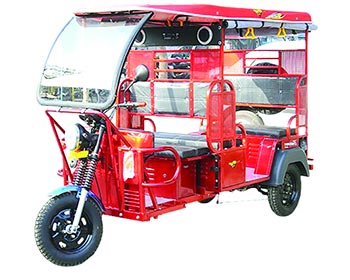 As the ongoing conflict in the Middle East continues to destabilise global energy markets and pressure Bangladesh's economy, a quieter but significant domestic challenge is emerging in the power sector. Battery-powered rickshaws, widely seen as an eco-friendly transport option and a vital source of income for low-income groups, are now placing substantial strain on the national electricity grid.
According to data from the Centre for Policy Dialogue (CPD), around 750 to 800 megawatts (MW) of electricity are consumed daily from the national grid solely to charge these vehicles. This accounts for nearly 4 to 5 per cent of the country's total electricity generation. Experts say a significant portion of this demand is linked to illegal connections and electricity theft, causing an estimated Tk 4,000 crore in annual revenue losses.
Information from the Dhaka Metropolitan Police (DMP) suggests that, alongside authorised facilities, the capital has at least 48,136 illegal charging points and 992 garages. Many of these draw electricity directly from power poles through unauthorised hooking, increasing pressure on the national grid and system losses.
Although 2,201 legal charging stations have been approved under the Dhaka Power Distribution Company Limited (DPDC), unauthorised stations far outnumber them. Areas such as Tejgaon, Mirpur, Wari, Gulshan, Uttara and Motijheel have seen a rapid spread of such facilities, often occupying sidewalks and complicating urban management.
Former Bangladesh University of Engineering and Technology (BUET) professor and energy expert Dr Ijaz Hossain said battery rickshaws account for around 4 to 5 per cent of national electricity consumption. He added that in many rural areas, batteries are charged using domestic connections, inflating household usage while payments remain below commercial tariffs.
He also noted that while official system losses are reported at 1.25 per cent, the actual figure could be closer to 2 per cent due to unauthorised charging activities.
Data from the Bangladesh Jatri Kalyan Samity shows more than six million battery rickshaws operate nationwide, with around two million in Dhaka alone. Each vehicle consumes roughly 6 to 8 kilowatt-hours (kWh) of electricity per day, contributing to heavy cumulative demand.
Despite the challenges, the sector remains a major source of employment for millions. Many operators enter the business through loans due to low entry costs and steady income prospects. Experts caution that an outright ban would be impractical and socially disruptive.
BUET Assistant Professor Kazi Md Saifun Newaz said Dhaka currently enjoys relatively stable electricity supply, but rural and suburban areas still face load shedding. Rising demand from battery rickshaws could further strain future supply.
BUET Professor Dr Md Hadiuzzaman estimated that 500 to 600 MW of electricity is used daily in Dhaka alone for charging, much of it through illegal connections. He warned this leads to significant revenue losses and puts pressure on the national grid.
While battery rickshaws are often considered environmentally friendly due to zero tailpipe emissions, their unregulated growth has created challenges for the power sector, urban planning and road safety. Unlike many countries promoting bicycle- and pedestrian-friendly cities, Bangladesh is seeing rapid and largely unplanned expansion of this transport mode.
Experts have suggested several measures, including registration and licensing, strict action against illegal charging, solar-powered charging stations, regulation of motor imports and the establishment of planned charging infrastructure.
They warn that battery rickshaws have become a "silent crisis" for the power sector. Without coordinated policy action, the strain on electricity supply, revenue collection and urban governance is likely to intensify further.

Loading...
Loading...
Also read



Editor : Iqbal Sobhan Chowdhury
Published by the Editor on behalf of the Observer Ltd. from Globe Printers, 24/A, New Eskaton Road, Ramna, Dhaka.
Editorial, News and Commercial Offices : Aziz Bhaban (2nd floor), 93, Motijheel C/A, Dhaka-1000.
Phone: PABX- 41053001-06; Advertisement: 41053012; 01793317829, 01550707291, E-mail: [email protected], [email protected] Online: email: [email protected] 41053014; 01550707297 Advertisement: 01550707296
Published by the Editor on behalf of the Observer Ltd. from Globe Printers, 24/A, New Eskaton Road, Ramna, Dhaka.
Editorial, News and Commercial Offices : Aziz Bhaban (2nd floor), 93, Motijheel C/A, Dhaka-1000.
Phone: PABX- 41053001-06; Advertisement: 41053012; 01793317829, 01550707291, E-mail: [email protected], [email protected] Online: email: [email protected] 41053014; 01550707297 Advertisement: 01550707296


