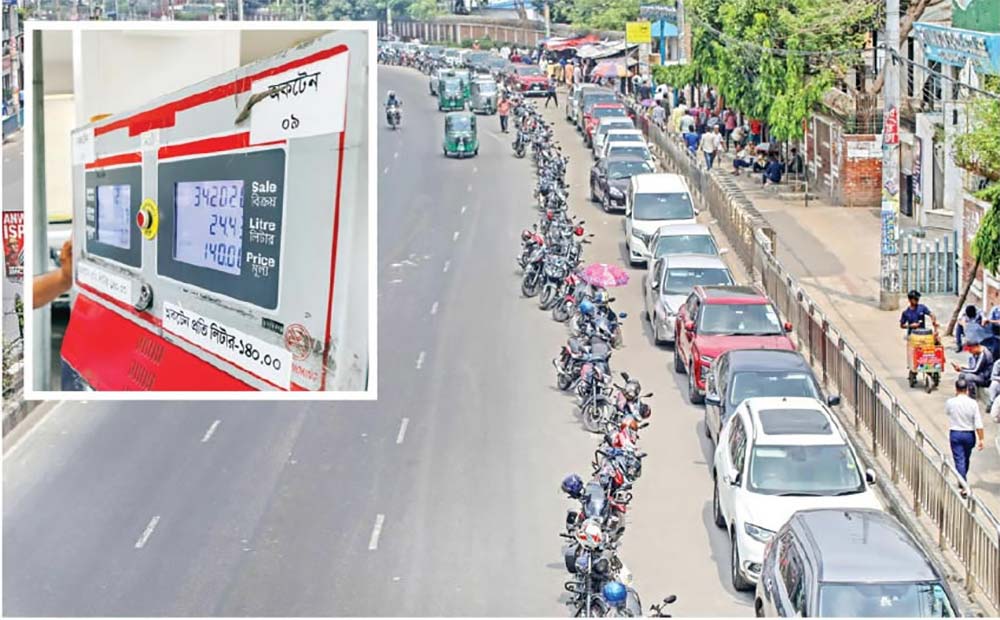
The government's latest fuel price hike is rapidly rippling through Bangladesh's economy, triggering transport disruptions, raising agricultural costs and intensifying pressure on household budgets, with fears mounting of a broader inflation surge in the months ahead.
The increase has begun to affect multiple sectors, including transport, agriculture and daily living costs. While filling stations appeared largely normal on the first day of implementation, public frustration and economic uncertainty have been rising as the wider impact becomes clearer.
Revised fuel prices came into effect immediately after midnight on Saturday, with the Ministry of Power, Energy and Mineral Resources citing global market trends and rising import costs of refined fuel as the basis for the adjustment.
Under the new structure, diesel is priced at Tk 115 per litre, octane at Tk 140, petrol at Tk 135 and kerosene at Tk 130. This marks a significant increase, with diesel rising by Tk 15 - which is 15 percent, petrol by Tk 19 - which is 16.4 percent, octane by Tk 20 - which is 16.6 percent and kerosene by Tk 18 per litre - which is 16.1 percent. On an average, the hike is around 16 percent.
Earlier of November 30, 2025 the government hiked the fuel price by Tk2 per litre.
Given diesel's extensive use in transport, agriculture and shipping, its impact is expected to be particularly widespread.
Officials pointed to rising global prices, supply disruptions and increased dependence on refined fuel imports as key drivers.
However, experts have questioned the timing, noting mixed trends in global crude oil prices. Energy analyst Shamsul Alam argued that with international prices reportedly falling from around $120 to below $90 per barrel, the scale of the domestic increase remains debatable.
He warned that the move could push inflation towards 12 per cent due to rising transport and production costs. The transport sector has been among the first to feel the effects. Bus services in some areas have reportedly been reduced, while informal fare increases have already emerged on several routes, with passengers alleging additional charges of Tk 5 to Tk 10.
Operators, however, say existing fare structures are no longer viable and have called for immediate revisions, warning of further disruptions if adjustments are delayed.
Agriculture is also under strain due to its reliance on diesel-powered irrigation. Farmers estimate irrigation costs could rise by nearly 50 per cent, with stakeholders suggesting an additional Tk 1,500 crore may be required to meet increased expenses. A farmer in Rangpur said irrigation costs could climb from Tk 100 to Tk 150 per hour, making cultivation more difficult.
Former Agriculture Secretary Anwar Faruq warned that higher fuel costs would raise production expenses, particularly for boro rice harvesting, threshing and transport, likely pushing up rice prices. Agricultural economist Jahangir Alam Khan stressed the need to maintain diesel supply for irrigation and suggested targeted subsidies to protect farmers and ensure food security.
Economists and market analysts warn the fuel price hike could trigger a wider inflationary cycle. Rising transport costs are expected to increase prices of essential commodities, including rice, pulses, vegetables, fish and meat.
SM Nazer Hossain, vice-president of the Consumer Association of Bangladesh, cautioned that traders often use such adjustments to raise prices further, warning of hoarding and speculative practices. He said the increase would affect all sectors of daily life and intensify pressure on low- and middle-income households.
Consumers have already begun to feel the strain. Many expressed frustration over rising costs and stagnant incomes, saying the increase would make daily life more difficult. Some have started seeking cheaper alternatives, with reports of rising bicycle sales in cities such as Rangpur, though higher prices are limiting access for lower-income groups.
On the eve of the price hike, long queues formed at fuel stations, with reports of disorder, early closures and police intervention adding to public anxiety.
Economists say fuel price adjustments are common, but stress the need for strong policy coordination. They recommend rationalising public transport fares, strengthening market monitoring, providing targeted support for farmers and vulnerable groups, improving energy efficiency and investing in renewable energy.
Without such measures, analysts warn that inflationary pressure could deepen further, disproportionately affecting lower-income populations.
The fuel price hike has quickly evolved from a fiscal adjustment into a broader socio-economic challenge, with its full impact likely to unfold in the coming months.





