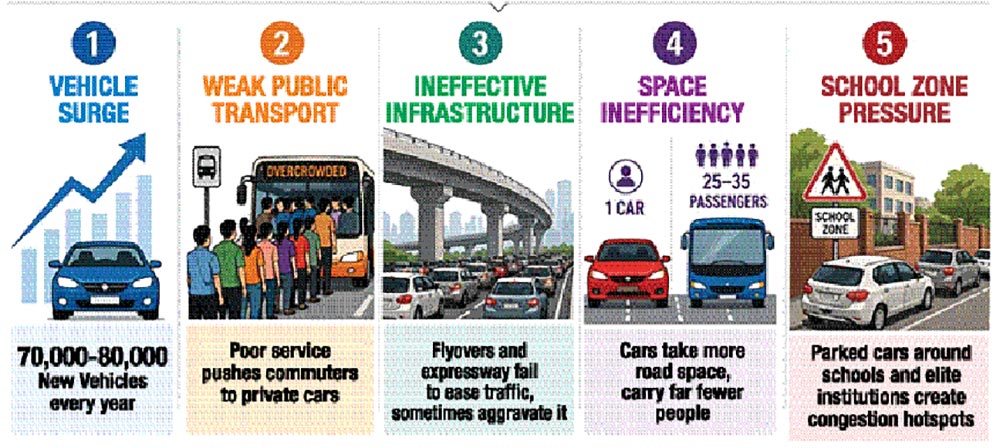
Despite little expansion in the capital's road network, the number of vehicles continues to rise sharply each year, making congestion an entrenched feature of urban life.
Transport sector sources say between 70,000 and 80,000 new vehicles are added to Dhaka's streets annually, with nearly 80 per cent being privately owned. Experts and stakeholders note that while several factors contribute to worsening congestion-such as narrow roads, encroached footpaths, traffic rule violations, unplanned urbanisation and indiscriminate parking-the rapid growth of private cars remains a principal driver.
The absence of a reliable and efficient public transport system is pushing more people towards private vehicles. As a result, both the number of cars and the severity of congestion continue to increase.
Even large-scale infrastructure projects have yielded limited relief. Multiple flyovers have failed to significantly ease congestion, while the partially operational elevated expressway has, in some areas, exacerbated traffic pressure.
Dr Md Hadiuzzaman, transport expert and professor at Bangladesh University of Engineering and Technology, said private cars are the main contributor to urban congestion. "Unless private vehicle use is controlled, infrastructure projects like flyovers or metro rail will not deliver the expected benefits," he said.
People from various professions point out that private cars occupy a substantial share of road space but carry relatively few passengers. In contrast, public transport can carry 25 to 35 passengers within the same space. They stress that regulating private vehicle use is essential for more efficient road utilisation, alongside improvements in public transport and the development of pedestrian- and bicycle-friendly infrastructure.
According to the Bangladesh Road Transport Authority (BRTA), the number of registered private cars in the country now stands at 425,843-nearly double the figure recorded in 2010. Over the same period, the number of motorcycles has surged from 755,000 to 4,734,418, marking more than a sixfold increase. A significant proportion of these vehicles is concentrated in Dhaka.
A recent survey found that 64 per cent of congestion in Dhaka is caused by rickshaws, 29 per cent by private cars, 5 per cent by buses and 2 per cent by three-wheelers. However, experts argue that in terms of road space occupation, private cars have a far greater impact than these figures suggest.
Mozammel Haque Chowdhury, Secretary General of the Bangladesh Jatri Kalyan Samity, said that although the 2013 National Transport Policy prioritised reducing private car use and strengthening public transport, implementation has remained weak. Easy access to bank loans has further fuelled private car ownership. Many people recognise that congestion is worsening, yet feel compelled to purchase private vehicles due to inadequate public transport options.
Traffic conditions are further strained by the concentration of private cars around elite educational institutions in the capital. These vehicles often remain parked on roads for extended periods, disrupting normal traffic flow, said Professor Adil Mohammad Khan of the Urban and Regional Planning Department at Jahangirnagar University.
Beyond economic losses, the impact of congestion is increasingly being felt at a personal level. Mental health experts warn that long hours spent in traffic are contributing to rising stress, frustration and tension within families.
Experts agree that addressing Dhaka's traffic crisis requires coordinated and sustained planning. Without measures to control private vehicle use, improve public transport, ensure adequate footpaths and promote bicycle-friendly urban design, congestion in the capital is likely to worsen further in the coming years.





