



| HEADLINE |

|

Farewell
Published : Saturday, 25 April, 2026 at 12:00 AM
Mahmudul Hasan


 “It’s not the goodbye that hurts, but the flashbacks that follow...” and there are times when the goodbyes hurt, along with the flashbacks, the memories, and the nostalgia. Shafiqur Rahman Sir did not say goodbye. That would have been poetic if he did.Before enrolling in the course “Literary Criticism,” I had no idea what literary criticism�"or criticism of any kind�"really was. I was simply happy to be taking the class with people I liked: Pritvi, Nowrin, and Maisha. It was my seventh semester, and I felt a sense of excitement about learning something that sounded so refined and intellectual.
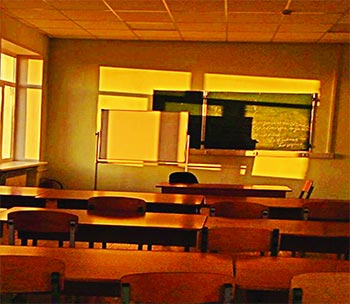
We were sitting in Room 241, chatting and waiting for the Teacher. Room 241 stays in the depth of my heart, for my last undergrad course with Pamela Ma’am was in that room. I had never met him before. An elderly man with a briefcase-like bag entered the room�"tall, handsome, with an ever-youthful mind. He sat down and began discussing a few things I can no longer recall, as I was too busy talking with my friends. Perhaps he was experienced enough to overlook a few inattentive students. His English accent always sounded elegant to me; every pronunciation, every utterance was so smooth that it was soothing to listen to him, regardless of the topic.
The first text we studied was Aristotle’s Poetics. At the time, the topics felt mundane�"ideas about high literature, how poetry and drama should be, Greek philosophy. The day I truly paid attention was when Sir quoted Jibanananda Das: “Temoni dekhechi tare andhokare; bolechhe se, ‘Eto din kothay chhilen?’” (“In the darkness I envisioned her; she asked, ‘Where were you?’”). Then he asked, “Who is the writer?” I almost shouted, “Jibanananda Das!” out of sheer excitement. I knew the poem, remembered every word�"I had lived and loved the poetry and Bonolota and Natore, the Northern area of Bengal, where she lives, where I lost the romance of my life.
Sir looked at me and smiled. He had not expected anyone to answer. It was a smile of pleasure and quiet happiness, as if he had found someone who shared his passion for poetry. He said, “No one has ever wondered that such simple language can be used in poetry�"but Jibanananda Das.” He was lecturing on the language of poetry�"that it should be elevated, organized, rhythmic, rich.
Although I did not particularly enjoy the course content at the time, I found myself enjoying the classes because of Sir�"his humor, his sarcasm, and his witty remarks. In almost every class, he would pick one or two students and ask simple questions like, “What’s your hobby?” or “What’s your favorite food?” Somehow, he would turn even the most ordinary answers into something hilariously memorable.
I passed the course with a decent grade and felt relieved that it was over�"I had mostly been surviving it. Afterward, I met Sir once or twice in the department. One day, while walking with Pamela Ma’am, we saw him approaching from the opposite direction. She stopped to greet him. I mentioned to her that I had taken his course and found him very witty. She replied, “Sir adores me very much; he was the Chairperson of this department.” I had not known that either, and it felt strange to realize how little I had known about him while being his student.
The last time I saw Sir, he was driving his car into the university.
Time passed. I graduated, began my Master’s, and started working. It was during the last Ramadan. I had entered my workplace at 9 AM. I usually do not use my phone during work, but that day the workload was light. I took out my phone, opened social media, and saw the news: Sir was no more.
My heart skipped a few beats. A strange pain took hold of me. The world seemed to turn blue, and the only thought echoing in my mind was that I would never see him again. I told my colleagues that my teacher had passed away. I was searching for someone to share the weight of that sudden grief, but it only grew heavier.
I kept wondering�"why did his death affect me so deeply? I was never close to him; I did not know him well. Yet the sense of loss was overwhelming. I am still searching for the answer.
I did not weep. Tears might have eased the pain, and had I wept, perhaps I would not have written this today.
A man of literature, a scholar of great wisdom, Shafiq Sir taught and enlightened countless students. He fulfilled his duty, shaping minds and nurturing thoughts. Now, he rests in the quiet embrace of the earth. “I suppose in the end the whole of life becomes an act of letting go, but what always hurts the most is not taking a moment to say goodbye.” I agree with the first part of Yann Martel, for I could never bid farewell if I knew that that is going to be the last. I regret not seeing him properly for the last time, I regret not taking a moment to greet him, I regret not standing in front of Sir and say “You have taught me well.” This grief I shall take with me to grave, and burn for eternity.

Loading...
Loading...



Editor : Iqbal Sobhan Chowdhury
Published by the Editor on behalf of the Observer Ltd. from Globe Printers, 24/A, New Eskaton Road, Ramna, Dhaka.
Editorial, News and Commercial Offices : Aziz Bhaban (2nd floor), 93, Motijheel C/A, Dhaka-1000.
Phone: PABX- 41053001-06; Advertisement: 41053012; 01793317829, 01550707291, E-mail: [email protected], [email protected] Online: email: [email protected] 41053014; 01550707297 Advertisement: 01550707296
Published by the Editor on behalf of the Observer Ltd. from Globe Printers, 24/A, New Eskaton Road, Ramna, Dhaka.
Editorial, News and Commercial Offices : Aziz Bhaban (2nd floor), 93, Motijheel C/A, Dhaka-1000.
Phone: PABX- 41053001-06; Advertisement: 41053012; 01793317829, 01550707291, E-mail: [email protected], [email protected] Online: email: [email protected] 41053014; 01550707297 Advertisement: 01550707296


