



| HEADLINE |

|

Selling Mirrors to
The Blind
Published : Saturday, 25 July, 2026 at 12:00 AM
Lekhak Gupta


 Hotel Madison. Room 65. Rahat Mahmud, a Bengali Postcolonial researcher at Sorbonne University, took one final glance at his reflection in the Saint-Gobain mirror, placed beside the south-facing window. He was amused to the heart to see the reflections of what he belonged to. It was Sunday. As there wasn’t much workload, he, along with his two daughters - Mauri and Tania - set out in the afternoon to visit some of Paris’ most celebrated landmarks - the Notre-Dame Cathedral, Saint-Chapelle, and the Île de la Cité.
 Taking a taxi from Mabillon Metro Station, they arrived at the Notre-Dame stop within minutes. As they crossed the Saint-Michel Bridge, both girls glanced simultaneously at their father’s face upon noticing the pizza shop to their right. Rahat Mahmud understood everything, even without hearing a single word from them, as he had been experiencing the same for so many years. Long ago, parental affection had surrendered him to his daughters’ wishes. Life, to their family, had become something of a magical mirror- it granted whatever they desired. His two daughters attended one of the best English-medium schools in Dhaka.
Comfort, Luxury, and abundance had become the common sights of their lives. Despite being an outspoken critic of capitalism, Rahat Mahmud had himself unknowingly fallen into the same box.
When the Piazzas arrived, Rahat Mahmud said, “Mauri and Tania, here you are.”
At that very moment, Rahat Mahmud noticed a blind man seated directly behind Mauri and the little one- Tania was watching him stealthily.
Sensing Mr Rahat’s presence, the blind man greeted him, “Good Afternoon.”
Rahat Mahmud replied to him immediately and perceived that he was not French, as the French, after all, seldom initiate conversation with strangers, and are most comfortable speaking in their own language.
Before Mr Rahat could say anything, the blind man uttered, “Mauri and Tania-two names yet one essence.”
Mr Rahat said, “What did you mean by that?”
-I am the jewel of the blind- Amir Gajuani, a man from the congenital blind community of Dali Koumbe.
Now the two looked at the blind man favourably as he mentioned the name Mauritania once again.
The man was about to leave the seat when Mr Rahat expressed his desire to get acquainted with him. Then he took a new chair to face the inquisitive trio. For the first time, they got a full glance of the blind man without a white cane in hand, except for a black middle-aged woman as an assistant. Probably she might be his better half.
The blind man introduced himself as a professor at a university in Nouakchott. He had come to Paris to attend a seminar on Philosophy at the Sorbonne University and to submit the manuscript of his seventh book, “The Noble Mission of the White in Africa”, to a French Publishing Company. The two daughters stared at him in astonishment.
“I finished my tasks yesterday,” he continued. “The next morning, I will return home.” Supporting the jaws with one hand and being unable to restrain herself, the little one, Tania, asked thoughtfully,
-But you are blind. So, how will you manage to get home?
Mr Gajuani remained silent.
Mouri, almost in a threatening tone, retorted to Tania, “The same way he came here. Now, be quiet.”
By that time, Rahat Mahmud had broken his silence and, with a smile, told Mr Gajuani, “Nice to meet you.”
Mr Gajuani nodded in acknowledgement and enquired about their residence there in Paris.
-At Hotel Madison. 143 Saint Germain.
-Oh, I see. You must have heard Albert Camus finished his renowned novel ‘The Stranger’ sitting in this luxurious room back in the 1940s.
Rahat couldn’t spell out anything in his utter surprise; rather, he slipped down to a different but astonishing topic, “What an extraordinary coincidence- that the name of your country echoes the names of my daughters! Please, tell me something special and remarkable about your country and community for showcasing our meeting alive forever, at least in the young minds of my daughters.”
In the meantime, Tania poked her elder, Mauri, and murmured, “Aren’t we going to Notre-Dame?”
Mauri zipped up the lips of Tania, as a samosa maker swiftly seals the open edge of a samosa, keeping all the ingredients inside it.
Mr Gajuani kept silent for a while, and then he began,
-Let me tell you the story I once heard from my grandpa, Mahmud Gajuani, the then Head of the Dali Koumbe village. On the eve of the 20th Century, when Mauritania became a colony, like other parts of the country, some businessmen started to come to Dali Koumbe. But none stayed even for a single day except one, Ferdinand Nicholas, a member of a French company. He came, it was said, with a noble mission: to sell mirrors to the land of the blind. He went from house to house proclaiming that a mirror allows one to behold one’s own face. “What meaning does life hold,” he would say, “if a human being is born yet never sees himself?”
-Did they purchase any? Mouri asked.
Mr Gajuani reminded, “In H. G. Wells’ ‘The Country of the Blind’, Nunez entered the land of the blind believing he would become their king. In the end, he fled the country to save his eyes.”
A faint suspicion crossed Rahat Mahmud’s mind. “Who is this man, really?”
Words poured out of him like fireworks. On a pale yellowish afternoon, carrying a satchel across the scorching red sands of the desert. Standing in the midst of the village, the mirror-man looked over very closely. It seemed to him that he had stumbled into the southern reaches of the Richat Structure- the eye of the Sahara. The houses were laid out in much the same fashion, even though neither the villagers nor their ancestors had seen the structure in their lifetime. Whatever the matter was was not the business of the mirror-man. His prime concern over there was to do business, make profit, and achieve, more significantly, power.
At first, he met Aref Matuani, a handsome blind Hafiz of 12. The mirror-man provoked him by saying of his beauty, vigorous look, and stern appearance like Tithonus. However, he deserved a mirror from him to figure out those beauties. In the meantime, the youths surrounded the mirror-man. One or two tried ineffectively to see the reflections of their faces in the mirror. But they saw nothing; nor were they supposed to. So they didn’t pay heed to the mirror-man and bought none. The mirror-man took shelter in a derelict house close to an old well. At night, he satisfied his hunger with the last leftovers and water from that well. The next morning, he appeared to the olders with new ways and means. He thought that if the old agreed to buy mirrors, the young would subsequently follow them.
The mirror-man, at first, went to my grandpa’s home; Mr Gajuani never stopped since then. My grandpa, Mr Mahmud Gajuani, the village leader, wasn’t home then. My grandma, the mother of six, was busy with her household chores. The mirror-man tried to uphold the importance of the mirror to my grandma. Now she said,
- Those who tried yesterday to see themselves in the mirror saw nothing. Why should they buy a mirror then?
- What faith can attain, endless argument keeps beyond reach, said the man.
- That’s why you are here, leaving your own country. My granny murmured.
He was at a loss to reply instantly. However, he should not lose hope, and that’s why he reassured her that men would regain their sight by seeing the mirrors. My granny smiled and paid for a mirror in silence. At that, the mirror-man seemed to get a certificate for selling mirrors by means of delivering a speech only. He spread that news among the villagers. As a result, the sales suddenly saw a rise in numbers. The grown-up youth started to pass their time before the mirror. Those who bought mirrors had their daily work undone. Some couldn’t help rebuking the mirror-man. But he must not lose to him. He had to receive some; then he could cast plenty. That was the common thought of the Nobleman from Europe. So he kept as silent as a statue.
From a long distance, noticing my grandpa heading home, they returned to their respective houses. But the mirror-man wished to take the next step- probably the last one. If he somehow managed to agree with that old leader, all his mirrors would be sold to the blind. The head, Mahmud Gajuani, called on Ferdinand Nicolas to his home. My grandpa guided the mirror-man to his home, reversing the universal fact: A blind showing the path to the eyed and the eyed following the blind!
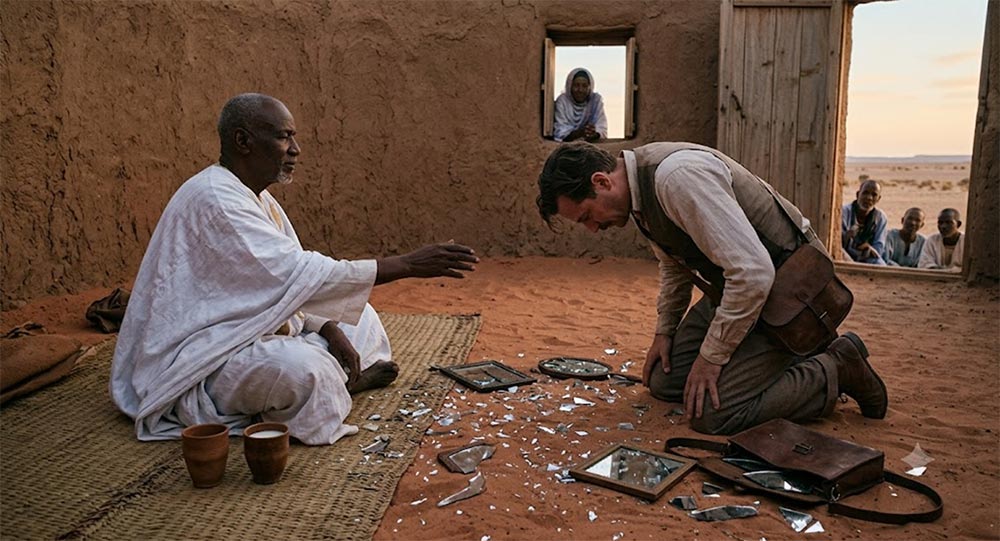
Sensing the presence of my grandpa, my granny brought and rolled out a mat made of date leaves and brought two earthen cups of hot camel milk. The mirror-man took a close look at the structure, both interior and exterior decoration of the house, while sipping on the cup. A cylindrical mud wall, two doors, and windows facing opposite each other were all that belonged to the house. What was lacking there was a mirror, indeed.
After sipping the last drop of milk, the mirror-man told my grandpa,
-I have brought these mirrors from Europe- exactly from that distant Paris. If a man takes a glance at the mirror, now he won’t walk in the same way, and may regain his eyesight.
-Oh, I see, nodded my grandpa
This little word inspired the mirror-man a lot. Meanwhile, people started gathering in front of the Head’s house. Today, their leader would decide whether they would purchase the mirror or not.
The mirror-man continued, men wouldn’t know how beautiful they are if there weren’t any mirrors. The use of mirrors isn’t merely limited to watching one’s face; rather, they reflect the whole society and civilisations. Interrupting him, Grandpa asked,
-Can you see your own reflection in the Mirror?
-Yes, indeed.
-That’s a dare lie.
The presence there started chattering. Then the mirror-man, clearing his throat, uttered firmly,
- There it is. I can still see it.
Now Mr Mahmud Gajuani stepped down to the yard, and the presence went for pin-point silence. He said, “No one in the world, even if he is eyed, can see his real face in mirrors. Even the ancient people couldn’t see their real reflections on still water.”
The mirror-man got astonished.
Mahmud Gajuani added, “When someone looks in the mirror, he sees his right hand as left hand, right eye as left eye, and vice versa. It happens for all human beings irrespective of being blind and eyed. What is placed before the mirror, the reflection follows it: Wealth to wealth, poverty to poverty. It will never reflect the lootings, rules, and oppressions happening in Africa. I knew that your pocket was dying soon. Hence, I kept two coins in my house to provide for you and not to purchase any mirror. Moreover, we don’t need a mirror either. We lead our lives sensing smell, footsteps, as well as hearing and touching.
Furthermore, beauty lies in the mind, not in the body or face. And that mind can never be seen. Man never sees God. But no one says He isn’t beautiful. Actually, blind and eyed- all are equal to God. To see Him, we need to shut our eyes and look inside.
Listening to those last words, it seemed to Ferdinand that something was crushing inside him. He bowed down to Mahmud Gajuani, who was literally a blind man but an enlightened one in a broader sense. From that very moment, Ferdinand realised that he himself was a blind man till today and had just got sight in a real sense. Another thing happened within the twinkling of an eye. When he bent over my grandpa, his bag fell on the ground, resulting in all the mirrors breaking into innumerable pieces. Likewise, the mirror crashing his long-held belief, pride, and one-dimensional concept of civilisation crashed into pieces.
A few months after his leaving the village, Mauritania achieved independence from France. Then the scenario changed rapidly. My father settled permanently in Nouakchott, where I came of age.
At the mention of Mauritania once again, Mr Rahat’s two daughters - Mauri and Tania stirred and perked up. Yet Mr Rahat remained mute and motionless. By now, perhaps, Mr Rahat’s own mirror is no longer unbroken. The afternoon drew on. The Seine flew on in silence.
Loading...
Loading...



Editor : Iqbal Sobhan Chowdhury
Published by the Editor on behalf of the Observer Ltd. from Globe Printers, 24/A, New Eskaton Road, Ramna, Dhaka.
Editorial, News and Commercial Offices : Aziz Bhaban (2nd floor), 93, Motijheel C/A, Dhaka-1000.
Phone: PABX- 41053001-06; Advertisement: 41053012; 01793317829, 01550707291, E-mail: [email protected], [email protected] Online: email: [email protected] 41053014; 01550707297 Advertisement: 01550707296
Published by the Editor on behalf of the Observer Ltd. from Globe Printers, 24/A, New Eskaton Road, Ramna, Dhaka.
Editorial, News and Commercial Offices : Aziz Bhaban (2nd floor), 93, Motijheel C/A, Dhaka-1000.
Phone: PABX- 41053001-06; Advertisement: 41053012; 01793317829, 01550707291, E-mail: [email protected], [email protected] Online: email: [email protected] 41053014; 01550707297 Advertisement: 01550707296


