



| HEADLINE |

|

Rooppur enters final phase with fuel loading tomorrow


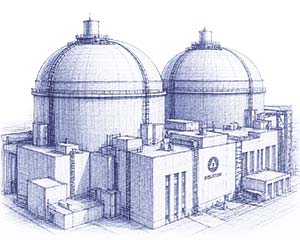 Bangladesh's flagship Rooppur Nuclear Power Plant is set to move into power generation phase as fuel loading for Unit-1 begins on April 28, marking a key milestone in the country's first nuclear energy project.
Minister of Posts, Telecommunications and Information Technology Faqir Mahbub Anam will inaugurate the fuel loading in Bangladesh, while Russian state-owned nuclear agency ROSATOM, a senior official of the International Atomic Energy Agency (IAEA), and representatives of the Russian government are expected to attend the event-a critical stage before commissioning the dream plant, which will mark Bangladesh's entry into the "Nuclear Club."
"The initial electricity generation from Unit-1 could begin within three months of the process starting, by late July or early August to October. Once operational, the plant is expected to ease chronic electricity shortages and reduce Bangladesh's reliance on costly imported liquid fuels," an official said.
Around 300MW is expected to be generated in the early stages, with full output to follow gradually by January 2027, he added.
Earlier, the Bangladesh Atomic Energy Regulatory Authority granted commissioning licences and personnel authorisations for Unit-1.
Plant Will Not Immediately Reach Full Capacity
Officials of Nuclear Power Plant Company Bangladesh Limited (NPCBL) said the fuel loading process would take around one month, followed by reactor startup and water heating phases, expected to require another month to complete. After that, trial operations will begin in phases, during which partial electricity generation may be supplied to the national grid for the first time.
According to the operational plan, electricity output will be increased gradually-first to 10 per cent, then 40 per cent, followed by 70 per cent, and eventually reaching 100 per cent capacity.
According to the operational roadmap, it may take another eight to ten months after physical startup to gradually scale up generation to the full 1,200 megawatts. If everything proceeds as planned, full commercial production from the first unit may be possible by October 2026.
Any technical anomaly detected during fuel loading, reactor startup or trial operations could lead to adjustments in the timeline, they said, noting that safety and quality assurance are being prioritised over speed at every stage of the commissioning process.
Mounting Financial And Scheduling Pressures
The country's largest project, costing Tk 113,092.91 crore, began in 2016. Russia is providing a loan of Tk 91,040 crore. The construction contract with Russian firm Atomstroyexport was signed in December 2015, valued at Tk 101,200 crore.
Original schedule planned Unit-1 operation in December 2022, Unit-2 in October 2023, and project completion by December 2025. Revised schedule set Unit-1 for December 2025 and Unit-2 for December 2026.
Russia's state-backed lender is financing the bulk of the project through an $11.38bn loan, much of which has already been disbursed at less favourable exchange rates than initially projected.
"The rise is largely attributed to currency depreciation and escalating costs over the project's nine-year implementation period. The Bangladeshi taka has weakened considerably against the US dollar since the original estimates were prepared, inflating repayment and procurement costs," an official said.
According to Planning Commission documents, the cost escalation is driven mainly by higher allocation for project components, including 10 newly added ones, and the depreciation of the local currency taka against the US dollar.
As Bangladesh's first nuclear project, limited prior experience led to an underestimation of costs related to maintenance, spare parts and advisory services, it said.
The documents mention that the combined allocation for 38 components has been increased in the revised development project proposal, including expanded facilities at the residential bloc Green City.
Besides, additional requirements emerged during the long implementation period, contributing to higher costs.
Why the project was crawling?
The project has also faced external challenges, including supply chain disruptions caused by the Russia-Ukraine war and subsequent Western sanctions on Moscow.
Energy analysts warn that continued delays and rising costs could weigh on the project's economic viability, particularly if electricity tariffs are not carefully structured. The Bangladesh Power Development Board is expected to finalise a power purchase agreement and tariff framework in consultation with regulators.
Officials cautioned, however, that the timeline could change due to technical complexities. Any fault detected at any stage before trial operations could lead to adjustments in the schedule.
No Compromise In Safety
The IAEA focused on the installation of offsite water supply facilities, enhancement of nuclear regulatory infrastructure, construction of the plant's physical protection system, and establishment of an external telecommunications network.
Officials of the Ministry of Science and Technology said the newly appointed Russian contractor informed them last week that fuel loading at Rooppur's first unit would begin only after all required tests are completed.

Loading...
Loading...
Also read



Editor : Iqbal Sobhan Chowdhury
Published by the Editor on behalf of the Observer Ltd. from Globe Printers, 24/A, New Eskaton Road, Ramna, Dhaka.
Editorial, News and Commercial Offices : Aziz Bhaban (2nd floor), 93, Motijheel C/A, Dhaka-1000.
Phone: PABX- 41053001-06; Advertisement: 41053012; 01793317829, 01550707291, E-mail: [email protected], [email protected] Online: email: [email protected] 41053014; 01550707297 Advertisement: 01550707296
Published by the Editor on behalf of the Observer Ltd. from Globe Printers, 24/A, New Eskaton Road, Ramna, Dhaka.
Editorial, News and Commercial Offices : Aziz Bhaban (2nd floor), 93, Motijheel C/A, Dhaka-1000.
Phone: PABX- 41053001-06; Advertisement: 41053012; 01793317829, 01550707291, E-mail: [email protected], [email protected] Online: email: [email protected] 41053014; 01550707297 Advertisement: 01550707296


