



| HEADLINE |

|

No PPA yet, no tariff clarity


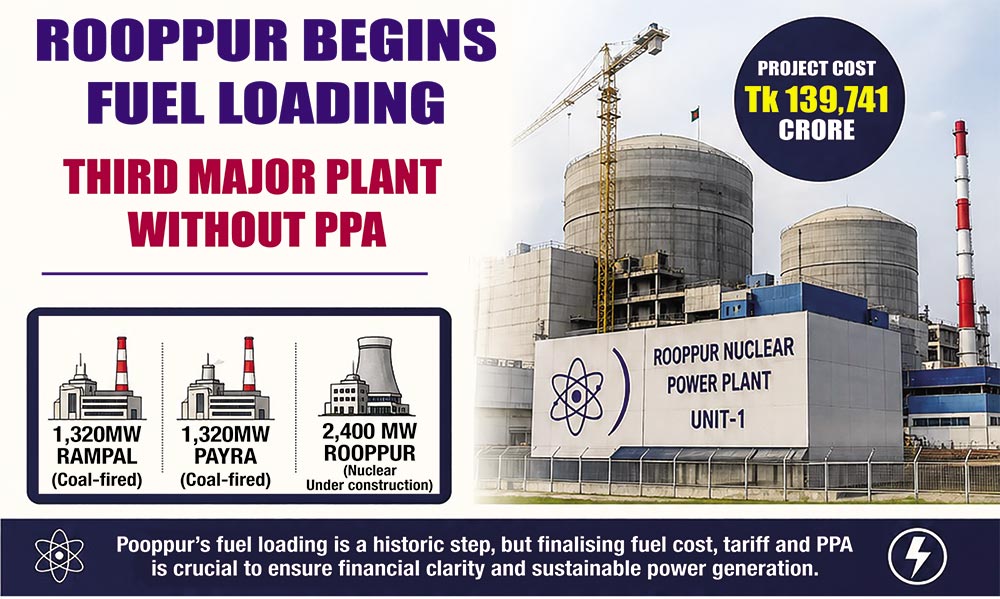 The Tk 139,741 crore Rooppur Nuclear Power Plant (RNPP) has begun fuel loading at Unit-1, marking a major milestone in Bangladesh's energy sector, though key pricing issues remain unresolved.
The plant has entered this phase without a power purchase agreement (PPA), leaving the tariff for electricity generation undisclosed.
Nuclear fuel, or uranium, is a new energy source for Bangladesh, and the Bangladesh Power Development Board (BPDB) - the country's sole bulk electricity buyer - is yet to receive pricing details. The Ministry of Science and Technology (MoST) has also not finalised or shared the fuel cost, preventing the BPDB from determining the per-unit tariff.
A senior BPDB official said the board would not assume liability for any subsidy requirements linked to the project unless the tariff is finalised.
A Power Division official confirmed that both the MoST and the Ministry of Finance have been informed that the division will not take responsibility for subsidy-related liabilities.
BPDB Chairman Engr Rezaul Karim said most cost components of the project have been received, except for fuel costs, which are essential to determine the electricity tariff.
"We expect to receive the fuel pricing details soon, which will allow us to finalise both the tariff and the long-pending PPA," he said.
MoST Secretary Anwar Hossain said efforts are under way to finalise both the tariff and the agreement, adding that the issue would be resolved soon.
The RNPP is set to become the third major power plant to begin operations without a PPA, following the 1,320MW Rampal and 1,320MW Payra coal-fired plants.
The issue has gained renewed importance after the government recently suspended subsidies for these two plants, citing the absence of approvals from the cabinet committee on government purchases.
Energy expert Prof Ijaz Hossain said the tariff for the Rooppur project, being a government-to-government initiative, may not be finalised quickly without high-level political consensus.
Under current arrangements, Russia's Rosatom will supply nuclear fuel for the first three years of operation. The fuel will initially be replaced every 18 months and later at two-year intervals, according to officials.

Loading...
Loading...
Also read



Editor : Iqbal Sobhan Chowdhury
Published by the Editor on behalf of the Observer Ltd. from Globe Printers, 24/A, New Eskaton Road, Ramna, Dhaka.
Editorial, News and Commercial Offices : Aziz Bhaban (2nd floor), 93, Motijheel C/A, Dhaka-1000.
Phone: PABX- 41053001-06; Advertisement: 41053012; 01793317829, 01550707291, E-mail: [email protected], [email protected] Online: email: [email protected] 41053014; 01550707297 Advertisement: 01550707296
Published by the Editor on behalf of the Observer Ltd. from Globe Printers, 24/A, New Eskaton Road, Ramna, Dhaka.
Editorial, News and Commercial Offices : Aziz Bhaban (2nd floor), 93, Motijheel C/A, Dhaka-1000.
Phone: PABX- 41053001-06; Advertisement: 41053012; 01793317829, 01550707291, E-mail: [email protected], [email protected] Online: email: [email protected] 41053014; 01550707297 Advertisement: 01550707296


