



| HEADLINE |

|

Economic co-op backbone of BD-India ties: Businesses
Published : Tuesday, 5 May, 2026 at 12:00 AM
Shahnaj Begum from New Delhi, India


 Indian business leaders have identified three major barriers to doing business in Bangladesh, which they termed as the main obstacles to attracting foreign direct investment (FDI).
"Frequent policy shifting is the number one issue in Bangladesh. Then came the sovereign guaranteed issue. Unfortunately, doing business was also physically very difficult in last one and a half years. These issues are a serious matter for doing business for any investor in any country," said Pankaj Tandon, a senior member of the Confederation of Indian Industry (CII). He was exchanging views with a Bangladesh media delegation at the CII headquarters in New Delhi on Monday.
He said the current phase in Bangladesh-India relations was crucial not only for sustaining existing ties but also for shaping the next stage of economic cooperation and collaboration for Bangladesh's long-term growth and competitiveness.
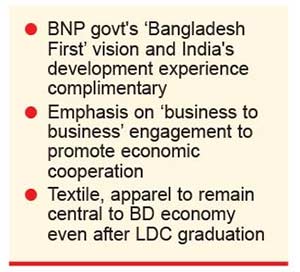
Highlighting sector-specific opportunities, Tandon said textiles and apparel would continue to remain central to Bangladesh's economy even after its graduation from the least developed country status, while future competitiveness would increasingly depend on productivity, compliance standards, machinery, and design capabilities. He also identified medical tourism, food processing, agricultural value chains, the digital economy, startups, energy cooperation, and MSME linkages as promising areas for expanded collaboration.
Pankaj Tandon is actively involved in industry policy forums, including the SAARC Chamber, BIMSTEC, IEEMA, CII, and FICCI, and has served as Chairman of the T&D (Projects Division) at IEEMA.
"We see strong alignment between the new government of Bangladesh's 'Bangladesh First' vision and India's own development experience," he said.
At its core, Tandon said, "Bangladesh First" emphasizes domestic capacity building, job creation, productivity enhancement, export diversification, digital transformation, and long-term resilience. "Importantly, this is not an inward-looking strategy. It is about strengthening national capabilities through well-designed partnerships," he added.
Describing Bangladesh as India's largest trading partner in South Asia, Tandon said India remained Bangladesh's second-largest trading partner in Asia, with bilateral trade standing at around US$13.5 billion in the 2024-25 fiscal year. He said economic cooperation remained the backbone of bilateral relations, adding that expanding market access, reducing non-tariff barriers, and improving border infrastructure could significantly boost trade.
Tandon said Bangladesh's industrial strength and India's manufacturing and services sectors complement each other, creating opportunities for integrated regional value chains. He said the proposed Comprehensive Economic Partnership Agreement (CEPA) between the two countries could significantly enhance trade and investment growth by going beyond trade in goods to include services, investment facilitation, technology cooperation, standards, and skills development.
Tandon said Indian expertise in digital public infrastructure, fintech, renewable energy, manufacturing excellence, and sustainable development could support Bangladesh's economic transformation. He reaffirmed CII's commitment to working closely with partner organizations in Bangladesh to deepen business-to-business engagement and strengthen economic cooperation between the two neighboring countries.

Loading...
Loading...
Also read



Editor : Iqbal Sobhan Chowdhury
Published by the Editor on behalf of the Observer Ltd. from Globe Printers, 24/A, New Eskaton Road, Ramna, Dhaka.
Editorial, News and Commercial Offices : Aziz Bhaban (2nd floor), 93, Motijheel C/A, Dhaka-1000.
Phone: PABX- 41053001-06; Advertisement: 41053012; 01793317829, 01550707291, E-mail: [email protected], [email protected] Online: email: [email protected] 41053014; 01550707297 Advertisement: 01550707296
Published by the Editor on behalf of the Observer Ltd. from Globe Printers, 24/A, New Eskaton Road, Ramna, Dhaka.
Editorial, News and Commercial Offices : Aziz Bhaban (2nd floor), 93, Motijheel C/A, Dhaka-1000.
Phone: PABX- 41053001-06; Advertisement: 41053012; 01793317829, 01550707291, E-mail: [email protected], [email protected] Online: email: [email protected] 41053014; 01550707297 Advertisement: 01550707296


