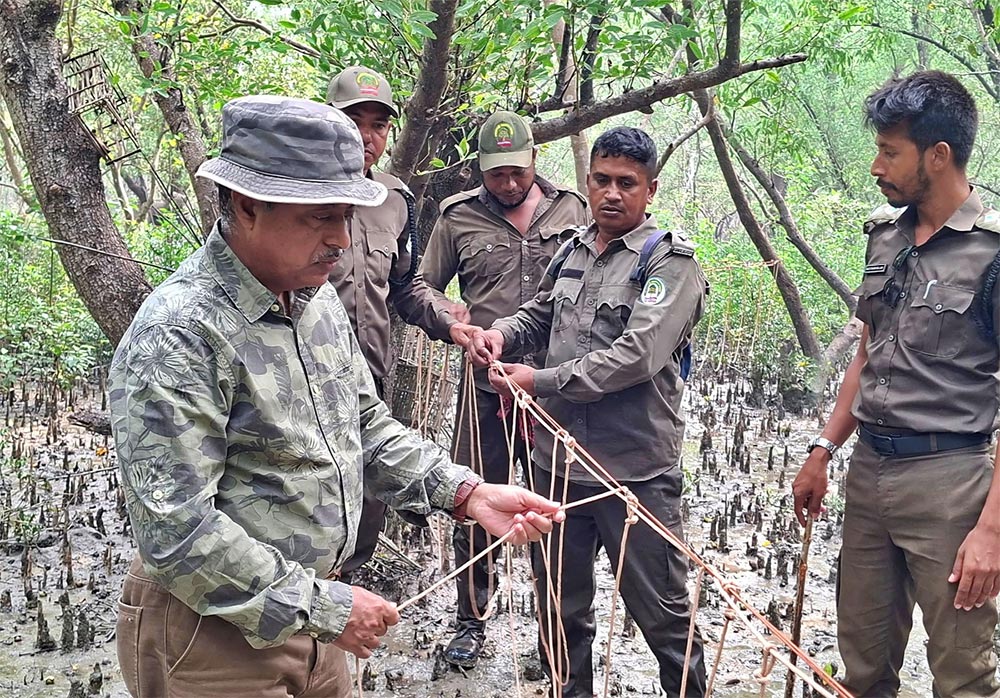
FAKIRHAT, BAGERHAT, May 8: The presence of tigers, deer and various bird species has increased in the eastern part of the Sundarban over the past year, according to the Forest Department, which attributes the improvement to intensified anti-poaching drives, tighter control over illegal extraction in sanctuaries, and strengthened patrol activities.
However, forest officials say piracy, manpower shortages and the region's difficult geography continue to pose major challenges to conservation efforts.
Divisional Forest Officer (DFO) of the Eastern Sundarban Forest Division, Md Rezaul Karim Chowdhury, said a large-scale crackdown on wildlife crimes was carried out between May 2025 and April 2026.
During the period, forest officials recovered around 114,553 feet of deadly snare traps used for deer hunting, equivalent to nearly 35 kilometres in length. They also removed 813 wire traps and 2,294 foot traps from different parts of the forest.
According to the Forest Department, thousands of deer, wild boars, monkeys and even tigers could have fallen victim to the traps had they not been removed. A total of 70 poachers were arrested and sent to court in connection with illegal hunting.
Officials said the sustained drives significantly reduced deer poaching and cut the supply of venison in illegal markets.
Data from the department show that the amount of seized deer meat dropped from 750 kilograms last year to only 250 kilograms this year, indicating a decline in hunting activities.
To curb poaching, the Forest Department has strengthened foot patrols, smart surveillance and drone monitoring across the eastern Sundarban.
In the past year alone, authorities conducted 474 drives, filed 241 cases and arrested 377 individuals. Cases were also filed against another 396 people under forest laws.
During the drives, officials seized 448 boats and trawlers, 8,381 illegal crab-catching devices, 300 feet of nets, 724 kilograms of poison-caught fish, 1,066 kilograms of crabs and 250 kilograms of deer meat.
Forest officials said reduced illegal supply has pushed the market price of deer meat up from Tk 500 per kilogram to around Tk 1,500.
Local fishermen and honey collectors from Sharankhola Upazila said they now frequently see tiger footprints while fishing or collecting honey in the forest and occasionally hear tiger calls.
"We also see more deer and wild boars than before," said local fisherman Kabir Munshi.
They added that crocodiles and swimming tigers are now spotted more often in rivers and canals.
Locals also reported an increase in the presence of bird species, including brown-winged kingfishers, stork-billed kingfishers, ruddy kingfishers, scarlet-backed flower-peckers, adjutants, Brahminy kites and white-bellied sea eagles.
Wildlife experts said deer are the principal herbivores of the Sundarban and a key prey species for the Royal Bengal Tiger. An increase in deer population and safe movement naturally supports tiger presence in the forest.
They also noted that reduced hunting, restrictions on poison fishing and tighter control over illegal entry into sanctuaries have created a more favourable environment for birds and other wildlife.
The Forest Department claimed that illegal fishing and crab collection in sanctuary areas such as Kotka, Kochikhali, Kokilmoni and Tiar Char has almost dropped to zero over the last year.
Authorities also jailed around 300 fishermen for illegal entry and poison fishing during the period.
Officials said drone surveillance has also been intensified in fire-prone areas, including Dhangsagar, Kolmotegi, Nangli and Amurbunia Dasher Bharani.
Awareness campaigns among forest-dependent communities have also brought behavioural changes, officials said.
Over the past year, locals in Sharankhola helped rescue and return three spotted deer, one tiger and 37 pythons to the forest instead of killing them after the animals strayed into human settlements.
Despite the progress, officials and local sources said several organised pirate groups remain active inside the Sundarban, creating fresh security concerns for fishermen and honey collectors.
The vast size of the forest, limited manpower and the loss of navigability in many rivers and canals connected to nearby localities have also made illegal entry easier for criminals, they added.
DFO Md Rezaul Karim Chowdhury said protecting forests was essential for preserving wildlife and stressed the importance of involving local communities in conservation efforts.
"If the tiger, which sits at the top of the food chain, survives, the entire ecosystem of the Sundarban will survive," he said.
According to the Forest Department, the number of tigers in the Sundarban stood at 125 in the 2024 survey. Officials hope the ongoing conservation measures could increase the tiger population by another one-fourth in the next survey.
Director of the Institute for Integrated Studies on the Sundarban and Coastal Ecosystem (IISSCE), Dr Mohammad Raihan Ali, said every element of the ecosystem depends on one another.
"The data from the Eastern Sundarban Forest Division may reasonably indicate a positive ecological shift. Since the Forest Department is the principal management authority, it is natural that their activities would have an impact," he said.





