



| HEADLINE |

|
Bangladesh overtakes China in garment exports to US, but falls short of celebration
Published : Tuesday, 12 May, 2026 at 12:00 AM


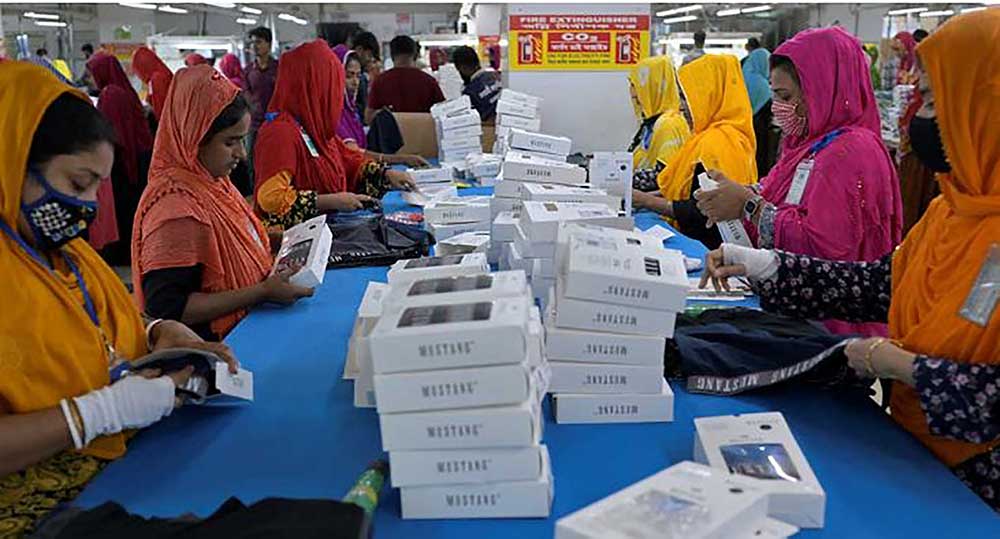 Bangladesh has overtaken China to become the second-largest apparel exporter to the United States, yet garment manufacturers say there is little reason for celebration.
What appears at first glance as a breakthrough is, in reality, a reshuffling driven by contraction. US tariffs imposed under President Donald Trump have sharply reduced Chinese exports, while Bangladesh's shipments have also fallen -- just at a slower pace.
"We would have been truly happy if exports had increased and we had reached second position," exporters say, warning that the real trend will only become clear after a couple of months.
Garments account for more than 80 percent of Bangladesh's export earnings, and the US is the single largest destination, contributing roughly 20 percent of apparel export revenue.
According to updated figures from the US Department of Commerce's Office of Textiles and Apparel (OTEXA), US buyers imported apparel worth $17.73 billion in January-March, down 11.60 percent from a year earlier.
Bangladesh exported $2.04 billion during the period, an 8.38 percent fall. China's exports plunged nearly 53 percent to $1.7 billion, compared with $3.61 billion a year earlier.
Vietnam, meanwhile, retained the top position with $3.98 billion in exports, rising 2.73 percent and capturing about 22 percent of the market. Bangladesh holds roughly 11.5 percent.
India's exports fell 27 percent to $1.1 billion, while Indonesia's slipped marginally to $1.22 billion.
The ranking changes have unfolded amid repeated shifts in US tariff policy.
After initial tariffs imposed on 157 countries in April 2024, Bangladesh's rate fluctuated -- from 37 percent to 35 percent, then down to 20 percent after negotiations, and later 19 percent following a bilateral agreement in February.
Subsequent legal and policy changes, including a Supreme Court ruling and renewed tariff measures, added further uncertainty before partial suspension by a US trade court in May.
Despite early gains from diverted orders away from China, exporters say the momentum has faded as prices rose and demand weakened amid global inflation and rising fuel costs after geopolitical tensions.
Industry leaders say Bangladesh's improved ranking reflects a relative decline elsewhere rather than structural strength.
BKMEA President Mohammad Hatem said exports have been on a negative trajectory for months. He noted that March shipments were affected by Eid holidays, creating distortions in April figures. �"bdnews24
Loading...
Loading...
Also read



Editor : Iqbal Sobhan Chowdhury
Published by the Editor on behalf of the Observer Ltd. from Globe Printers, 24/A, New Eskaton Road, Ramna, Dhaka.
Editorial, News and Commercial Offices : Aziz Bhaban (2nd floor), 93, Motijheel C/A, Dhaka-1000.
Phone: PABX- 41053001-06; Advertisement: 41053012; 01793317829, 01550707291, E-mail: [email protected], [email protected] Online: email: [email protected] 41053014; 01550707297 Advertisement: 01550707296
Published by the Editor on behalf of the Observer Ltd. from Globe Printers, 24/A, New Eskaton Road, Ramna, Dhaka.
Editorial, News and Commercial Offices : Aziz Bhaban (2nd floor), 93, Motijheel C/A, Dhaka-1000.
Phone: PABX- 41053001-06; Advertisement: 41053012; 01793317829, 01550707291, E-mail: [email protected], [email protected] Online: email: [email protected] 41053014; 01550707297 Advertisement: 01550707296


