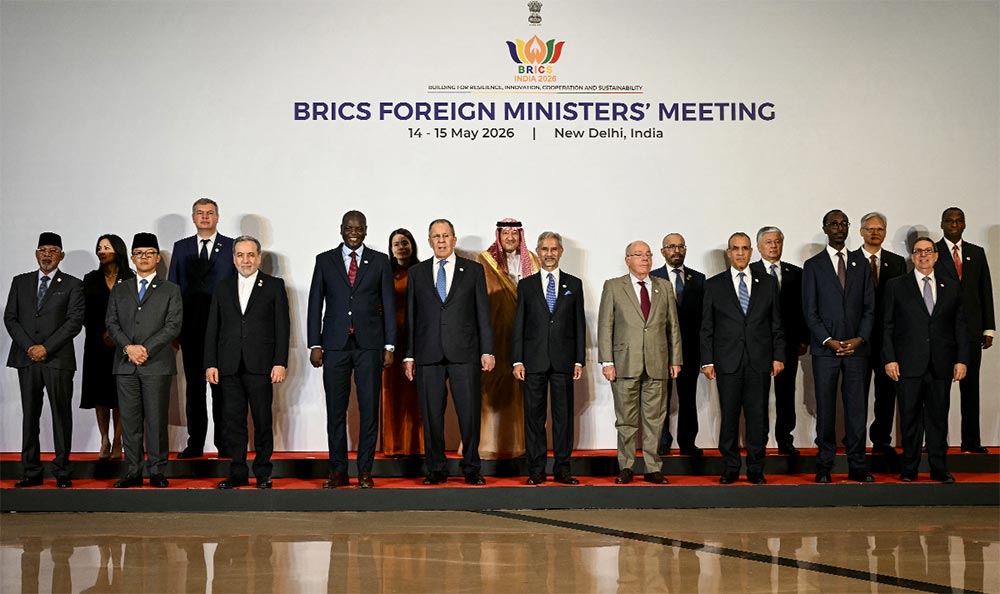
NEW DELHI, May 14: With the world buffeted by war, climate stress, and deepening economic fault lines, External Affairs Minister S Jaishankar has used India's chairship of the BRICS Foreign Ministers' Meeting to deliver a sweeping call for global reform, demanding an overhaul of the United Nations Security Council, an immediate ceasefire in Gaza, and an unrelenting international stance against terrorism.
Speaking at Bharat Mandapam in New Delhi, where foreign ministers and senior representatives of the expanded BRICS bloc had gathered for the first major ministerial engagement under India's 2026 chairship, Jaishankar warned that the international community was confronting something far more dangerous than a run of bad luck.
"What we are witnessing is not a series of isolated events, but a convergence of challenges testing the resilience of multilateral systems," he said.
The two-day meeting, running May 14 and 15, is the centrepiece of India's BRICS presidency and is expected to shape the agenda for the Leaders' Summit that New Delhi will host later this year.
Jaishankar opened his address with a frank assessment of a deteriorating global landscape. Conflicts, climate events, and the Covid pandemic, he said, had been "key contributory factors" to widening vulnerabilities. But he pointed to something deeper at work -- a rebalancing of the global order that not every nation was willing to accept. The cumulative effect, he argued, was weakening growth prospects and hitting developing countries hardest, through "pressures on energy, food and fertiliser security, supply chain disruptions, inflationary trends and constraints on growth."
It was in this context, he said, that BRICS solidarity assumed particular importance. "Collective action and resolve are essential to promote stability, sustainability and prosperity," he told delegates. "The BRICS must not only deliberate on these issues but also work towards effective and coordinated responses."
The most urgent passages of Jaishankar's remarks addressed the continuing carnage in the Middle East. On Gaza, he was direct: the conflict carries "grave humanitarian implications," and what is needed now is "a sustained ceasefire, humanitarian access, and a credible pathway towards a durable and peaceful resolution." India, he reaffirmed, supports a two-state solution to the Palestinian question.
The minister's concerns fanned out across the broader region. He flagged the risks to maritime traffic in critical international waterways, warning that "safe and unimpeded maritime flows through international waterways, including the Strait of Hormuz and Red Sea, remain vital for global economic well-being." Lebanon, Syria, Sudan, Yemen, and Libya each received mention-- a catalogue of crises that, according to Jaishankar, demand sustained engagement rather than selective attention.
"Stability cannot be selective, and peace cannot be piecemeal," he said, insisting on the importance of upholding international law, protecting civilians, and avoiding attacks on public infrastructure. India, he added, "stands ready to contribute constructively to de-escalation efforts." �"NDTV





