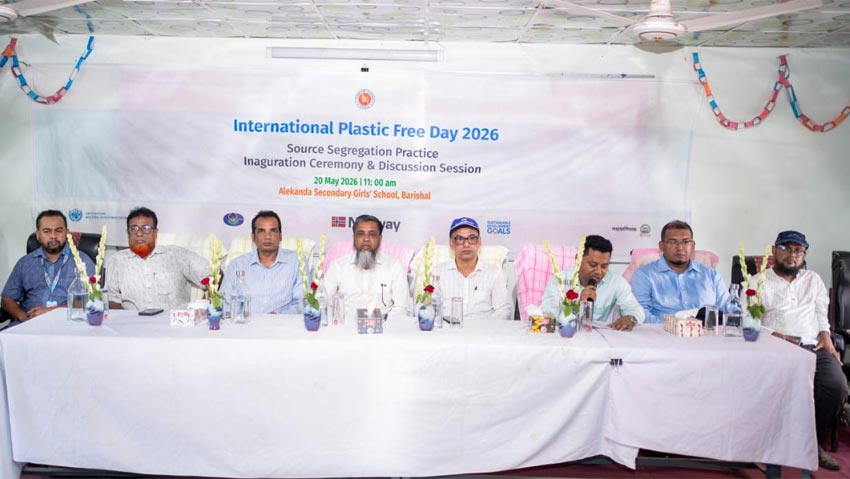
An awareness programme titled ‘’Source Segregation Practices” was held at Alekanda Secondary Girls’ School in Barishal on Wednesday to mark International Plastic-Free Day 2026, with speakers stressing the need for household-level waste segregation to tackle growing plastic pollution.
The programme was organised under the project “Integrated Approach Towards Sustainable Plastics Use and Marine Litter Prevention in Bangladesh,” implemented by the Department of Environment (DoE) with technical support from the United Nations Industrial Development Organization (UNIDO) and financial assistance from the Government of Norway.
The event featured a discussion session and an awareness rally aimed at promoting sustainable plastic waste management and source segregation practices at the household level. More than 300 people participated in the programme, around 65 per cent of whom were women. Children, students and local residents also joined the event spontaneously.
Director of the Department of Environment (DoE), Barishal, Muhammad Mujahidul Islam attended the programme as the chief guest.
Addressing the event, he said unregulated use and poor management of plastic waste pose serious threats to both the environment and public health.
“Plastic pollution clogs drainage systems, causes waterlogging and increases the risk of microplastics entering the human body,” he said, urging people to adopt responsible waste management practices and segregate waste at source to protect rivers, canals and the ecosystem.
Welcoming the guests, DoE Barishal Assistant Director Md Saidur Rahman said mismanaged plastic waste has emerged as a major environmental challenge and that household-level segregation is essential to ensure a clean urban environment.
He also stressed the importance of collective action in reducing the harmful impacts of plastic waste across the country.
UNIDO Bangladesh National Project Coordinator Sattya Bhattacharjee, who attended as a special guest, said source segregation plays a crucial role in preventing plastic waste from leaking into the environment and ensuring the sustainability of recycling initiatives.
He noted that UNIDO, in collaboration with the DoE, has been working to strengthen sustainable plastic waste management, promote behavioural change at the community level and support industries in adopting resource-efficient and cleaner production methods.
He further called on the residents of Barishal’s Ward No. 15 to become more proactive in connecting communities with recycling networks to protect the environment and create local economic opportunities.
Among other speakers, Government Syed Hatem Ali College Principal Md Akhtaruzzaman Khan highlighted the need for coordinated social, economic and environmental efforts to build a clean and sustainable Bangladesh.
Dr Md Khorshed Alam, associate professor of Physics at Barishal University and adviser to BD Clean Barishal, observed that many developed countries generate comparatively less plastic waste despite high consumption due to effective source segregation practices at the household level.
The programme was also attended by Alekanda Secondary Girls’ School Headmaster Md Rokibul Islam, UNIDO Bangladesh representative Shahidul Islam Siam, Bismillah Plastic and Packaging proprietor Nazmun Nahar Rina and volunteers from BD Clean Barishal.
At the end of the event, participants pledged to practise sustainable plastic use and environmentally friendly waste management. The chief guest and special guests also signed a commemorative board as a symbolic commitment to the campaign.
As part of the initiative, specialised bins for separating plastic and non-plastic waste were distributed among participating households.
The programme concluded with a colourful awareness rally joined by residents, volunteers and stakeholders.
Organisers said BD Clean volunteers have been conducting door-to-door awareness campaigns and implementation drives on waste segregation in the Alekanda area since May 18, which will continue until May 21.
Published by the Editor on behalf of the Observer Ltd. from Globe Printers, 24/A, New Eskaton Road, Ramna, Dhaka.
Editorial, News and Commercial Offices : Aziz Bhaban (2nd floor), 93, Motijheel C/A, Dhaka-1000. Phone: PABX- 41053001-06; Online: 41053014; Advertisement: 41053012.
E-mail: district@dailyobserverbd.com, news@dailyobserverbd.com, advertisement@dailyobserverbd.com, For Online Edition: mailobserverbd@gmail.com