



| HEADLINE |

|
Bangladesh's economy holds strong potential for trillion-dollar future: BIDS DG
Published : Tuesday, 2 June, 2026 at 12:00 AM


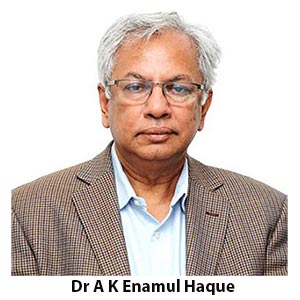 Bangladesh Institute of Development Studies (BIDS) Director General Dr A. K. Enamul Haque has described Bangladesh's current economic condition as 'full of potential,' saying sustained investment and steady growth could transform the country into a near trillion-dollar economy within the next decade.
 "The economy is currently a bit weak, but if investment increases, Bangladesh has strong long-term potential," he told BSS in an interview reflecting his thoughts on the different aspects of the national budget for the upcoming FY27.
He said maintaining a minimum six percent economic growth rate over the coming years would be critical for achieving the country's long-term development ambitions.
"If Bangladesh can maintain around 6 percent real growth consistently, the economy could approach a trillion dollars by the early 2030s," he said.
Finance Minister Amir Khosru Mahmud Chowdhury has already reaffirmed the government's goal of transforming Bangladesh into a trillion-dollar economy by 2034 as well as establish Bangladesh as a developed and dignified nation in the global arena.
Explaining the projection, Dr. Enamul noted that with inflation included, Bangladesh's nominal growth could remain around 12 percent annually.
"At that pace, the size of the economy could nearly double within five to six years," he added.
The noted economist stressed that private sector investment would play the decisive role in sustaining growth momentum.
"The government alone can't achieve this. Private sector participation and real investment are essential," he said.
He also emphasized the need for balanced regional development so that economic expansion does not remain overly concentrated in Dhaka.
"Bangladesh's growth should not remain Dhaka-centric. Every district has equal rights to development," he said.
According to him, the country must improve urban planning and strengthen secondary cities to reduce pressure on the capital and improve productivity nationwide.
On the banking sector, Dr Enamul said restoring public confidence should become the top priority for the Bangladesh Bank.
"If people lose trust in banks, they will stop keeping money in the financial system," he warned.
He said in case of forced bank mergers, weak banks cannot automatically become strong simply through administrative consolidation.
"Two weak banks can't create a healthy bank through a forced merger," he said.
Instead, he recommended stricter accountability mechanisms and allowing poorly managed banks to face consequences if they fail to improve within a specified period.
Referring to the governance standards in the financial sector, he said confidence cannot return without stronger rule of law.
"People need assurance that their deposits are protected and wrongdoing is punished fairly," he added.
On the capital market, Dr Enamul said meaningful recovery would require broader reforms across the financial sector and governance system.
"Capital market functions properly only where the rule of law exists and financial discipline is maintained," he observed.
The BIDS DG also emphasized the importance of improving project selection and reducing corruption in public spending.
"Our main problem is not the projects themselves-it is the waste and corruption in project implementation," he said.
Dr Enamul concluded by saying the FY27 budget should primarily focus on building the foundation for sustainable long-term growth.
"The main target should be preserving economic growth momentum for the next five years," he added. �"BSS
Loading...
Loading...
Also read



Editor : Iqbal Sobhan Chowdhury
Published by the Editor on behalf of the Observer Ltd. from Globe Printers, 24/A, New Eskaton Road, Ramna, Dhaka.
Editorial, News and Commercial Offices : Aziz Bhaban (2nd floor), 93, Motijheel C/A, Dhaka-1000.
Phone: PABX- 41053001-06; Advertisement: 41053012; 01793317829, 01550707291, E-mail: [email protected], [email protected] Online: email: [email protected] 41053014; 01550707297 Advertisement: 01550707296
Published by the Editor on behalf of the Observer Ltd. from Globe Printers, 24/A, New Eskaton Road, Ramna, Dhaka.
Editorial, News and Commercial Offices : Aziz Bhaban (2nd floor), 93, Motijheel C/A, Dhaka-1000.
Phone: PABX- 41053001-06; Advertisement: 41053012; 01793317829, 01550707291, E-mail: [email protected], [email protected] Online: email: [email protected] 41053014; 01550707297 Advertisement: 01550707296


