



| HEADLINE |

|

New power tariff hike highest in BD's history



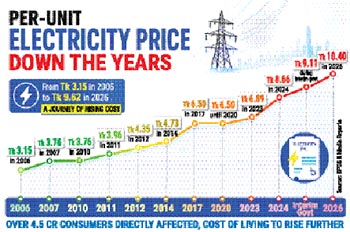 Analysing data from the last 20 years in light of the new electricity tariff, it becomes evident that the June 2026 retail electricity price hike is the highest single price adjustment in Bangladesh's history, both in terms of absolute taka amount and percentage.
The new tariff, effective from June 1, will directly impact over 4.5 crore consumers across the country and increase the cost of living for ordinary people, increased industrial and agricultural production costs which will have a multifaceted negative effect on the macro-economy.
According to BERC's new order, specific consumer-level tariffs are as follows:
For General Residential (1st tier, 0-75 units), the previous price was 4.66 Tk per unit, and the new price is 6.18 Tk per unit. The price difference is 1.52 Tk per unit, with a rate of increase of 32.62 per cent.
For General Residential (4th tier, 301-400 units), the previous price was 8.10 Tk per unit, and the new price is Tk 9.62 per unit. The price difference is 1.52 Tk per unit, with a rate of increase of 18.77 per cent.
For Residential (highest tier, above 600 units), the previous price was 15.83 Tk per unit, and the new price is 17.35 Tk per unit. The price difference is 1.52 Tk per unit, with a rate of increase of 9.60 per cent.
For Irrigation/ Agriculture, the previous price was 4.52 Tk per unit, and the new price is 6.04 Tk per unit. The price difference is 1.52 Tk per unit, with a rate of increase of 33.63 per cent.
For Education, Religious, Charitable Institutions & Hospitals, the previous price was 7.53 Tk per unit, and the new price is 9.05 Tk per unit. The price difference is 1.52 Tk per unit, with a rate of increase of 20.19 per cent.
Analysis of the price hike data reveals that although the flat rate increase per unit is Tk 1.52, the biggest proportional impact has hit lower-income and productive sectors. Lifeline customers have seen their electricity bills jump by a maximum of 40 percent. The irrigation or agricultural sector, tied to food security, has seen a 33.63 percent increase. In contrast, the rate of increase for wealthy or highest-tier residential customers is only 9.6 percent.
A review of electricity prices in the country shows that in 2006, the per-unit price was Tk 3.15. This increased to Tk 3.76 in 2007, a rate that remained stable until 2010. It is worth noting that the 2007 adjusted rate was determined during the tenure of the previous caretaker government. In 2011, a new adjustment raised the per-unit price by 5.32 percent to Tk 3.96.
The following year, it increased by 9.8 percent to Tk 4.35. Another significant jump occurred in 2014, when the per-unit price was raised by over 7 percent to Tk 4.73. A major hike followed in 2017, with a 5.3 percent increase, bringing the retail price to Tk 6.50 per unit, which remained stable until 2020. That year, prices were again raised by 5.3 percent to Tk 6.89. Subsequently, in January, February, and March 2023, electricity prices were raised three times, each by 5 percent.
In 2024, prices were adjusted again, this time by 8.5 percent, bringing the per-unit cost to Tk 8.66. After the mass uprising, the interim government took power during turbulent times, and under that government, electricity prices were kept stable at Tk 9.11 via executive order.
Now, under the BNP-led government, BERC has raised electricity prices again. However, the rate itself has raised questions-never before has such a high single hike been implemented. Even in 2023, three separate 5 percent hikes totaled 15 percent, but this time, a single increase of 16.68 percent has been imposed.
By any standard, this is the largest single electricity price hike in the country's history. Consumer-level electricity prices have been increased by 16.68 percent this time. The previous highest hike was 8.5 percent in 2024. Thus, the current increase is nearly double the previous record.
In 2006, the per-unit electricity price was Tk 3.15. Under the newly determined rates, the current average per-unit price will stand at Tk 10.63, up from Tk 9.11 according to the previous tariff schedule. This represents a 16.68 percent increase-a leap never seen before in the last two decades.
A review of BERC's latest announced tariff shows that the average retail electricity price per unit has been raised by Tk 1.52, from Tk 9.11 to Tk 10.63. At the wholesale level, the weighted average price per unit has been increased by Tk 1.39, from Tk 7.00 to Tk 8.39. Additionally, the transmission or wheeling charge has been raised from Tk 0.3134 to Tk 0.3886 per unit.
Analysts consider the price hike order completely illegal and contrary to consumer rights. Although the price was announced after a public hearing, at a press conference the Commission's Chairman stated that the Energy Regulatory Commission had not conducted any assessment of the impact the price hike would have on consumers!
Why were prices increased?
As the primary reasons behind the record electricity price hike, BERC and the Bangladesh Power Development Board (BPDB) have cited rising generation costs and a massive financial deficit. BERC stated that even after raising wholesale prices, it is not possible to fully cover BPDB's enormous financial shortfall. To fill this gap, the government will still have to provide an additional subsidy of approximately Tk 41,000 crore this year.
At a press conference, Commission Chairman Jalal Ahmed said that while generation capacity has been increased far beyond demand over the past five years, this has had a major negative impact on costs. Currently, against a peak demand of around 16,000 megawatts, the country has a generation capacity of about 28,000 megawatts. Because this surplus capacity of around 12,000 megawatts remains idle, substantial 'capacity charges' (plant rent) must be regularly paid to Independent Power Producers (IPPs). These massive capacity charges are the primary factor driving up the overall per-unit generation cost.
Additionally, high international prices for LNG and furnace oil, coupled with the consistent depreciation of the Taka against the US dollar and dollar crisis, have abnormally increased fuel import costs. Consequently, the price hike proposal was implemented to reduce distribution company losses and align BPDB's purchase costs with selling prices.
Although BERC's price hike decision appears to be an independent order, economists believe it is primarily a strategic government effort to secure IMF loan installments and maintain the Ministry of Finance's budgetary balance.
The underlying condition of the International Monetary Fund (IMF) is easily discernible. A key condition of the IMF's $4.7 billion loan program is the gradual reduction of subsidies in the power and energy sector and the establishment of a market-based or cost-reflective pricing structure. The IMF's 'Article IV Consultation Report' and the World Bank's 'Bangladesh Development Update' have repeatedly noted that massive subsidies in the power sector are putting intense pressure on the government's revenue structure and squeezing allocations for social safety nets.
The government has pursued this record price hike primarily to meet the IMF's subsidy reform condition and its goal of reducing the budget deficit. Economists believe that while BERC's decision appears independent, it is fundamentally a strategic governmental effort to secure IMF loan installments and maintain fiscal balance.
Expert Opinion: Criticism and Policy Recommendations
The government and BERC's decision has drawn sharp criticism from economists and energy experts. Responding to Chaarcha, economist Professor Selim Jahan said, "Although there is theoretical justification for raising prices due to international crises, given the current domestic reality, this will place immense pressure on people's lives."
Regarding its impact, he stated, "Given the current state of the people, inflation is not coming down, and they are unable to maintain their standard of living. If, in trying to ensure budget balance, you destabilize the balance of people's lives, the outcome will not be good."
Many economists believe that while reform is needed, this is not the right time. Instead of choosing the easy path of cutting subsidies to reduce government expenditure, there was a significant opportunity to increase revenue by reducing tax exemptions. Professor Selim Jahan noted, "Currently, the country is giving away about Tk 1.7 lakh crore in tax exemptions, of which corporate tax exemptions alone amount to Tk 73,000 crore. Reducing these exemptions could have covered the budget deficit without increasing pressure on ordinary people."
Professor Shamsul Alam, Energy Advisor to the Consumers Association of Bangladesh (CAB), has termed this price hike order completely 'illegal' and 'contrary to consumer rights'. Speaking to media, he said, "The price hike order shows that BERC is not neutral. BERC's claim that it was not influenced is false because I know there was pressure on it. When adjudication is rushed, it becomes confused, and judicial activism is destroyed."
It is noteworthy that although the commission had 60 working days to announce new rates after the public hearing, this time the organization announced the new rates just 5 working days after the hearing.
Professor Shamsul Alam alleged, "By conducting public hearings for six companies in just two days and disposing of them quickly, the commission has succumbed to government pressure and undermined its own independence. This price hike has been implemented according to the decision of a Ministry of Finance-led committee, which is contrary to regulatory culture. BERC has rendered the law ineffective by establishing a 'bureaucratic culture' instead of an independent regulatory culture, which is a serious offense under the BERC Act. For this offense, CAB has already proposed the removal of BERC officials, and legal action is now inevitable."

Loading...
Loading...
Also read



Editor : Iqbal Sobhan Chowdhury
Published by the Editor on behalf of the Observer Ltd. from Globe Printers, 24/A, New Eskaton Road, Ramna, Dhaka.
Editorial, News and Commercial Offices : Aziz Bhaban (2nd floor), 93, Motijheel C/A, Dhaka-1000.
Phone: PABX- 41053001-06; Advertisement: 41053012; 01793317829, 01550707291, E-mail: [email protected], [email protected] Online: email: [email protected] 41053014; 01550707297 Advertisement: 01550707296
Published by the Editor on behalf of the Observer Ltd. from Globe Printers, 24/A, New Eskaton Road, Ramna, Dhaka.
Editorial, News and Commercial Offices : Aziz Bhaban (2nd floor), 93, Motijheel C/A, Dhaka-1000.
Phone: PABX- 41053001-06; Advertisement: 41053012; 01793317829, 01550707291, E-mail: [email protected], [email protected] Online: email: [email protected] 41053014; 01550707297 Advertisement: 01550707296


