Thursday | 11 June 2026 | Reg No- 06

| BREAKING: |
Collected Photo
The expansion of the 2026 FIFA World Cup to a historic 48-nation format has not only altered the competitive landscape of global football but has triggered an unprecedented commercial and creative battleground among the world’s sportswear titans.
As hundreds of thousands of fans fill stadiums and fan zones, the garments worn on the pitch have evolved far beyond basic performance gear. Today, the modern football kit serves as a highly calculated hybrid of high-fashion street apparel, commercial asset, and soft-power diplomatic branding.
Industry experts note that this cycle’s designs reveal a distinct shift away from the sterile, cookie-cutter templates that dominated the past decade. Instead, sportswear giants like Nike, Adidas, and Puma are leaning heavily into national folklore, historical revivals, and subtle literary iconography to turn shirts into wearable cultural manifestos.
The Design Narrative: Micro-Textures and Historical Callbacks
Football kit collectors and industry analysts look for specific storytelling details when assessing a tournament’s lineup. This year, the focus is squarely on tactile, embedded micro-textures that require close inspection to fully appreciate.
Adidas: The Power of Nostalgia and Literature
The German manufacturer has dominated design conversations by utilizing its kits to weave complex regional narratives. Rather than relying on simple blocks of color, their 2026 portfolio uses fabric weave as an artistic canvas.
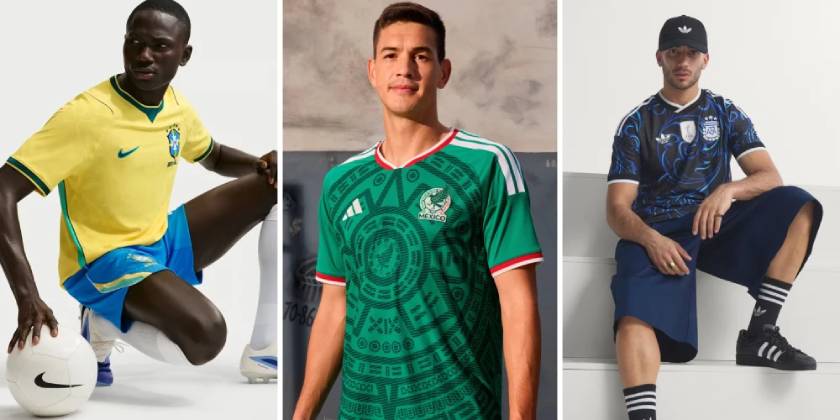
Argentina: The traditional Albiceleste light blue and white stripes return, but with a structural twist. The panels feature a subtle gradient combining three distinct shades of blue- each matched to the exact hue worn during the nation’s three historic World Cup victories.
Mexico: Looking backward to move forward, the Mexican home kit revives the aggressive, highly stylized Aztec iconography popularized during the 1998 tournament in France. The pattern integrates a faint imprint of the Piedra del Sol (the Aztec sun stone), anchoring athletic identity in deep archaeological heritage.
Colombia: Perhaps the most sophisticated narrative on the market, Colombia’s traditional bright yellow kit appears minimalist from a distance. Up close, however, the fabric features a woven butterfly motif. This serves as a quiet homage to the legendary Colombian novelist Gabriel García Márquez, whose use of yellow butterflies symbolized hope and magical realism.
Nike: Waving Flags and Preppy Minimalism
Nike’s strategy for 2026 leans into sharp tailoring and bold, graphic reinterpretations of patriotic symbols.
United States: As co-hosts, the American kit steps away from plain white shirts by incorporating fluid, distorted red and white lines across the front panel, meant to evoke a flag rippling in the wind. A deep navy collar anchors the look, striking a balance between patriotism and modern street style.
France: Widely praised by designers for its structural elegance, the French shirt utilizes tonal variation. A subtle, geometric “F” is repeated across alternating blue shades, paired with a stark white buttoned collar that mirrors high-end European menswear rather than traditional athletic activewear.
Brazil: The iconic canary yellow remains non-negotiable, but Nike has introduced complex green layered patterns across the collar and sleeve cuffs to give the classic silhouette a sharper, organic finish.
Puma: Moving Textiles and Urban Rhythms
Puma has chosen to capture the kinetic energy of local environments, translating movement and transport into knit patterns.
Portugal: Moving away from flat red fields, the Portuguese shirt utilizes wavy, undulating lines along its side panels, celebrating the country’s maritime history and Atlantic coastline.
Senegal: Taking direct inspiration from the streets of Dakar, the West African nation’s shirt incorporates vivid red, yellow, and green geometric blocks. The design patterns mimic the famous hand-painted car rapide minibuses that form the backbone of local urban transit.
Consumer Economics: The Structural Divide of Modern Kits
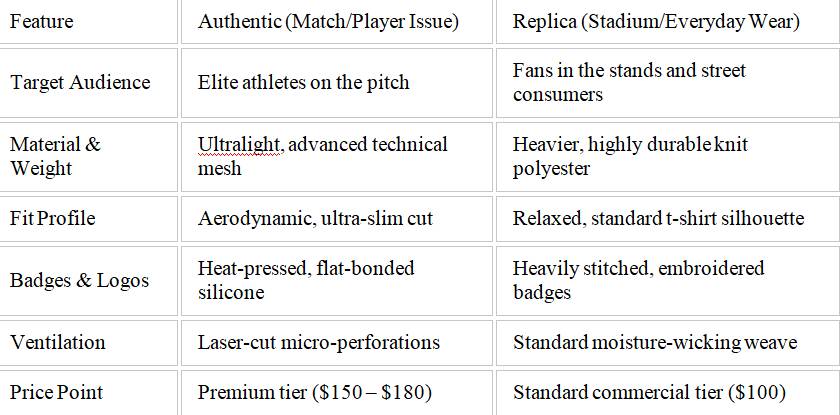
For fans looking to purchase a piece of the tournament, navigating the retail market requires understanding a crucial technical and economic divide: Authentic vs. Replica.
While both versions look visually identical from a distance, they are fundamentally different garments designed for entirely different use cases.
Source: NBC News