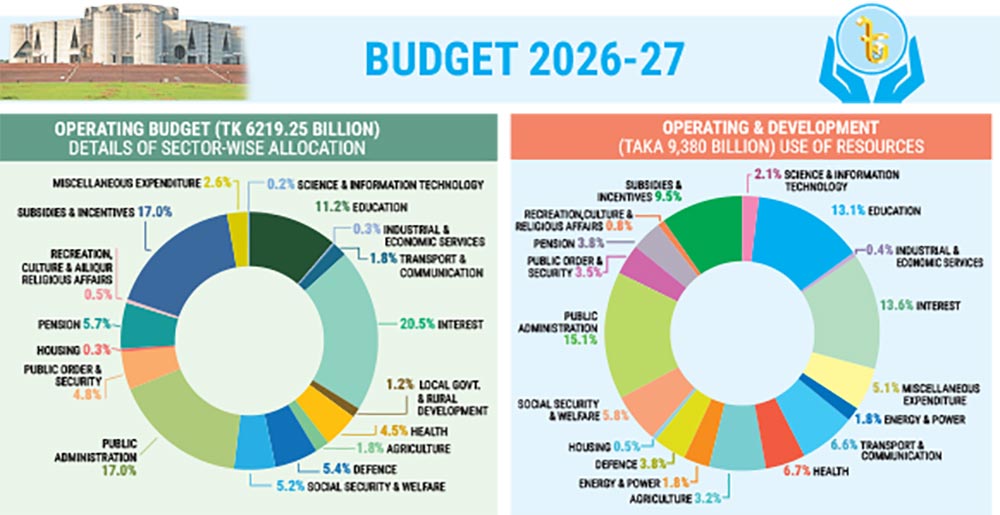
Finance Minister Amir Khosru Mahmud Chowdhury on Thursday placed before Parliament a record-breaking national budget of Tk 9,38,000 crore for the fiscal year 2026-27-the largest in Bangladesh’s history-setting the stage for an ambitious yet high-stakes economic push under mounting fiscal pressure.
The proposed budget projects total revenue of Tk 6,95,000 crore against expenditure of Tk 9,38,000 crore, leaving a yawning deficit of Tk 2,43,000 crore, equivalent to 3.6 per cent of GDP.
To bridge the gap, the government plans to mobilise Tk 1,16,000 crore in foreign loans and grants, while Tk 1,27,000 crore will be raised domestically. Of the domestic borrowing, Tk 1,12,000 crore is expected from the banking system-raising fresh concerns over private sector credit squeeze-while Tk 15,000 crore will come from savings instruments.
The macroeconomic framework sets a GDP growth target of 6.5 per cent, while aiming to rein in inflation to 7.5 per cent. The economy is projected to expand to Tk 68.30 lakh crore, with the tax-to-GDP ratio modestly rising to 9.2 per cent.
Described by officials as a “reform and recovery budget”, the fiscal plan signals a shift towards structural adjustment-focusing on widening the tax base, tightening compliance, and expanding digital tax administration rather than increasing VAT rates. Yet economists caution that the revenue ambition may prove difficult to realise.
Inside Parliament, the ceremonial moment unfolded with full tradition and theatre. Carrying the iconic black budget briefcase beside the Prime Minister, the Finance Minister entered the chamber at 3:00pm to desk-thumping from both treasury and opposition benches.
After Speaker Hafiz Uddin Ahmed, Bir Bikram took the chair and proceedings resumed, the Finance Minister formally opened the briefcase and presented the long-awaited fiscal blueprint. It marks the first budget of the BNP-led administration formed after the February 12 general election and the second session of the 13th Parliament.
Earlier in the day, the Cabinet had approved the budget at a special meeting chaired by Prime Minister Tarique Rahman at the Jatiya Sangsad Secretariat, with President Mohammad Shahabuddin giving final assent.
The Parliament complex was transformed for the occasion into a high-security, high-profile state venue, with diplomats, military chiefs, advisers, senior journalists and dignitaries in attendance as the fiscal roadmap was unveiled.
A defining feature of the budget is its dual-track strategy: easing the cost of living while tightening fiscal extraction from luxury consumption.
Nearly 60 essential commodities have been granted tax and duty exemptions to cushion inflation-hit households, while higher duties will be imposed on luxury and non-essential imports to protect reserves and broaden revenue.
Officials said the approach seeks to "rebalance taxation in favour of the common citizen", though the effectiveness will depend on enforcement across supply chains.
On the expenditure side, operating costs dominate at Tk 6,05,740 crore, while the Annual Development Programme is set at Tk 3,00,000 crore. Debt servicing alone will consume Tk 1,14,700 crore, underscoring the growing burden of past borrowing.
Key sectoral allocations include Tk 1,44,338 crore for social protection, Tk 1,36,606 crore for education and human capital, Tk 69,409 crore for health, Tk 60,730 crore for infrastructure, Tk 43,335 crore for agriculture, and Tk 41,352 crore for local government development.
In a bid to signal future-oriented growth, the budget introduces a Tk 500 crore startup fund targeting AI, 5G and women entrepreneurs, alongside allocations for sports development, creative industries, climate resilience and religious welfare.
Tax policy adjustments include an increase in the tax-free income threshold to Tk 3,75,000, up from Tk 3,50,000-offering modest relief amid persistent inflationary pressure.
The fiscal framework also controversially opens a limited window for legalising undisclosed money through investment in real estate transactions, a move likely to spark political and ethical debate.
Officials describe the budget as a "roadmap for recovery and transformation", built around 10 strategic priorities aimed at job creation, welfare expansion, industrial diversification, energy security, and digital transformation.
Yet beneath the scale and ambition lies a critical question: whether the machinery of implementation can match the magnitude of the promise. Economists and business leaders are expected to scrutinise the budget closely in the days ahead, particularly its heavy reliance on revenue expansion and banking-sector borrowing.
For now, the FY2026-27 budget stands as a bold fiscal gamble-grand in vision, vast in scale, and deeply dependent on execution.





