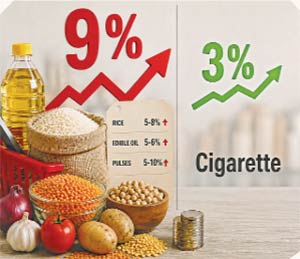
Amid a relentless surge in the cost of living, overall inflation in Bangladesh reached 9.42 percent in May 2026, with food inflation also breaching the 9 percent mark, according to the Bangladesh Bureau of Statistics (BBS). The latest data, consistent with year-long rise in the prices of daily essentials including staple commodities such as rice, flour, eggs, sugar, and edible oil.
Yet, despite this sharp spike in food prices over the past year, the cost of low-tier cigarettes has failed to keep pace. This gap is particularly significant given that the lowest-priced tier accounts for the majority of the country's smokers. In the proposed budget for the upcoming 2026-27 fiscal year, the government has called for a meager price increase of just 20 paisa per stick, a mere 3 percent hike compared to last year.
Analysts warn that because these price adjustments fall far short of inflation, low-tier cigarettes will remain highly affordable for consumers. This is expected to drive up consumption within this segment. Furthermore, because higher-tier cigarettes face a steeper price increase, budget-conscious consumers are more likely to downgrade to cheaper brands.
Market data from the Trading Corporation of Bangladesh (TCB) underscores the strain on households budgets, showing that the prices of various essential commodities have jumped by up to 7 percent year-on-year. Rice prices have risen by Tk 5 to Tk 8 depending on the variety. The edible oil market has seen similar volatility; a 1-liter bottle of soybean oil now retails for Tk 199, up from Tk 188 to Tk 190 last year. Meanwhile, pulse prices have ticked up by Tk 5 to Tk 10.
In stark contrast to these soaring grocery bills, the price of low-end cigarettes is remaining practically stagnant. In the budget proposal unveiled on June 11, the minimum retail price for a 10-stick pack of low-tier cigarettes was raised by a token Tk 2, moving from Tk 60 to Tk 62.
This price increase of about 3 percent means the adjustment for low-segment cigarettes is growing at just one-third the rate of food inflation. By comparison, mid-tier cigarette prices will rise by 15 percent, high-tier brands by about 15%, and premium-tier cigarettes by approximately 15%. Such a disproportionate price increase is likely to have a negative impact on government revenue since the lowest segment has the most consumers - if revenue generation and public health ambitions.
Public health experts point out that by failing to meaningfully raise prices alongside other consumer goods, the government is keeping low-tier cigarettes well within reach of the general public. Because these products remain highly affordable, particularly for low-income demographics, the state's tobacco control targets will be significantly harder to achieve.
"While the cost of living and general expenses are climbing, the stagnant pricing of low-tier cigarettes effectively makes them more affordable in real terms," said Ibrahim Khalil, Senior Project and Communication Officer of the Tobacco Tax Project at Dhaka University's Bureau of Economic Research (BER). "Instead of deterring smokers, this will drive up consumption, dealing a blow to tobacco control efforts and public health. In my view, the cigarette pricing in this budget is fundamentally anti-people."
Public health advocates and economists agree that curbing smoking is nearly impossible when tobacco remains cheap relative to purchasing power. They argue that although the broader cost of living has skyrocketed, cheap cigarettes remain easily accessible. This creates a double barrier: it fails to deter new smokers while discouraging existing smokers from quitting. Experts maintain that raising the price of low-end tobacco is the only viable path to safeguarding public health, urging the government to re-evaluate low-tier cigarette pricing before the budget is finalized on June 30.





