Private universities across Bangladesh are increasingly relying on part-time teachers and junior faculty amid a shortage of senior academics, raising concerns over academic supervision and student support while exposing widespread violations of University Grants Commission (UGC) regulations.
Education experts and students say the practice is weakening academic supervision, reducing access to mentoring and highlighting a broader shortage of permanent teachers in the country's private higher education sector.
Official data show that private universities currently employ 1,007 part-time professors compared to only 952 full-time professors. Educationists say the shortage of permanent senior faculty limits students' access to academic leadership, research supervision and mentoring.
Students say the impact is felt beyond the classroom.
Arnab Chowdhury, a third-year student at a private university in Dhaka, said counselling hours often exist only on paper.
“When I try to discuss academic matters after class, the teachers are nowhere to be found. They teach and leave. We get no real benefit from the hours that are supposed to be set aside for guidance,” he said.
Kamrul Hassan, who teaches part-time at another private institution, pointed to challenges faced by visiting faculty.
“Even when counselling hours exist, most students do not show up,” he said. “But spending personal time outside class to mentor individuals adds enormous pressure on instructors who already earn far less than permanent faculty.”
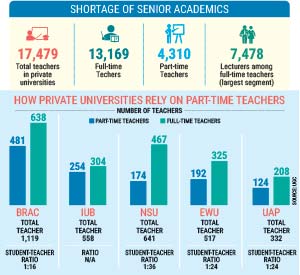
According to the latest UGC annual report, private universities employ a total of 17,479 teachers, including 13,169 full-time and 4,310 part-time faculty members. The report also reveals a heavy dependence on junior academics, with lecturers accounting for 7,478 of the full-time teachers.
The UGC says many universities are violating the Private University Act 2010. Under Section 35(3) of the law, part-time teachers cannot exceed one-third of a university's full-time faculty. However, the commission noted that most private universities fail to comply with the requirement.
Data from individual institutions illustrate the extent of the dependence on temporary faculty.
BRAC University employs 1,119 teachers, including 481 part-time faculty members. The university also has 742 lecturers and maintains a student-teacher ratio of 1:16.
Independent University, Bangladesh employs 558 teachers, of whom 254 are part-time.
North South University has 641 teachers, including 174 part-time faculty members and 287 lecturers. The university reports a student-teacher ratio of 1:36.
East West University employs 517 teachers, including 192 part-time faculty members, while maintaining a student-teacher ratio of 1:24.
The University of Asia Pacific has 332 teachers, including 124 part-time faculty members, and reports a student-teacher ratio of 1:24.
American International University-Bangladesh (AIUB), meanwhile, employs only 33 full-time professors among its 528 teachers and has a student-teacher ratio of 1:21.
Professor Mujib Khan, founder of the University of Development Alternative, criticised the extensive reliance on visiting faculty and stressed the need for permanent academic leadership.
“A university should primarily have full-time teachers,” he said. “We do not even need one-third part-time teachers. Permanent teachers should handle the core academic workload.”
He alleged that some institutions operate departments with only a handful of permanent teachers while relying on visiting faculty to conduct most classes.
Professor Dr Md Serajul Islam of the Institute of Education and Research at Dhaka University said higher education requires continuous engagement between teachers and students.
“Students heavily need teachers inside and outside the classroom,” he said. “Full-time teachers are essential for the complete development of the students. Part-time teachers simply cannot provide this vital emotional support.”
UGC member Dr Mohammad Anwar Hossain acknowledged that many private universities exceed the legal ceiling on part-time teachers.
“We are taking continuous steps to control this major issue,” he said. “Universities cannot keep more than thirty-three percent part-time teachers. We apply continuous administrative pressure when they cross this limit.”
According to him, the commission restricts approvals for new academic subjects and programmes and withholds other facilities from institutions that fail to comply with the regulations.
“Our actions are completely visible and clear,” he said. “We are highly conservative in approving subjects for universities running on temporary teachers. We strictly follow government guidelines.”





